Event submissions
Published
This submission belongs to the session S4. Polymer Composites and Nanocomposites of the event The 3rd International Online Conference on Polymer Science
Published date
14 Nov, 2025
Academic Editor
'%3e%3cpath%20d='M12.6657%2010.9104C12.4185%2010.325%2012.0599%209.79327%2011.6097%209.34482C11.1609%208.89508%2010.6293%208.5365%2010.0442%208.28888C10.0389%208.28626%2010.0337%208.28495%2010.0285%208.28233C10.8446%207.69279%2011.3752%206.73249%2011.3752%205.64904C11.3752%203.8542%209.92103%202.39999%208.1262%202.39999C6.33136%202.39999%204.87715%203.8542%204.87715%205.64904C4.87715%206.73249%205.40774%207.69279%206.22393%208.28364C6.21869%208.28626%206.21345%208.28757%206.20821%208.29019C5.62129%208.5378%205.09463%208.89284%204.64265%209.34613C4.1929%209.79493%203.83432%2010.3266%203.58671%2010.9117C3.34345%2011.4845%203.21226%2012.0987%203.20023%2012.7209C3.19988%2012.7349%203.20233%2012.7488%203.20744%2012.7619C3.21255%2012.7749%203.22022%2012.7867%203.22998%2012.7968C3.23975%2012.8068%203.25142%2012.8147%203.26431%2012.8202C3.2772%2012.8256%203.29105%2012.8284%203.30504%2012.8284H4.09109C4.14874%2012.8284%204.19459%2012.7825%204.1959%2012.7262C4.2221%2011.7148%204.62823%2010.7676%205.34617%2010.0497C6.08899%209.30683%207.0755%208.89808%208.1262%208.89808C9.17689%208.89808%2010.1634%209.30683%2010.9062%2010.0497C11.6242%2010.7676%2012.0303%2011.7148%2012.0565%2012.7262C12.0578%2012.7838%2012.1037%2012.8284%2012.1613%2012.8284H12.9474C12.9613%2012.8284%2012.9752%2012.8256%2012.9881%2012.8202C13.001%2012.8147%2013.0126%2012.8068%2013.0224%2012.7968C13.0322%2012.7867%2013.0398%2012.7749%2013.0449%2012.7619C13.0501%2012.7488%2013.0525%2012.7349%2013.0522%2012.7209C13.0391%2012.0947%2012.9094%2011.4855%2012.6657%2010.9104ZM8.1262%207.9024C7.52486%207.9024%206.9589%207.6679%206.53312%207.24211C6.10733%206.81633%205.87283%206.25037%205.87283%205.64904C5.87283%205.0477%206.10733%204.48174%206.53312%204.05596C6.9589%203.63018%207.52486%203.39567%208.1262%203.39567C8.72753%203.39567%209.29349%203.63018%209.71927%204.05596C10.1451%204.48174%2010.3796%205.0477%2010.3796%205.64904C10.3796%206.25037%2010.1451%206.81633%209.71927%207.24211C9.29349%207.6679%208.72753%207.9024%208.1262%207.9024Z'%20fill='%235D1EE1'/%3e%3c/g%3e%3c/svg%3e) Alessandro Pegoretti
Alessandro PegorettiCitation
Ing. Isabel Iraí Aguilar De la Portilla, Dra. Deyanira Del Ángel López, Dra. Elizabeth Reyna Beltrán, Dr. Eugenio Rodríguez González, Functionalization of pectin hydrogels with in situ synthesized magnetite nanoparticles for hyperthermia treatments against cancer, in Proceedings of The 3rd International Online Conference on Polymer Science, 19 November–21 November 2025, MDPI: Basel, Switzerland
Share
Email
Facebook
Twitter
LinkedIn
Functionalization of pectin hydrogels with in situ synthesized magnetite nanoparticles for hyperthermia treatments against cancer

Ing. Isabel Iraí Aguilar De la Portilla 1
'%3e%3cpath%20d='M12.6647%2010.9104C12.4176%2010.325%2012.0589%209.7933%2011.6088%209.34485C11.16%208.89511%2010.6283%208.53653%2010.0432%208.28891C10.038%208.28629%2010.0327%208.28498%2010.0275%208.28236C10.8437%207.69282%2011.3743%206.73252%2011.3743%205.64907C11.3743%203.85423%209.92005%202.40002%208.12522%202.40002C6.33038%202.40002%204.87618%203.85423%204.87618%205.64907C4.87618%206.73252%205.40677%207.69282%206.22296%208.28367C6.21772%208.28629%206.21248%208.2876%206.20724%208.29022C5.62031%208.53783%205.09365%208.89287%204.64167%209.34616C4.19192%209.79496%203.83334%2010.3266%203.58573%2010.9117C3.34247%2011.4846%203.21128%2012.0987%203.19925%2012.721C3.1989%2012.735%203.20135%2012.7489%203.20646%2012.7619C3.21157%2012.7749%203.21924%2012.7868%203.22901%2012.7968C3.23877%2012.8068%203.25045%2012.8148%203.26334%2012.8202C3.27623%2012.8256%203.29007%2012.8284%203.30406%2012.8284H4.09012C4.14776%2012.8284%204.19362%2012.7825%204.19493%2012.7262C4.22113%2011.7148%204.62726%2010.7676%205.34519%2010.0497C6.08802%209.30686%207.07452%208.89811%208.12522%208.89811C9.17592%208.89811%2010.1624%209.30686%2010.9052%2010.0497C11.6232%2010.7676%2012.0293%2011.7148%2012.0555%2012.7262C12.0568%2012.7839%2012.1027%2012.8284%2012.1603%2012.8284H12.9464C12.9604%2012.8284%2012.9742%2012.8256%2012.9871%2012.8202C13%2012.8148%2013.0117%2012.8068%2013.0214%2012.7968C13.0312%2012.7868%2013.0389%2012.7749%2013.044%2012.7619C13.0491%2012.7489%2013.0515%2012.735%2013.0512%2012.721C13.0381%2012.0947%2012.9084%2011.4856%2012.6647%2010.9104ZM8.12522%207.90243C7.52388%207.90243%206.95792%207.66793%206.53214%207.24215C6.10636%206.81636%205.87185%206.2504%205.87185%205.64907C5.87185%205.04773%206.10636%204.48177%206.53214%204.05599C6.95792%203.63021%207.52388%203.3957%208.12522%203.3957C8.72655%203.3957%209.29252%203.63021%209.7183%204.05599C10.1441%204.48177%2010.3786%205.04773%2010.3786%205.64907C10.3786%206.2504%2010.1441%206.81636%209.7183%207.24215C9.29252%207.66793%208.72655%207.90243%208.12522%207.90243Z'%20fill='%235D1EE1'/%3e%3c/g%3e%3c/svg%3e)
Dra. Deyanira Del Ángel López 1
Dra. Elizabeth Reyna Beltrán 2
Dr. Eugenio Rodríguez González 1
1. Graduate Department of the Center for Research in Applied Science and Advanced Technology - Altamira Unit, National Polytechnic Institute, Altamira, Tamaulipas 89600, Mexico
2. Department of Postgraduate Studies and Research - Tampico Unit, Autonomous University of Tamaulipas, Tampico, Tamaulipas 89336, Mexico
Abstract
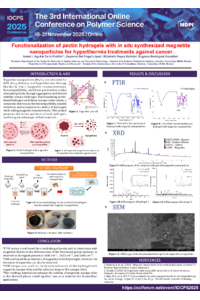
Cancer remains one of the leading causes of mortality worldwide. Despite the availability of various treatments, most of them cause adverse side effects that affect the health and well-being of patients. This has driven the search for innovative, less invasive, and more body-friendly therapies, such as hyperthermia, which involves raising the temperature of tumors to between 40 and 45°C to induce cellular damage without compromising healthy tissue. With the goal of developing a localized treatment that targets tumor tissue without affecting surrounding tissue, the use of magnetite (Fe₃O₄) nanoparticles has been proposed. These nanoparticles have generated significant interest due to their ability to generate heat when exposed to an alternating magnetic field. However, their stability in biological systems represents a challenge; therefore, the present project proposes the functionalization of pectin hydrogels with magnetite nanoparticles, taking advantage of the biocompatibility and encapsulation capacity of pectin together with the magnetic properties of magnetite. The hydrogel was synthesized in situ by mixing a pectin solution with iron salt precursors and stabilizing agents (FeSO₄, urea, and glycine). The pH was adjusted to 9-11 to favor magnetite formation over the other oxide phases, using NaOH and NaHCO₃. Subsequently, the hydrogel was crosslinked with CaCl₂, and once the polymeric three-dimensional network was stabilized, it was analyzed using various characterization techniques. Among these techniques, Fourier Transform Infrared Spectroscopy was employed to assess chemical structural changes resulting from the synthesis process. The analysis confirmed the crosslinking of pectin chains by CaCl₂ addition and the interaction of magnetite nanoparticles with the polymer matrix. Additionally, X-Ray Powder Diffraction analysis confirmed the formation of pure magnetite, distinguishing it from the other iron oxide phases. The preliminary results suggest that pectin–magnetite hydrogels may offer a promising platform for magnetic field response in biomedical applications.
Keywords
magnetite
hydrogel
pectin
nanoparticles
hyperthermia
Poster
sciforum-139371 poster-mdpi-aguilar-isabel (2)-1.pdf
Biosorbent nanocomposites as an innovative strategy for solving water pollution problems
A Comparative Study of Polyolefin-Based and Biodegradable Composites containing Metal Hydroxides