Event submissions
Published
This submission belongs to the session S4. Polymer Composites and Nanocomposites of the event The 3rd International Online Conference on Polymer Science
Published date
14 Nov, 2025
Academic Editor
'%3e%3cpath%20d='M12.6657%2010.9104C12.4185%2010.325%2012.0599%209.79327%2011.6097%209.34482C11.1609%208.89508%2010.6293%208.5365%2010.0442%208.28888C10.0389%208.28626%2010.0337%208.28495%2010.0285%208.28233C10.8446%207.69279%2011.3752%206.73249%2011.3752%205.64904C11.3752%203.8542%209.92103%202.39999%208.1262%202.39999C6.33136%202.39999%204.87715%203.8542%204.87715%205.64904C4.87715%206.73249%205.40774%207.69279%206.22393%208.28364C6.21869%208.28626%206.21345%208.28757%206.20821%208.29019C5.62129%208.5378%205.09463%208.89284%204.64265%209.34613C4.1929%209.79493%203.83432%2010.3266%203.58671%2010.9117C3.34345%2011.4845%203.21226%2012.0987%203.20023%2012.7209C3.19988%2012.7349%203.20233%2012.7488%203.20744%2012.7619C3.21255%2012.7749%203.22022%2012.7867%203.22998%2012.7968C3.23975%2012.8068%203.25142%2012.8147%203.26431%2012.8202C3.2772%2012.8256%203.29105%2012.8284%203.30504%2012.8284H4.09109C4.14874%2012.8284%204.19459%2012.7825%204.1959%2012.7262C4.2221%2011.7148%204.62823%2010.7676%205.34617%2010.0497C6.08899%209.30683%207.0755%208.89808%208.1262%208.89808C9.17689%208.89808%2010.1634%209.30683%2010.9062%2010.0497C11.6242%2010.7676%2012.0303%2011.7148%2012.0565%2012.7262C12.0578%2012.7838%2012.1037%2012.8284%2012.1613%2012.8284H12.9474C12.9613%2012.8284%2012.9752%2012.8256%2012.9881%2012.8202C13.001%2012.8147%2013.0126%2012.8068%2013.0224%2012.7968C13.0322%2012.7867%2013.0398%2012.7749%2013.0449%2012.7619C13.0501%2012.7488%2013.0525%2012.7349%2013.0522%2012.7209C13.0391%2012.0947%2012.9094%2011.4855%2012.6657%2010.9104ZM8.1262%207.9024C7.52486%207.9024%206.9589%207.6679%206.53312%207.24211C6.10733%206.81633%205.87283%206.25037%205.87283%205.64904C5.87283%205.0477%206.10733%204.48174%206.53312%204.05596C6.9589%203.63018%207.52486%203.39567%208.1262%203.39567C8.72753%203.39567%209.29349%203.63018%209.71927%204.05596C10.1451%204.48174%2010.3796%205.0477%2010.3796%205.64904C10.3796%206.25037%2010.1451%206.81633%209.71927%207.24211C9.29349%207.6679%208.72753%207.9024%208.1262%207.9024Z'%20fill='%235D1EE1'/%3e%3c/g%3e%3c/svg%3e) Alessandro Pegoretti
Alessandro PegorettiCitation
Giulia Infurna, Corrado Albeggiani, Federico Ferrante, Giuseppe Battaglia, Diego Tirelli, Lucia Campanelli, Giorgio Maria Micale, Dintcheva Nadka Tz., A Comparative Study of Polyolefin-Based and Biodegradable Composites containing Metal Hydroxides, in Proceedings of The 3rd International Online Conference on Polymer Science, 19 November–21 November 2025, MDPI: Basel, Switzerland
Share
Email
Facebook
Twitter
LinkedIn
A Comparative Study of Polyolefin-Based and Biodegradable Composites containing Metal Hydroxides

Giulia Infurna 1
'%3e%3cpath%20d='M12.6647%2010.9104C12.4176%2010.325%2012.0589%209.7933%2011.6088%209.34485C11.16%208.89511%2010.6283%208.53653%2010.0432%208.28891C10.038%208.28629%2010.0327%208.28498%2010.0275%208.28236C10.8437%207.69282%2011.3743%206.73252%2011.3743%205.64907C11.3743%203.85423%209.92005%202.40002%208.12522%202.40002C6.33038%202.40002%204.87618%203.85423%204.87618%205.64907C4.87618%206.73252%205.40677%207.69282%206.22296%208.28367C6.21772%208.28629%206.21248%208.2876%206.20724%208.29022C5.62031%208.53783%205.09365%208.89287%204.64167%209.34616C4.19192%209.79496%203.83334%2010.3266%203.58573%2010.9117C3.34247%2011.4846%203.21128%2012.0987%203.19925%2012.721C3.1989%2012.735%203.20135%2012.7489%203.20646%2012.7619C3.21157%2012.7749%203.21924%2012.7868%203.22901%2012.7968C3.23877%2012.8068%203.25045%2012.8148%203.26334%2012.8202C3.27623%2012.8256%203.29007%2012.8284%203.30406%2012.8284H4.09012C4.14776%2012.8284%204.19362%2012.7825%204.19493%2012.7262C4.22113%2011.7148%204.62726%2010.7676%205.34519%2010.0497C6.08802%209.30686%207.07452%208.89811%208.12522%208.89811C9.17592%208.89811%2010.1624%209.30686%2010.9052%2010.0497C11.6232%2010.7676%2012.0293%2011.7148%2012.0555%2012.7262C12.0568%2012.7839%2012.1027%2012.8284%2012.1603%2012.8284H12.9464C12.9604%2012.8284%2012.9742%2012.8256%2012.9871%2012.8202C13%2012.8148%2013.0117%2012.8068%2013.0214%2012.7968C13.0312%2012.7868%2013.0389%2012.7749%2013.044%2012.7619C13.0491%2012.7489%2013.0515%2012.735%2013.0512%2012.721C13.0381%2012.0947%2012.9084%2011.4856%2012.6647%2010.9104ZM8.12522%207.90243C7.52388%207.90243%206.95792%207.66793%206.53214%207.24215C6.10636%206.81636%205.87185%206.2504%205.87185%205.64907C5.87185%205.04773%206.10636%204.48177%206.53214%204.05599C6.95792%203.63021%207.52388%203.3957%208.12522%203.3957C8.72655%203.3957%209.29252%203.63021%209.7183%204.05599C10.1441%204.48177%2010.3786%205.04773%2010.3786%205.64907C10.3786%206.2504%2010.1441%206.81636%209.7183%207.24215C9.29252%207.66793%208.72655%207.90243%208.12522%207.90243Z'%20fill='%235D1EE1'/%3e%3c/g%3e%3c/svg%3e)
Corrado Albeggiani 1
Federico Ferrante 1
Giuseppe Battaglia 1
Diego Tirelli 2
Lucia Campanelli 2

Giorgio Maria Micale 1

Dintcheva Nadka Tz. 1
1. Engineering Department, University of Palermo, Viale delle Scienze, ed 6, 90128 Palermo, Italy
2. Nuova Sima srl, Frazione Valtreara, 83, 60040 Genga (AN), Italy
Abstract
The present work proposes the use of metal hydroxides, specifically aluminium and magnesium hydroxides, as halogen-free flame-retardant additives in polymer matrices. The present study focuses on comparing their performance in polyolefin-based polymers and bio-polymer composite formulations. This approach is motivated by sustainability considerations and the growing market demand for environmentally friendly flame-retardant materials.
The incorporation of metal hydroxides occurred within two different composite materials: firstly, an EVA/LLDPE blend and secondly, a PBS matrix. Two types of metal hydroxide were evaluated for use in the formulation of flame-retardant composites (FRCs): precipitated aluminium hydroxide (p-ATH) and naturally milled magnesium hydroxide (nm-MDH). The p-ATH displays a crystalline composition, whereas nm-MDH manifests a brucite crystalline form. The presence of this dolomite phase is advantageous, as it decomposes at higher temperatures than the metal hydroxides and releases inert gases such as carbon dioxide, thereby enhancing flame resistance.
The characterisation of both metal hydroxides was accomplished through a multifaceted approach encompassing X-ray powder diffraction (XRD), thermogravimetric analysis (TGA), meticulous morphological observation, and a comprehensive application of spectroscopic methodologies. It has been established that upon exposure to heat or flame, the metal hydroxides undergo endothermic decomposition, forming metal oxides and releasing water molecules. This reaction has been shown to result in an intumescent effect.
Through our investigation, we found that all of the examined FRCs displayed remarkable flame retardancy, fire resistance, and thermal stability—that is to say, resistance to static heat. These results underscore the potential of these metal hydroxides as effective halogen-free flame-retardant additives. Furthermore, while to a lesser extent, the presence of hydroxides of metals was found to reduce the accumulation of groups containing carbonyl and hydroxyl functionality during UVB weathering exposure. This finding suggests a protective effect on the polymer matrix.
Keywords
metal hydroxides
halogen-free flame retardants
polyolefin-based composites
biodegradable polymers
fire retardant index
stating heat resistance
Poster
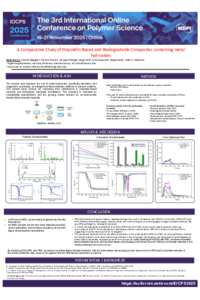
poster iocps.pdf
Functionalization of pectin hydrogels with in situ synthesized magnetite nanoparticles for hyperthermia treatments against cancer
THREE-DIMENSIONAL PRINTING OF ACRYLATE EPOXIDIZED SOYBEAN OIL (AESO)-BASED COMPOSITES CONTAINING BAMBOO