Event submissions
Published
This submission belongs to the session S4. Polymer Composites and Nanocomposites of the event The 3rd International Online Conference on Polymer Science
Published date
14 Nov, 2025
Academic Editor
'%3e%3cpath%20d='M12.6657%2010.9104C12.4185%2010.325%2012.0599%209.79327%2011.6097%209.34482C11.1609%208.89508%2010.6293%208.5365%2010.0442%208.28888C10.0389%208.28626%2010.0337%208.28495%2010.0285%208.28233C10.8446%207.69279%2011.3752%206.73249%2011.3752%205.64904C11.3752%203.8542%209.92103%202.39999%208.1262%202.39999C6.33136%202.39999%204.87715%203.8542%204.87715%205.64904C4.87715%206.73249%205.40774%207.69279%206.22393%208.28364C6.21869%208.28626%206.21345%208.28757%206.20821%208.29019C5.62129%208.5378%205.09463%208.89284%204.64265%209.34613C4.1929%209.79493%203.83432%2010.3266%203.58671%2010.9117C3.34345%2011.4845%203.21226%2012.0987%203.20023%2012.7209C3.19988%2012.7349%203.20233%2012.7488%203.20744%2012.7619C3.21255%2012.7749%203.22022%2012.7867%203.22998%2012.7968C3.23975%2012.8068%203.25142%2012.8147%203.26431%2012.8202C3.2772%2012.8256%203.29105%2012.8284%203.30504%2012.8284H4.09109C4.14874%2012.8284%204.19459%2012.7825%204.1959%2012.7262C4.2221%2011.7148%204.62823%2010.7676%205.34617%2010.0497C6.08899%209.30683%207.0755%208.89808%208.1262%208.89808C9.17689%208.89808%2010.1634%209.30683%2010.9062%2010.0497C11.6242%2010.7676%2012.0303%2011.7148%2012.0565%2012.7262C12.0578%2012.7838%2012.1037%2012.8284%2012.1613%2012.8284H12.9474C12.9613%2012.8284%2012.9752%2012.8256%2012.9881%2012.8202C13.001%2012.8147%2013.0126%2012.8068%2013.0224%2012.7968C13.0322%2012.7867%2013.0398%2012.7749%2013.0449%2012.7619C13.0501%2012.7488%2013.0525%2012.7349%2013.0522%2012.7209C13.0391%2012.0947%2012.9094%2011.4855%2012.6657%2010.9104ZM8.1262%207.9024C7.52486%207.9024%206.9589%207.6679%206.53312%207.24211C6.10733%206.81633%205.87283%206.25037%205.87283%205.64904C5.87283%205.0477%206.10733%204.48174%206.53312%204.05596C6.9589%203.63018%207.52486%203.39567%208.1262%203.39567C8.72753%203.39567%209.29349%203.63018%209.71927%204.05596C10.1451%204.48174%2010.3796%205.0477%2010.3796%205.64904C10.3796%206.25037%2010.1451%206.81633%209.71927%207.24211C9.29349%207.6679%208.72753%207.9024%208.1262%207.9024Z'%20fill='%235D1EE1'/%3e%3c/g%3e%3c/svg%3e) Alessandro Pegoretti
Alessandro PegorettiCitation
Ariel Eduardo Alarcón Fuentes, Diana Palma Ramírez, Yunuén López Grijalba, José Alberto Andraca Adame, Juan Cruz Castro, Miguel Angel Cerro Ramírez, Polymer blends based on poly(lactic acid) (PLA) and poly(caprolactone) (PCL) for engineering applications, in Proceedings of The 3rd International Online Conference on Polymer Science, 19 November–21 November 2025, MDPI: Basel, Switzerland
Share
Email
Facebook
Twitter
LinkedIn
Polymer blends based on poly(lactic acid) (PLA) and poly(caprolactone) (PCL) for engineering applications
'%3e%3cpath%20d='M12.6647%2010.9104C12.4176%2010.325%2012.0589%209.7933%2011.6088%209.34485C11.16%208.89511%2010.6283%208.53653%2010.0432%208.28891C10.038%208.28629%2010.0327%208.28498%2010.0275%208.28236C10.8437%207.69282%2011.3743%206.73252%2011.3743%205.64907C11.3743%203.85423%209.92005%202.40002%208.12522%202.40002C6.33038%202.40002%204.87618%203.85423%204.87618%205.64907C4.87618%206.73252%205.40677%207.69282%206.22296%208.28367C6.21772%208.28629%206.21248%208.2876%206.20724%208.29022C5.62031%208.53783%205.09365%208.89287%204.64167%209.34616C4.19192%209.79496%203.83334%2010.3266%203.58573%2010.9117C3.34247%2011.4846%203.21128%2012.0987%203.19925%2012.721C3.1989%2012.735%203.20135%2012.7489%203.20646%2012.7619C3.21157%2012.7749%203.21924%2012.7868%203.22901%2012.7968C3.23877%2012.8068%203.25045%2012.8148%203.26334%2012.8202C3.27623%2012.8256%203.29007%2012.8284%203.30406%2012.8284H4.09012C4.14776%2012.8284%204.19362%2012.7825%204.19493%2012.7262C4.22113%2011.7148%204.62726%2010.7676%205.34519%2010.0497C6.08802%209.30686%207.07452%208.89811%208.12522%208.89811C9.17592%208.89811%2010.1624%209.30686%2010.9052%2010.0497C11.6232%2010.7676%2012.0293%2011.7148%2012.0555%2012.7262C12.0568%2012.7839%2012.1027%2012.8284%2012.1603%2012.8284H12.9464C12.9604%2012.8284%2012.9742%2012.8256%2012.9871%2012.8202C13%2012.8148%2013.0117%2012.8068%2013.0214%2012.7968C13.0312%2012.7868%2013.0389%2012.7749%2013.044%2012.7619C13.0491%2012.7489%2013.0515%2012.735%2013.0512%2012.721C13.0381%2012.0947%2012.9084%2011.4856%2012.6647%2010.9104ZM8.12522%207.90243C7.52388%207.90243%206.95792%207.66793%206.53214%207.24215C6.10636%206.81636%205.87185%206.2504%205.87185%205.64907C5.87185%205.04773%206.10636%204.48177%206.53214%204.05599C6.95792%203.63021%207.52388%203.3957%208.12522%203.3957C8.72655%203.3957%209.29252%203.63021%209.7183%204.05599C10.1441%204.48177%2010.3786%205.04773%2010.3786%205.64907C10.3786%206.2504%2010.1441%206.81636%209.7183%207.24215C9.29252%207.66793%208.72655%207.90243%208.12522%207.90243Z'%20fill='%235D1EE1'/%3e%3c/g%3e%3c/svg%3e)
Ariel Eduardo Alarcón Fuentes 1
Diana Palma Ramírez 1
Yunuén López Grijalba 1
José Alberto Andraca Adame 1
Juan Cruz Castro 1
Miguel Angel Cerro Ramírez 1
1. Department of Polymers, Interdisciplinary Professional Engineering Unit, Hidalgo Campus (UPIIH), National Polytechnique Institute (IPN), San Agustín Tlaxiaca, Hidalgo, 42162, Mexico
Abstract
Self-healing materials have garnered significant interest in the industry due to their potential for various applications, particularly in the automotive sector, including exterior parts and interior components. In this context, multiple strategies have been implemented to develop sustainable materials, especially for interior vehicle elements. Additionally, consumers demand constant improvements in material quality, as well as innovations in design, shapes, and colors.
In the automotive field, polylactic acid (PLA) has been proposed as a suitable material for this industry, with modifications or incorporations of other materials aimed at improving its properties. Self-healing polymers offer a good solution for maintaining the appearance of interior car components. By combining PLA with polycaprolactone (PCL), a more flexible material is obtained, and the incorporation of murexide (Mu) particles contributes to enhancing its self-healing capabilities.
To evaluate the properties of the resulting material, reactive extrusion was carried out using maleic anhydride as a grafting agent for PLA, likewise improving its compatibility with PCL and murexide (Mu) particles. Characterizations were performed using nuclear magnetic resonance (NMR), Fourier Transform infrared (FT-IR) spectroscopy, X-ray diffraction (XRD), thermogravimetric / differential scanning calorimetry (TGA)/(DSC), and confocal laser scanning microscopy (CLSM) techniques to analyze the morphology, structure, and thermal behavior of the material. The observed results show that the extrusion process alters the system's crystallinity, favoring an amorphous structure and achieving adequate dispersion of the constituent materials. However, no significant changes were observed between the samples and the raw materials when analyzed by NMR and FT-IR. Based on the collection of all analyses, it can be inferred that a self-healing material is obtained, though further studies are required to confirm that the material meets the necessary properties.
Keywords
Self-healing
polymer blends
nanocomposites
Poster
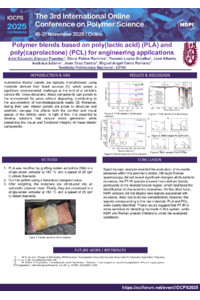
sciforum-138646 Ariel-Eduardo-Alarcon-Fuentes-Poster-IOCPS-2025.pdf
A design-driven strategy for the development of polypropylene composites tailored for 3D printing
Monofilament melt spinning of PET-based antimicrobial composite fibers with hybrid fillers