Event submissions
Published
This submission belongs to the session S2. Polymer Analysis and Characterisation of the event The 3rd International Online Conference on Polymer Science
Published date
14 Nov, 2025
Academic Editor
'%3e%3cpath%20d='M12.6657%2010.9104C12.4185%2010.325%2012.0599%209.79327%2011.6097%209.34482C11.1609%208.89508%2010.6293%208.5365%2010.0442%208.28888C10.0389%208.28626%2010.0337%208.28495%2010.0285%208.28233C10.8446%207.69279%2011.3752%206.73249%2011.3752%205.64904C11.3752%203.8542%209.92103%202.39999%208.1262%202.39999C6.33136%202.39999%204.87715%203.8542%204.87715%205.64904C4.87715%206.73249%205.40774%207.69279%206.22393%208.28364C6.21869%208.28626%206.21345%208.28757%206.20821%208.29019C5.62129%208.5378%205.09463%208.89284%204.64265%209.34613C4.1929%209.79493%203.83432%2010.3266%203.58671%2010.9117C3.34345%2011.4845%203.21226%2012.0987%203.20023%2012.7209C3.19988%2012.7349%203.20233%2012.7488%203.20744%2012.7619C3.21255%2012.7749%203.22022%2012.7867%203.22998%2012.7968C3.23975%2012.8068%203.25142%2012.8147%203.26431%2012.8202C3.2772%2012.8256%203.29105%2012.8284%203.30504%2012.8284H4.09109C4.14874%2012.8284%204.19459%2012.7825%204.1959%2012.7262C4.2221%2011.7148%204.62823%2010.7676%205.34617%2010.0497C6.08899%209.30683%207.0755%208.89808%208.1262%208.89808C9.17689%208.89808%2010.1634%209.30683%2010.9062%2010.0497C11.6242%2010.7676%2012.0303%2011.7148%2012.0565%2012.7262C12.0578%2012.7838%2012.1037%2012.8284%2012.1613%2012.8284H12.9474C12.9613%2012.8284%2012.9752%2012.8256%2012.9881%2012.8202C13.001%2012.8147%2013.0126%2012.8068%2013.0224%2012.7968C13.0322%2012.7867%2013.0398%2012.7749%2013.0449%2012.7619C13.0501%2012.7488%2013.0525%2012.7349%2013.0522%2012.7209C13.0391%2012.0947%2012.9094%2011.4855%2012.6657%2010.9104ZM8.1262%207.9024C7.52486%207.9024%206.9589%207.6679%206.53312%207.24211C6.10733%206.81633%205.87283%206.25037%205.87283%205.64904C5.87283%205.0477%206.10733%204.48174%206.53312%204.05596C6.9589%203.63018%207.52486%203.39567%208.1262%203.39567C8.72753%203.39567%209.29349%203.63018%209.71927%204.05596C10.1451%204.48174%2010.3796%205.0477%2010.3796%205.64904C10.3796%206.25037%2010.1451%206.81633%209.71927%207.24211C9.29349%207.6679%208.72753%207.9024%208.1262%207.9024Z'%20fill='%235D1EE1'/%3e%3c/g%3e%3c/svg%3e) Ivan Gitsov
Ivan GitsovCitation
Wiktoria Żyła, Adrianna Gołuchowska, Piotr Gajewski, Agnieszka Marcinkowska, Ionogels Containing EMImFSI Obtained via Photopolymerization: Tailoring Mechanical and Electrochemical Properties for Flexible Energy Storage Devices, in Proceedings of The 3rd International Online Conference on Polymer Science, 19 November–21 November 2025, MDPI: Basel, Switzerland
Share
Email
Facebook
Twitter
LinkedIn
Ionogels Containing EMImFSI Obtained via Photopolymerization: Tailoring Mechanical and Electrochemical Properties for Flexible Energy Storage Devices
'%3e%3cpath%20d='M12.6647%2010.9104C12.4176%2010.325%2012.0589%209.7933%2011.6088%209.34485C11.16%208.89511%2010.6283%208.53653%2010.0432%208.28891C10.038%208.28629%2010.0327%208.28498%2010.0275%208.28236C10.8437%207.69282%2011.3743%206.73252%2011.3743%205.64907C11.3743%203.85423%209.92005%202.40002%208.12522%202.40002C6.33038%202.40002%204.87618%203.85423%204.87618%205.64907C4.87618%206.73252%205.40677%207.69282%206.22296%208.28367C6.21772%208.28629%206.21248%208.2876%206.20724%208.29022C5.62031%208.53783%205.09365%208.89287%204.64167%209.34616C4.19192%209.79496%203.83334%2010.3266%203.58573%2010.9117C3.34247%2011.4846%203.21128%2012.0987%203.19925%2012.721C3.1989%2012.735%203.20135%2012.7489%203.20646%2012.7619C3.21157%2012.7749%203.21924%2012.7868%203.22901%2012.7968C3.23877%2012.8068%203.25045%2012.8148%203.26334%2012.8202C3.27623%2012.8256%203.29007%2012.8284%203.30406%2012.8284H4.09012C4.14776%2012.8284%204.19362%2012.7825%204.19493%2012.7262C4.22113%2011.7148%204.62726%2010.7676%205.34519%2010.0497C6.08802%209.30686%207.07452%208.89811%208.12522%208.89811C9.17592%208.89811%2010.1624%209.30686%2010.9052%2010.0497C11.6232%2010.7676%2012.0293%2011.7148%2012.0555%2012.7262C12.0568%2012.7839%2012.1027%2012.8284%2012.1603%2012.8284H12.9464C12.9604%2012.8284%2012.9742%2012.8256%2012.9871%2012.8202C13%2012.8148%2013.0117%2012.8068%2013.0214%2012.7968C13.0312%2012.7868%2013.0389%2012.7749%2013.044%2012.7619C13.0491%2012.7489%2013.0515%2012.735%2013.0512%2012.721C13.0381%2012.0947%2012.9084%2011.4856%2012.6647%2010.9104ZM8.12522%207.90243C7.52388%207.90243%206.95792%207.66793%206.53214%207.24215C6.10636%206.81636%205.87185%206.2504%205.87185%205.64907C5.87185%205.04773%206.10636%204.48177%206.53214%204.05599C6.95792%203.63021%207.52388%203.3957%208.12522%203.3957C8.72655%203.3957%209.29252%203.63021%209.7183%204.05599C10.1441%204.48177%2010.3786%205.04773%2010.3786%205.64907C10.3786%206.2504%2010.1441%206.81636%209.7183%207.24215C9.29252%207.66793%208.72655%207.90243%208.12522%207.90243Z'%20fill='%235D1EE1'/%3e%3c/g%3e%3c/svg%3e)
Wiktoria Żyła 1
Adrianna Gołuchowska 1

Piotr Gajewski 1

Agnieszka Marcinkowska 1
1. Faculty of Chemical Technology , Poznan University of Technology, Poznan 60-965, Poland
Abstract
In recent years, the rapid advancement of electrochemical technologies—such as supercapacitors, fuel cells, and flexible energy storage—has intensified the search for new functional materials. Ionogels, hybrid systems combining ionic liquids and polymer matrices, have gained attention for their high ionic conductivity, mechanical flexibility, and chemical stability.
This study reports on the synthesis and characterization of ionogels containing 1-ethyl-3-methylimidazolium bis(fluorosulfonyl)imide (EMIm FSI), aimed at evaluating their applicability as gel electrolytes in electrochemical capacitors. Various formulations were prepared using different monomer mixtures, and the most promising systems were selected based on visual inspection, conductivity, and mechanical properties.
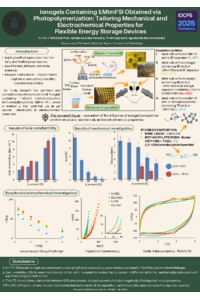
The most notable result was the development of an ionogel based on Dymax XR-771-MS resin, which exhibited high ionic conductivity, excellent flexibility, and no ionic liquid leaching. The addition of thiol T2 significantly increased conductivity but reduced mechanical strength, especially in systems containing ≥85% IL, which showed low puncture resistance.
Mechanical tests showed that increasing IL content decreased Young’s modulus and tensile strength while enhancing elongation, indicating a trade-off between conductivity and durability. FTIR analysis confirmed efficient cross-linking through the disappearance of C=C bands after photopolymerization.
Electrochemical performance was evaluated in three capacitor configurations (IL+GF/A, gel+GF/A, gel+gel). Ionogel-based electrodes enabled pseudocapacitive effects associated with redox reactions, increasing capacitance. The gel+GF/A configuration offered the best performance, balancing conductivity with internal stability. Capacitance declined with increasing scan rate and current due to ion transport and redox kinetics limitations. High capacitance values in gel systems were attributed to pseudocapacitive contributions, dependent on accessible surface area and reaction dynamics.
Overall, the results show that EMIm FSI-based ionogels can be tailored for optimal performance by adjusting their composition, offering potential as safe and flexible electrolytes in electrochemical energy storage devices.
This work was supported by the Ministry of Science and Higher Education.
Keywords
Ionogels
Ionic liquids
Gel electrolytes
EMIm FSI
Electrochemical capacitors
Pseudocapacitance
Mechanical properties
Photopolymerization
Poster
MDPI Poster Wiktoria Patz.pdf
THE EFFECT OF FILLER TYPE AND RADITATION DOSE ON THE MECHANICAL PROPERTIES OF HNBR COMPOSITES PREPARED BY THERMAL AND THERMO-RADIATION VULCANIZATION
Tensile electromechanical properties of carbon nanotube/poly (lactic acid)–polyhydroxyalkanoate filaments and additive manufactured coupons