Event submissions
Published
This submission belongs to the session S4. Polymer Composites and Nanocomposites of the event The 3rd International Online Conference on Polymer Science
Published date
14 Nov, 2025
Academic Editor
'%3e%3cpath%20d='M12.6657%2010.9104C12.4185%2010.325%2012.0599%209.79327%2011.6097%209.34482C11.1609%208.89508%2010.6293%208.5365%2010.0442%208.28888C10.0389%208.28626%2010.0337%208.28495%2010.0285%208.28233C10.8446%207.69279%2011.3752%206.73249%2011.3752%205.64904C11.3752%203.8542%209.92103%202.39999%208.1262%202.39999C6.33136%202.39999%204.87715%203.8542%204.87715%205.64904C4.87715%206.73249%205.40774%207.69279%206.22393%208.28364C6.21869%208.28626%206.21345%208.28757%206.20821%208.29019C5.62129%208.5378%205.09463%208.89284%204.64265%209.34613C4.1929%209.79493%203.83432%2010.3266%203.58671%2010.9117C3.34345%2011.4845%203.21226%2012.0987%203.20023%2012.7209C3.19988%2012.7349%203.20233%2012.7488%203.20744%2012.7619C3.21255%2012.7749%203.22022%2012.7867%203.22998%2012.7968C3.23975%2012.8068%203.25142%2012.8147%203.26431%2012.8202C3.2772%2012.8256%203.29105%2012.8284%203.30504%2012.8284H4.09109C4.14874%2012.8284%204.19459%2012.7825%204.1959%2012.7262C4.2221%2011.7148%204.62823%2010.7676%205.34617%2010.0497C6.08899%209.30683%207.0755%208.89808%208.1262%208.89808C9.17689%208.89808%2010.1634%209.30683%2010.9062%2010.0497C11.6242%2010.7676%2012.0303%2011.7148%2012.0565%2012.7262C12.0578%2012.7838%2012.1037%2012.8284%2012.1613%2012.8284H12.9474C12.9613%2012.8284%2012.9752%2012.8256%2012.9881%2012.8202C13.001%2012.8147%2013.0126%2012.8068%2013.0224%2012.7968C13.0322%2012.7867%2013.0398%2012.7749%2013.0449%2012.7619C13.0501%2012.7488%2013.0525%2012.7349%2013.0522%2012.7209C13.0391%2012.0947%2012.9094%2011.4855%2012.6657%2010.9104ZM8.1262%207.9024C7.52486%207.9024%206.9589%207.6679%206.53312%207.24211C6.10733%206.81633%205.87283%206.25037%205.87283%205.64904C5.87283%205.0477%206.10733%204.48174%206.53312%204.05596C6.9589%203.63018%207.52486%203.39567%208.1262%203.39567C8.72753%203.39567%209.29349%203.63018%209.71927%204.05596C10.1451%204.48174%2010.3796%205.0477%2010.3796%205.64904C10.3796%206.25037%2010.1451%206.81633%209.71927%207.24211C9.29349%207.6679%208.72753%207.9024%208.1262%207.9024Z'%20fill='%235D1EE1'/%3e%3c/g%3e%3c/svg%3e) Alberto Jiménez Suárez
Alberto Jiménez SuárezCitation
Aurelio Bifulco, Claudio Imparato, Sandro Lehner, Antonio Aronne, Giulio Malucelli, Sabyasachi Gaan, Sol–gel complements conventional strategies for the synthesis of self-extinguishing hybrid silica–epoxy nanocomposites., in Proceedings of The 3rd International Online Conference on Polymer Science, 19 November–21 November 2025, MDPI: Basel, Switzerland
Share
Email
Facebook
Twitter
LinkedIn
Sol–gel complements conventional strategies for the synthesis of self-extinguishing hybrid silica–epoxy nanocomposites.

Aurelio Bifulco 1

Claudio Imparato 1
'%3e%3cpath%20d='M12.6647%2010.9104C12.4176%2010.325%2012.0589%209.7933%2011.6088%209.34485C11.16%208.89511%2010.6283%208.53653%2010.0432%208.28891C10.038%208.28629%2010.0327%208.28498%2010.0275%208.28236C10.8437%207.69282%2011.3743%206.73252%2011.3743%205.64907C11.3743%203.85423%209.92005%202.40002%208.12522%202.40002C6.33038%202.40002%204.87618%203.85423%204.87618%205.64907C4.87618%206.73252%205.40677%207.69282%206.22296%208.28367C6.21772%208.28629%206.21248%208.2876%206.20724%208.29022C5.62031%208.53783%205.09365%208.89287%204.64167%209.34616C4.19192%209.79496%203.83334%2010.3266%203.58573%2010.9117C3.34247%2011.4846%203.21128%2012.0987%203.19925%2012.721C3.1989%2012.735%203.20135%2012.7489%203.20646%2012.7619C3.21157%2012.7749%203.21924%2012.7868%203.22901%2012.7968C3.23877%2012.8068%203.25045%2012.8148%203.26334%2012.8202C3.27623%2012.8256%203.29007%2012.8284%203.30406%2012.8284H4.09012C4.14776%2012.8284%204.19362%2012.7825%204.19493%2012.7262C4.22113%2011.7148%204.62726%2010.7676%205.34519%2010.0497C6.08802%209.30686%207.07452%208.89811%208.12522%208.89811C9.17592%208.89811%2010.1624%209.30686%2010.9052%2010.0497C11.6232%2010.7676%2012.0293%2011.7148%2012.0555%2012.7262C12.0568%2012.7839%2012.1027%2012.8284%2012.1603%2012.8284H12.9464C12.9604%2012.8284%2012.9742%2012.8256%2012.9871%2012.8202C13%2012.8148%2013.0117%2012.8068%2013.0214%2012.7968C13.0312%2012.7868%2013.0389%2012.7749%2013.044%2012.7619C13.0491%2012.7489%2013.0515%2012.735%2013.0512%2012.721C13.0381%2012.0947%2012.9084%2011.4856%2012.6647%2010.9104ZM8.12522%207.90243C7.52388%207.90243%206.95792%207.66793%206.53214%207.24215C6.10636%206.81636%205.87185%206.2504%205.87185%205.64907C5.87185%205.04773%206.10636%204.48177%206.53214%204.05599C6.95792%203.63021%207.52388%203.3957%208.12522%203.3957C8.72655%203.3957%209.29252%203.63021%209.7183%204.05599C10.1441%204.48177%2010.3786%205.04773%2010.3786%205.64907C10.3786%206.2504%2010.1441%206.81636%209.7183%207.24215C9.29252%207.66793%208.72655%207.90243%208.12522%207.90243Z'%20fill='%235D1EE1'/%3e%3c/g%3e%3c/svg%3e)
Sandro Lehner 2
Antonio Aronne 1

Giulio Malucelli 3

Sabyasachi Gaan 2
1. Department of Chemical, Materials and Production Engineering (DICMaPI), University of Naples Federico II, Piazzale Tecchio 80, 80125 Naples, Italy
2. Laboratory for Advanced Fibers, Empa Swiss Federal Laboratories for Materials Science and Technology, Lerchenfeldstrasse 5, 9014 St. Gallen, Switzerland
3. Department of Applied Science and Technology, Politecnico di Torino, Viale Teresa Michel 5, 15121 Alessandria, Italy
Abstract
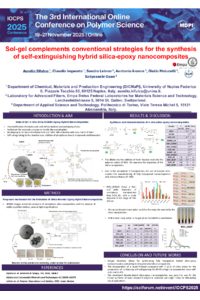
Introduction. Growing industry demand, together with rising pollution and the depletion of phosphorus, is moving the scientific community towards the development of flame-retardant (FR) epoxy nanocomposites (ENCs) containing low P contents and more sustainable additives.
Methods. High-resolution transmission electron microscopy (HRTEM) analysis was carried out to study the morphology of ENCs. Cone calorimetry (CC) and UL-94 vertical flame spread tests were performed to investigate the fire response of all ENCs.
Results. The reaction of DGEBA (Bisphenol A diglycidyl ether)- or Novolac-based resins with APTES (3-aminopropyltriethoxysilane) allows the production of organic–inorganic silanized epoxy moieties. The hybrid moieties can condense with tetraethyl orthosilicate (TEOS), a silica precursor, to form an in situ silica phase through sol–gel reactions. HRTEM analysis revealed that in the case of DGEBA, the silica phase was composed of well-ordered multi-lamellar nanoparticles (NPs). In contrast, the investigation of Novolac highlighted that fully amorphous silica NPs were embedded in the hybrid co-continuous polymer network. The incorporation of DOPO-based FRs into silica–epoxy systems based on DGEBA/Novolac resin produces aliphatic nanocomposites with high transparency, no-dripping UL-94-V0 rating, and a strong decrease (up to 80%) in the peak of the heat release rate in CC tests, with up to 3 wt.% of P loading. Regarding Novolac, the transparency is remains even at loadings of silica NPs beyond 4 wt.%, thanks to their amorphous nature. More waste-to-wealth approaches involve the use of humic acids or biochar from spent coffee grounds, together with ammonium polyphosphate and urea, in APTES-modified DGEBA-based epoxy systems to obtain no-dripping self-extinguishing systems, even with only 1 wt.% of P content.
Conclusions. The sol–gel in situ generation of inorganic phases has been explored in combination with DOPO-based FRs, bio-wastes, and other synergists to prepare no-dripping self-extinguishing (V-0 rating in UL-94 flammability tests) aliphatic ENCs, even keeping P at low loadings (1-3 wt.%).
Keywords
Sol-gel
hybrid nanocomposites
epoxy resin
silica nanodomains
biowaste
flammability
fire behavior.
Poster
ABifulco_sciforum-133961_poster.pdf
A sustainable path for composite tooling: novel materials, design, and technologies through FEM and LCA
Low-density polyethylene beads integrity disruption induced by native Fusarium oxysporum