Event submissions
Published
This submission belongs to the session S4. Polymer Composites and Nanocomposites of the event The 3rd International Online Conference on Polymer Science
Published date
14 Nov, 2025
Academic Editor
'%3e%3cpath%20d='M12.6657%2010.9104C12.4185%2010.325%2012.0599%209.79327%2011.6097%209.34482C11.1609%208.89508%2010.6293%208.5365%2010.0442%208.28888C10.0389%208.28626%2010.0337%208.28495%2010.0285%208.28233C10.8446%207.69279%2011.3752%206.73249%2011.3752%205.64904C11.3752%203.8542%209.92103%202.39999%208.1262%202.39999C6.33136%202.39999%204.87715%203.8542%204.87715%205.64904C4.87715%206.73249%205.40774%207.69279%206.22393%208.28364C6.21869%208.28626%206.21345%208.28757%206.20821%208.29019C5.62129%208.5378%205.09463%208.89284%204.64265%209.34613C4.1929%209.79493%203.83432%2010.3266%203.58671%2010.9117C3.34345%2011.4845%203.21226%2012.0987%203.20023%2012.7209C3.19988%2012.7349%203.20233%2012.7488%203.20744%2012.7619C3.21255%2012.7749%203.22022%2012.7867%203.22998%2012.7968C3.23975%2012.8068%203.25142%2012.8147%203.26431%2012.8202C3.2772%2012.8256%203.29105%2012.8284%203.30504%2012.8284H4.09109C4.14874%2012.8284%204.19459%2012.7825%204.1959%2012.7262C4.2221%2011.7148%204.62823%2010.7676%205.34617%2010.0497C6.08899%209.30683%207.0755%208.89808%208.1262%208.89808C9.17689%208.89808%2010.1634%209.30683%2010.9062%2010.0497C11.6242%2010.7676%2012.0303%2011.7148%2012.0565%2012.7262C12.0578%2012.7838%2012.1037%2012.8284%2012.1613%2012.8284H12.9474C12.9613%2012.8284%2012.9752%2012.8256%2012.9881%2012.8202C13.001%2012.8147%2013.0126%2012.8068%2013.0224%2012.7968C13.0322%2012.7867%2013.0398%2012.7749%2013.0449%2012.7619C13.0501%2012.7488%2013.0525%2012.7349%2013.0522%2012.7209C13.0391%2012.0947%2012.9094%2011.4855%2012.6657%2010.9104ZM8.1262%207.9024C7.52486%207.9024%206.9589%207.6679%206.53312%207.24211C6.10733%206.81633%205.87283%206.25037%205.87283%205.64904C5.87283%205.0477%206.10733%204.48174%206.53312%204.05596C6.9589%203.63018%207.52486%203.39567%208.1262%203.39567C8.72753%203.39567%209.29349%203.63018%209.71927%204.05596C10.1451%204.48174%2010.3796%205.0477%2010.3796%205.64904C10.3796%206.25037%2010.1451%206.81633%209.71927%207.24211C9.29349%207.6679%208.72753%207.9024%208.1262%207.9024Z'%20fill='%235D1EE1'/%3e%3c/g%3e%3c/svg%3e) Alessandro Pegoretti
Alessandro PegorettiCitation
Celia Idres, Mustapha Kaci, Nadjet Dehouche, Mohamed Kemmache, Christelle Delaite, Aging of Poly(3-Hydroxybutyrate-Co-3-Hydroxyhexanoate)-Based Biocomposites under Accelerated Photo-Oxidation, in Proceedings of The 3rd International Online Conference on Polymer Science, 19 November–21 November 2025, MDPI: Basel, Switzerland
Share
Email
Facebook
Twitter
LinkedIn
Aging of Poly(3-Hydroxybutyrate-Co-3-Hydroxyhexanoate)-Based Biocomposites under Accelerated Photo-Oxidation
'%3e%3cpath%20d='M12.6647%2010.9104C12.4176%2010.325%2012.0589%209.7933%2011.6088%209.34485C11.16%208.89511%2010.6283%208.53653%2010.0432%208.28891C10.038%208.28629%2010.0327%208.28498%2010.0275%208.28236C10.8437%207.69282%2011.3743%206.73252%2011.3743%205.64907C11.3743%203.85423%209.92005%202.40002%208.12522%202.40002C6.33038%202.40002%204.87618%203.85423%204.87618%205.64907C4.87618%206.73252%205.40677%207.69282%206.22296%208.28367C6.21772%208.28629%206.21248%208.2876%206.20724%208.29022C5.62031%208.53783%205.09365%208.89287%204.64167%209.34616C4.19192%209.79496%203.83334%2010.3266%203.58573%2010.9117C3.34247%2011.4846%203.21128%2012.0987%203.19925%2012.721C3.1989%2012.735%203.20135%2012.7489%203.20646%2012.7619C3.21157%2012.7749%203.21924%2012.7868%203.22901%2012.7968C3.23877%2012.8068%203.25045%2012.8148%203.26334%2012.8202C3.27623%2012.8256%203.29007%2012.8284%203.30406%2012.8284H4.09012C4.14776%2012.8284%204.19362%2012.7825%204.19493%2012.7262C4.22113%2011.7148%204.62726%2010.7676%205.34519%2010.0497C6.08802%209.30686%207.07452%208.89811%208.12522%208.89811C9.17592%208.89811%2010.1624%209.30686%2010.9052%2010.0497C11.6232%2010.7676%2012.0293%2011.7148%2012.0555%2012.7262C12.0568%2012.7839%2012.1027%2012.8284%2012.1603%2012.8284H12.9464C12.9604%2012.8284%2012.9742%2012.8256%2012.9871%2012.8202C13%2012.8148%2013.0117%2012.8068%2013.0214%2012.7968C13.0312%2012.7868%2013.0389%2012.7749%2013.044%2012.7619C13.0491%2012.7489%2013.0515%2012.735%2013.0512%2012.721C13.0381%2012.0947%2012.9084%2011.4856%2012.6647%2010.9104ZM8.12522%207.90243C7.52388%207.90243%206.95792%207.66793%206.53214%207.24215C6.10636%206.81636%205.87185%206.2504%205.87185%205.64907C5.87185%205.04773%206.10636%204.48177%206.53214%204.05599C6.95792%203.63021%207.52388%203.3957%208.12522%203.3957C8.72655%203.3957%209.29252%203.63021%209.7183%204.05599C10.1441%204.48177%2010.3786%205.04773%2010.3786%205.64907C10.3786%206.2504%2010.1441%206.81636%209.7183%207.24215C9.29252%207.66793%208.72655%207.90243%208.12522%207.90243Z'%20fill='%235D1EE1'/%3e%3c/g%3e%3c/svg%3e)
Celia Idres 1,2

Mustapha Kaci 2
Nadjet Dehouche 2
Mohamed Kemmache 3
Christelle Delaite 3
1. Research Center in Agro-Food Technologies, Route de Targa-Ouzemmour, University Campus, Bejaia 06000, Algeria
2. Laboratory of Advanced Polymer Materials (LMPA), Targa-Ouzemmour Campus, University of Bejaia 06000, Algeria
3. LPIM EA 4567, Haute-Alsace University, F-68100 Mulhouse, France
Abstract
In recent decades, the use of polyhydroxyalkanoate biopolymers has drawn increasing attention. Still, one of the biggest challenges that hinders their wide applications is the fine-tuning of their photooxidative aging. Therefore, the objective of this study is to investigate the effect of Agave Americana fibers (AFs) before and after surface treatment with sodium bicarbonate (NaHCO3) on the accelerated photooxidation of PHBHHx using a SEPAP 24-48 enclosure. Biocomposite samples are prepared by melt compounding at a filler content of 30 wt.%. Colorimetric analysis reveals a yellowing effect of neat PHBHHx after 216h of exposure to UV rays, which is attributed to the formation of carbonyl groups. For the untreated biocomposites (PAF), they show a browning in color, while the PHBHHx-treated AF (PAFB) shows a lighter surface. The former process is attributed to the presence of lignin, whereas the latter is owing to the successful removal of lignin and hemicellulose by NaHCO3. Changes in the chemical structure are assessed via FTIR-ATR spectroscopy, which shows a decrease in the 1741 cm-1 band intensity for PHBHHx and PAF (after photooxidation) due to chain scission. However, no noticeable change is observed considering the same peak in the PAFB spectra. Furthermore, the evaluation of the hydroxyhexanoate (HHx) content in the different formulations is evaluated by 1H NMR spectroscopy. The results show a slight decrease in HHx molar % after exposure to 216 h under accelerated photooxidation. Nevertheless, the decrease seems to level off after the addition of AF, particularly the treated ones. The overall findings highlight the beneficial effect of the incorporation of AF into the PHBHHx matrix, especially when treated with NaHCO3 which confers a better photostability.
Keywords
Aging
Photo-oxidation
Biocomposites
PHBHHx
Agave Americana fibers.
Poster
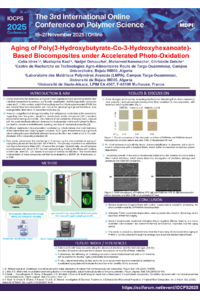
sciforum-136525 M. Kaci Poster.pdf
Influence of boundary conditions and impact velocity on the ballistic behavior of aramid fabrics
Design of Safe and Sustainable Hyperbranched Polyesters as Additives for PHAs