Event submissions
Published
This submission belongs to the session S1. Biobased, Biodegradable-compostable, and Recyclable Polymers of the event The 3rd International Online Conference on Polymer Science
Published date
14 Nov, 2025
Academic Editor
'%3e%3cpath%20d='M12.6657%2010.9104C12.4185%2010.325%2012.0599%209.79327%2011.6097%209.34482C11.1609%208.89508%2010.6293%208.5365%2010.0442%208.28888C10.0389%208.28626%2010.0337%208.28495%2010.0285%208.28233C10.8446%207.69279%2011.3752%206.73249%2011.3752%205.64904C11.3752%203.8542%209.92103%202.39999%208.1262%202.39999C6.33136%202.39999%204.87715%203.8542%204.87715%205.64904C4.87715%206.73249%205.40774%207.69279%206.22393%208.28364C6.21869%208.28626%206.21345%208.28757%206.20821%208.29019C5.62129%208.5378%205.09463%208.89284%204.64265%209.34613C4.1929%209.79493%203.83432%2010.3266%203.58671%2010.9117C3.34345%2011.4845%203.21226%2012.0987%203.20023%2012.7209C3.19988%2012.7349%203.20233%2012.7488%203.20744%2012.7619C3.21255%2012.7749%203.22022%2012.7867%203.22998%2012.7968C3.23975%2012.8068%203.25142%2012.8147%203.26431%2012.8202C3.2772%2012.8256%203.29105%2012.8284%203.30504%2012.8284H4.09109C4.14874%2012.8284%204.19459%2012.7825%204.1959%2012.7262C4.2221%2011.7148%204.62823%2010.7676%205.34617%2010.0497C6.08899%209.30683%207.0755%208.89808%208.1262%208.89808C9.17689%208.89808%2010.1634%209.30683%2010.9062%2010.0497C11.6242%2010.7676%2012.0303%2011.7148%2012.0565%2012.7262C12.0578%2012.7838%2012.1037%2012.8284%2012.1613%2012.8284H12.9474C12.9613%2012.8284%2012.9752%2012.8256%2012.9881%2012.8202C13.001%2012.8147%2013.0126%2012.8068%2013.0224%2012.7968C13.0322%2012.7867%2013.0398%2012.7749%2013.0449%2012.7619C13.0501%2012.7488%2013.0525%2012.7349%2013.0522%2012.7209C13.0391%2012.0947%2012.9094%2011.4855%2012.6657%2010.9104ZM8.1262%207.9024C7.52486%207.9024%206.9589%207.6679%206.53312%207.24211C6.10733%206.81633%205.87283%206.25037%205.87283%205.64904C5.87283%205.0477%206.10733%204.48174%206.53312%204.05596C6.9589%203.63018%207.52486%203.39567%208.1262%203.39567C8.72753%203.39567%209.29349%203.63018%209.71927%204.05596C10.1451%204.48174%2010.3796%205.0477%2010.3796%205.64904C10.3796%206.25037%2010.1451%206.81633%209.71927%207.24211C9.29349%207.6679%208.72753%207.9024%208.1262%207.9024Z'%20fill='%235D1EE1'/%3e%3c/g%3e%3c/svg%3e) Valentina Siracusa
Valentina SiracusaCitation
Melina Kloster, Bárbara Tomadoni, Antonio Guerrero Conejo, Norma E. Marcovich, Mirna A. Mosiewicki, Gelation kinetics of chitosan-based hydrogels using different crosslinking agents, in Proceedings of The 3rd International Online Conference on Polymer Science, 19 November–21 November 2025, MDPI: Basel, Switzerland
Share
Email
Facebook
Twitter
LinkedIn
Gelation kinetics of chitosan-based hydrogels using different crosslinking agents
'%3e%3cpath%20d='M12.6647%2010.9104C12.4176%2010.325%2012.0589%209.7933%2011.6088%209.34485C11.16%208.89511%2010.6283%208.53653%2010.0432%208.28891C10.038%208.28629%2010.0327%208.28498%2010.0275%208.28236C10.8437%207.69282%2011.3743%206.73252%2011.3743%205.64907C11.3743%203.85423%209.92005%202.40002%208.12522%202.40002C6.33038%202.40002%204.87618%203.85423%204.87618%205.64907C4.87618%206.73252%205.40677%207.69282%206.22296%208.28367C6.21772%208.28629%206.21248%208.2876%206.20724%208.29022C5.62031%208.53783%205.09365%208.89287%204.64167%209.34616C4.19192%209.79496%203.83334%2010.3266%203.58573%2010.9117C3.34247%2011.4846%203.21128%2012.0987%203.19925%2012.721C3.1989%2012.735%203.20135%2012.7489%203.20646%2012.7619C3.21157%2012.7749%203.21924%2012.7868%203.22901%2012.7968C3.23877%2012.8068%203.25045%2012.8148%203.26334%2012.8202C3.27623%2012.8256%203.29007%2012.8284%203.30406%2012.8284H4.09012C4.14776%2012.8284%204.19362%2012.7825%204.19493%2012.7262C4.22113%2011.7148%204.62726%2010.7676%205.34519%2010.0497C6.08802%209.30686%207.07452%208.89811%208.12522%208.89811C9.17592%208.89811%2010.1624%209.30686%2010.9052%2010.0497C11.6232%2010.7676%2012.0293%2011.7148%2012.0555%2012.7262C12.0568%2012.7839%2012.1027%2012.8284%2012.1603%2012.8284H12.9464C12.9604%2012.8284%2012.9742%2012.8256%2012.9871%2012.8202C13%2012.8148%2013.0117%2012.8068%2013.0214%2012.7968C13.0312%2012.7868%2013.0389%2012.7749%2013.044%2012.7619C13.0491%2012.7489%2013.0515%2012.735%2013.0512%2012.721C13.0381%2012.0947%2012.9084%2011.4856%2012.6647%2010.9104ZM8.12522%207.90243C7.52388%207.90243%206.95792%207.66793%206.53214%207.24215C6.10636%206.81636%205.87185%206.2504%205.87185%205.64907C5.87185%205.04773%206.10636%204.48177%206.53214%204.05599C6.95792%203.63021%207.52388%203.3957%208.12522%203.3957C8.72655%203.3957%209.29252%203.63021%209.7183%204.05599C10.1441%204.48177%2010.3786%205.04773%2010.3786%205.64907C10.3786%206.2504%2010.1441%206.81636%209.7183%207.24215C9.29252%207.66793%208.72655%207.90243%208.12522%207.90243Z'%20fill='%235D1EE1'/%3e%3c/g%3e%3c/svg%3e)
Melina Kloster 1,2

Bárbara Tomadoni 3

Antonio Guerrero Conejo 3
Norma E. Marcovich 1,2
Mirna A. Mosiewicki 1,2
1. Institute of Materials Science and Technology Research (INTEMA), National University of Mar del Plata (UNMdP) and National Research Council of Argentina (CONICET), Mar del Plata 7600, Argentina
2. Chemical and Food Engineering Department, Engineering Faculty, National University of Mar del Plata (UNMdP), Mar del Plata 7600, Argentina
3. Department of Chemical Engineering, Higher Polytechnic School, University of Seville, Seville 41012, Spain
Abstract
Introduction:
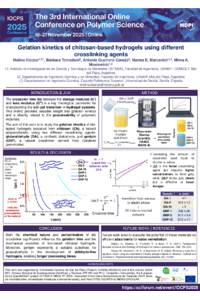
The crossover time (tc) between the storage modulus (G′) and loss modulus (G″) is a key rheological parameter used to characterize the sol–gel transition in hydrogel systems. This metric provides valuable insight into gelation kinetics and is directly associated with the processability of polymeric materials. In this study, bio-based hydrogels were prepared from chitosan (Ch), a natural polysaccharide, and crosslinked with two different agents: glutaraldehyde (GA), a synthetic dialdehyde, and genipin (GNP), a natural crosslinker derived from Gardenia jasminoides.
Methods:
Hydrogels were prepared by dissolving 4%w/v Ch in 2%v/v acetic acid, and then mixing in a 4:1 ratio with aqueous solutions containing GA or GNP at concentrations of 1, 5, and 10% relative to Ch weight. Rheological oscillatory measurements were performed during the crosslinking reaction.
Results:
Time sweep rheological tests were used to determine tc, which marks the transition from a liquid-like to a solid-like state. At the lowest concentration (1%w/w), GA was insufficient to induce gelation, whereas GNP at the same concentration produced a tc of 269 min. At 5%w/w, both crosslinkers successfully formed solid-like gels with tc values of 18.6 min for GA and 91.2 min for GNP. Increasing the crosslinker concentration to 10% w/w further decreased tc to 4.2 min for GA and 57.6 min for GNP. As expected, higher crosslinker concentrations led to faster gelation (lower tc values). These results show that GA promotes faster crosslinking but requires higher concentrations, while GNP enables gel formation at lower dosages but with slower kinetics.
Conclusion:
Both the chemical nature and concentration of the crosslinker significantly affect the gelation time and mechanical evolution of bio-based chitosan hydrogels. Moreover, genipin represents a suitable substitute for glutaraldehyde in the development of aldehyde-free hydrogels, allowing longer processing times.
Keywords
hydrogels
chitosan
glutaraldehyde
genipin
Poster
sciforum-136850 Kloster_IOCPS.pdf
Sustainable Polyesters via Ring-Opening Polymerization of Biobased (Macro)Cyclic Oligofuranoates and their subsequent cyclodepolymerization
Microencapsulation of Moringa oleifera leaf extract using food-grade biopolymers: A study on structure, stability and functionality