Event submissions
Published
This submission belongs to the session S3. Recent Functional and Structural Applications of Polymer Systems of the event The 3rd International Online Conference on Polymer Science
Published date
14 Nov, 2025
Academic Editor
'%3e%3cpath%20d='M12.6657%2010.9104C12.4185%2010.325%2012.0599%209.79327%2011.6097%209.34482C11.1609%208.89508%2010.6293%208.5365%2010.0442%208.28888C10.0389%208.28626%2010.0337%208.28495%2010.0285%208.28233C10.8446%207.69279%2011.3752%206.73249%2011.3752%205.64904C11.3752%203.8542%209.92103%202.39999%208.1262%202.39999C6.33136%202.39999%204.87715%203.8542%204.87715%205.64904C4.87715%206.73249%205.40774%207.69279%206.22393%208.28364C6.21869%208.28626%206.21345%208.28757%206.20821%208.29019C5.62129%208.5378%205.09463%208.89284%204.64265%209.34613C4.1929%209.79493%203.83432%2010.3266%203.58671%2010.9117C3.34345%2011.4845%203.21226%2012.0987%203.20023%2012.7209C3.19988%2012.7349%203.20233%2012.7488%203.20744%2012.7619C3.21255%2012.7749%203.22022%2012.7867%203.22998%2012.7968C3.23975%2012.8068%203.25142%2012.8147%203.26431%2012.8202C3.2772%2012.8256%203.29105%2012.8284%203.30504%2012.8284H4.09109C4.14874%2012.8284%204.19459%2012.7825%204.1959%2012.7262C4.2221%2011.7148%204.62823%2010.7676%205.34617%2010.0497C6.08899%209.30683%207.0755%208.89808%208.1262%208.89808C9.17689%208.89808%2010.1634%209.30683%2010.9062%2010.0497C11.6242%2010.7676%2012.0303%2011.7148%2012.0565%2012.7262C12.0578%2012.7838%2012.1037%2012.8284%2012.1613%2012.8284H12.9474C12.9613%2012.8284%2012.9752%2012.8256%2012.9881%2012.8202C13.001%2012.8147%2013.0126%2012.8068%2013.0224%2012.7968C13.0322%2012.7867%2013.0398%2012.7749%2013.0449%2012.7619C13.0501%2012.7488%2013.0525%2012.7349%2013.0522%2012.7209C13.0391%2012.0947%2012.9094%2011.4855%2012.6657%2010.9104ZM8.1262%207.9024C7.52486%207.9024%206.9589%207.6679%206.53312%207.24211C6.10733%206.81633%205.87283%206.25037%205.87283%205.64904C5.87283%205.0477%206.10733%204.48174%206.53312%204.05596C6.9589%203.63018%207.52486%203.39567%208.1262%203.39567C8.72753%203.39567%209.29349%203.63018%209.71927%204.05596C10.1451%204.48174%2010.3796%205.0477%2010.3796%205.64904C10.3796%206.25037%2010.1451%206.81633%209.71927%207.24211C9.29349%207.6679%208.72753%207.9024%208.1262%207.9024Z'%20fill='%235D1EE1'/%3e%3c/g%3e%3c/svg%3e) Mazeyar Parvinzadeh Gashti
Mazeyar Parvinzadeh GashtiCitation
Pegah Hajivand, Mariagiulia Longo, Marcello Monteleone, Teresa Mastropietro, Alessio Fuoco, Elisa Esposito, Donatella Armentano, Johanes Carolus Jansen, MOF-based Cellulose Acetate MMMs For an Advanced Propene/Propane Separation, in Proceedings of The 3rd International Online Conference on Polymer Science, 19 November–21 November 2025, MDPI: Basel, Switzerland
Share
Email
Facebook
Twitter
LinkedIn
MOF-based Cellulose Acetate MMMs For an Advanced Propene/Propane Separation
'%3e%3cpath%20d='M12.6647%2010.9104C12.4176%2010.325%2012.0589%209.7933%2011.6088%209.34485C11.16%208.89511%2010.6283%208.53653%2010.0432%208.28891C10.038%208.28629%2010.0327%208.28498%2010.0275%208.28236C10.8437%207.69282%2011.3743%206.73252%2011.3743%205.64907C11.3743%203.85423%209.92005%202.40002%208.12522%202.40002C6.33038%202.40002%204.87618%203.85423%204.87618%205.64907C4.87618%206.73252%205.40677%207.69282%206.22296%208.28367C6.21772%208.28629%206.21248%208.2876%206.20724%208.29022C5.62031%208.53783%205.09365%208.89287%204.64167%209.34616C4.19192%209.79496%203.83334%2010.3266%203.58573%2010.9117C3.34247%2011.4846%203.21128%2012.0987%203.19925%2012.721C3.1989%2012.735%203.20135%2012.7489%203.20646%2012.7619C3.21157%2012.7749%203.21924%2012.7868%203.22901%2012.7968C3.23877%2012.8068%203.25045%2012.8148%203.26334%2012.8202C3.27623%2012.8256%203.29007%2012.8284%203.30406%2012.8284H4.09012C4.14776%2012.8284%204.19362%2012.7825%204.19493%2012.7262C4.22113%2011.7148%204.62726%2010.7676%205.34519%2010.0497C6.08802%209.30686%207.07452%208.89811%208.12522%208.89811C9.17592%208.89811%2010.1624%209.30686%2010.9052%2010.0497C11.6232%2010.7676%2012.0293%2011.7148%2012.0555%2012.7262C12.0568%2012.7839%2012.1027%2012.8284%2012.1603%2012.8284H12.9464C12.9604%2012.8284%2012.9742%2012.8256%2012.9871%2012.8202C13%2012.8148%2013.0117%2012.8068%2013.0214%2012.7968C13.0312%2012.7868%2013.0389%2012.7749%2013.044%2012.7619C13.0491%2012.7489%2013.0515%2012.735%2013.0512%2012.721C13.0381%2012.0947%2012.9084%2011.4856%2012.6647%2010.9104ZM8.12522%207.90243C7.52388%207.90243%206.95792%207.66793%206.53214%207.24215C6.10636%206.81636%205.87185%206.2504%205.87185%205.64907C5.87185%205.04773%206.10636%204.48177%206.53214%204.05599C6.95792%203.63021%207.52388%203.3957%208.12522%203.3957C8.72655%203.3957%209.29252%203.63021%209.7183%204.05599C10.1441%204.48177%2010.3786%205.04773%2010.3786%205.64907C10.3786%206.2504%2010.1441%206.81636%209.7183%207.24215C9.29252%207.66793%208.72655%207.90243%208.12522%207.90243Z'%20fill='%235D1EE1'/%3e%3c/g%3e%3c/svg%3e)
Pegah Hajivand 1

Mariagiulia Longo 1
Marcello Monteleone 1
Teresa Mastropietro 2

Alessio Fuoco 1

Elisa Esposito 1

Donatella Armentano 2

Johanes Carolus Jansen 1
1. Institute on Membrane Technology, CNR-ITM, Rende (CS), 87036, Italy
2. Department of Chemistry and Chemical Technology, University of Calabria, Rende (CS), 87036, Italy
Abstract
Introduction.
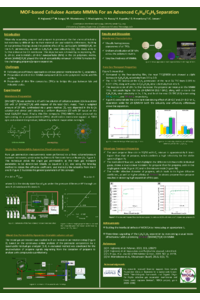
The separation of propene/propane is among the most energy-intensive industrial processes because of the massive scale and the high energy demanded by the traditional cryogenic distillation method [1]. In this work, we report the preparation of MMMs consisting of cellulose acetate, 30% wt. [BMIM]+[Tf2N]‑, and 20% wt. of a series of ZIFs (ZIF-8, ZIF-67, and ZIF-8-67). The aim is to surpass the current state-of-the-art by incorporating bimetallic ZIF-8-67, supported by an ionic liquid as both a compatibiliser and a promoter of permeability.
Experimental/methodology.
Thin film composites were fabricated by spin-coating on PAN support. X-Ray diffraction, FT-IR, and SEM were performed. Single-gas and mixed-gas permeation measurements were applied [2].
Results and discussion.
The addition of 30%[BMIM]+[Tf2N]‑, by showing the trade-off behaviour, led to an increase in Propene permeability, compared to the neat CA membrane. The contribution of a series of ZIFs in ZIF/IL-CA MMMs increased the C3H6/C3H8 selectivity as well as the C3H6 permeability, with ZIF-8-67 outperforming its parent ZIFs. C3H6/C3H8 Mixed-gas measurements confirmed a selective performance of ZIF-8-67/IL-CA MMM.
Conclusion
Overall, this study highlights the significant role of bimetallic ZIF-8-67 in enhancing gas separation performance when incorporated into IL-CA membranes. The synergistic properties of Zn²⁺ and Co²⁺ in ZIF-8-67, combined with the role of [BMIM]+[Tf2N]- in addressing interfacial inconsistency, contributed to its superior gas transport properties and selectivity.
[1] A.C.C. Campos, et al., Ind. Eng. Chem. Res. 2018, 57, 10071–10085.
[2] S. C. Fraga, et al., J. Membr. Sci. 2018, 561, 39.
Keywords
propene/propane separation
mixed matrix membrane
ionic liquids
Bimetallic ZIF
cellulose acetate
Poster
poster-Pegah_Hajivand.pdf
Assessment of Reprocessed Polylactic Acid from Controlled Virgin Feedstock for Food Packaging Applications
Biomechanical performance of natural and synthetic polymers in vascular surgery: a systematic review