Event submissions
Published
This submission belongs to the session S3. Recent Functional and Structural Applications of Polymer Systems of the event The 3rd International Online Conference on Polymer Science
Published date
14 Nov, 2025
Academic Editor
'%3e%3cpath%20d='M12.6657%2010.9104C12.4185%2010.325%2012.0599%209.79327%2011.6097%209.34482C11.1609%208.89508%2010.6293%208.5365%2010.0442%208.28888C10.0389%208.28626%2010.0337%208.28495%2010.0285%208.28233C10.8446%207.69279%2011.3752%206.73249%2011.3752%205.64904C11.3752%203.8542%209.92103%202.39999%208.1262%202.39999C6.33136%202.39999%204.87715%203.8542%204.87715%205.64904C4.87715%206.73249%205.40774%207.69279%206.22393%208.28364C6.21869%208.28626%206.21345%208.28757%206.20821%208.29019C5.62129%208.5378%205.09463%208.89284%204.64265%209.34613C4.1929%209.79493%203.83432%2010.3266%203.58671%2010.9117C3.34345%2011.4845%203.21226%2012.0987%203.20023%2012.7209C3.19988%2012.7349%203.20233%2012.7488%203.20744%2012.7619C3.21255%2012.7749%203.22022%2012.7867%203.22998%2012.7968C3.23975%2012.8068%203.25142%2012.8147%203.26431%2012.8202C3.2772%2012.8256%203.29105%2012.8284%203.30504%2012.8284H4.09109C4.14874%2012.8284%204.19459%2012.7825%204.1959%2012.7262C4.2221%2011.7148%204.62823%2010.7676%205.34617%2010.0497C6.08899%209.30683%207.0755%208.89808%208.1262%208.89808C9.17689%208.89808%2010.1634%209.30683%2010.9062%2010.0497C11.6242%2010.7676%2012.0303%2011.7148%2012.0565%2012.7262C12.0578%2012.7838%2012.1037%2012.8284%2012.1613%2012.8284H12.9474C12.9613%2012.8284%2012.9752%2012.8256%2012.9881%2012.8202C13.001%2012.8147%2013.0126%2012.8068%2013.0224%2012.7968C13.0322%2012.7867%2013.0398%2012.7749%2013.0449%2012.7619C13.0501%2012.7488%2013.0525%2012.7349%2013.0522%2012.7209C13.0391%2012.0947%2012.9094%2011.4855%2012.6657%2010.9104ZM8.1262%207.9024C7.52486%207.9024%206.9589%207.6679%206.53312%207.24211C6.10733%206.81633%205.87283%206.25037%205.87283%205.64904C5.87283%205.0477%206.10733%204.48174%206.53312%204.05596C6.9589%203.63018%207.52486%203.39567%208.1262%203.39567C8.72753%203.39567%209.29349%203.63018%209.71927%204.05596C10.1451%204.48174%2010.3796%205.0477%2010.3796%205.64904C10.3796%206.25037%2010.1451%206.81633%209.71927%207.24211C9.29349%207.6679%208.72753%207.9024%208.1262%207.9024Z'%20fill='%235D1EE1'/%3e%3c/g%3e%3c/svg%3e) Mazeyar Parvinzadeh Gashti
Mazeyar Parvinzadeh GashtiCitation
Roberto Grosso, M.-Violante de-Paz, Elena Benito, M.-Gracia García-Martín, Fátima Díaz-Carrasco, Nikola Grus, Design and Characterization of Hybrid Hydrogel Architectures Based on Agarose and Functional Copolymers, in Proceedings of The 3rd International Online Conference on Polymer Science, 19 November–21 November 2025, MDPI: Basel, Switzerland
Share
Email
Facebook
Twitter
LinkedIn
Design and Characterization of Hybrid Hydrogel Architectures Based on Agarose and Functional Copolymers
'%3e%3cpath%20d='M12.6647%2010.9104C12.4176%2010.325%2012.0589%209.7933%2011.6088%209.34485C11.16%208.89511%2010.6283%208.53653%2010.0432%208.28891C10.038%208.28629%2010.0327%208.28498%2010.0275%208.28236C10.8437%207.69282%2011.3743%206.73252%2011.3743%205.64907C11.3743%203.85423%209.92005%202.40002%208.12522%202.40002C6.33038%202.40002%204.87618%203.85423%204.87618%205.64907C4.87618%206.73252%205.40677%207.69282%206.22296%208.28367C6.21772%208.28629%206.21248%208.2876%206.20724%208.29022C5.62031%208.53783%205.09365%208.89287%204.64167%209.34616C4.19192%209.79496%203.83334%2010.3266%203.58573%2010.9117C3.34247%2011.4846%203.21128%2012.0987%203.19925%2012.721C3.1989%2012.735%203.20135%2012.7489%203.20646%2012.7619C3.21157%2012.7749%203.21924%2012.7868%203.22901%2012.7968C3.23877%2012.8068%203.25045%2012.8148%203.26334%2012.8202C3.27623%2012.8256%203.29007%2012.8284%203.30406%2012.8284H4.09012C4.14776%2012.8284%204.19362%2012.7825%204.19493%2012.7262C4.22113%2011.7148%204.62726%2010.7676%205.34519%2010.0497C6.08802%209.30686%207.07452%208.89811%208.12522%208.89811C9.17592%208.89811%2010.1624%209.30686%2010.9052%2010.0497C11.6232%2010.7676%2012.0293%2011.7148%2012.0555%2012.7262C12.0568%2012.7839%2012.1027%2012.8284%2012.1603%2012.8284H12.9464C12.9604%2012.8284%2012.9742%2012.8256%2012.9871%2012.8202C13%2012.8148%2013.0117%2012.8068%2013.0214%2012.7968C13.0312%2012.7868%2013.0389%2012.7749%2013.044%2012.7619C13.0491%2012.7489%2013.0515%2012.735%2013.0512%2012.721C13.0381%2012.0947%2012.9084%2011.4856%2012.6647%2010.9104ZM8.12522%207.90243C7.52388%207.90243%206.95792%207.66793%206.53214%207.24215C6.10636%206.81636%205.87185%206.2504%205.87185%205.64907C5.87185%205.04773%206.10636%204.48177%206.53214%204.05599C6.95792%203.63021%207.52388%203.3957%208.12522%203.3957C8.72655%203.3957%209.29252%203.63021%209.7183%204.05599C10.1441%204.48177%2010.3786%205.04773%2010.3786%205.64907C10.3786%206.2504%2010.1441%206.81636%209.7183%207.24215C9.29252%207.66793%208.72655%207.90243%208.12522%207.90243Z'%20fill='%235D1EE1'/%3e%3c/g%3e%3c/svg%3e)
Roberto Grosso 1

M.-Violante de-Paz 1
Elena Benito 1
M.-Gracia García-Martín 1
Fátima Díaz-Carrasco 1
Nikola Grus 2
1. Department of Organic and Pharmaceutical Chemistry, Faculty of Pharmacy, University of Seville, Seville 41012, Spain
2. Faculty of Pharmacy and Biochemistry, University of Zagreb, Zagreb 10000, Croatia
Abstract
Introduction
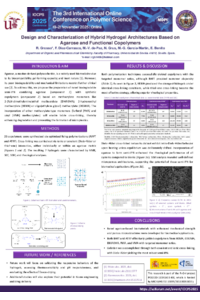
Agarose, a marine-derived polysaccharide, is a widely used biomedicine due to its biocompatibility, gel-forming capacity, and inert nature[1]. However, its poor biodegradability and mechanical limitations restrict further clinical use[2]. To address this, we propose the synthesis of a novel biodegradable semi-IPN combining agarose with methacrylate-based polymers (DMAEMA, HEMA, OEGMA). The degradation of these networks will be enhanced by incorporating monomers like FMA and VMA, which can establish labile cross-linking points, thereby preventing the formation of microplastics.
Methods
Copolymers were synthesized via living polymerizations —RAFT and ATRP— with reaction parameters systematically optimized. Following dialysis purification, cross-linking of copolymers was performed using Diels–Alder chemistry, thiol–ene reactions, or ionic interactions, either individually or within an agarose matrix. The resulting materials were characterized by NMR, SEC, SEM, and rheological analyses.
Results and Discussion
Both polymerization techniques successfully yielded copolymers with the targeted monomer ratios, although RAFT provided narrower dispersity. Among the monomers tested, HEMA produced the strongest hydrogels under identical cross-linking conditions, while thiol–ene cross-linking became the most effective strategy, offering superior rheological properties—even outperforming dual-cross-linked systems (Diels–Alder + ionic). Diels–Alder cross-linked networks did not exhibit retro-Diels–Alder behavior upon heating unless equilibrium was deliberately shifted. Incorporation of agarose to form semi-IPN enhanced the rheological performance of all systems compared to blanks, with the OEGMA-based, Diels–Alder cross-linked network performing best. SEM analysis revealed well-defined microporous architectures, supporting the potential of these semi-IPNs for biomedical applications.
Conclusions
Novel agarose-based biomaterials with enhanced mechanical strength and porous microstructures were developed for biomedical applications. RAFT and ATRP effectively yielded copolymers from HEMA, OEGMA, DMAEMA, FMA, and VMA with targeted monomer ratios. Gelation was achieved via covalent and ionic cross-linking, with Diels–Alder yielding the most robust semi-IPN.
References
[1] Molecules. 2023, doi: 10.3390/molecules21111577
[2] Pharmaceutics. 2023, doi: 10.3390/pharmaceutics15102514
Keywords
semi-IPN
agarose
RAFT
ATRP
biocompatible copolymers
Diels-Alder reaction
thiol ene chemistry
Poster
Póster Roberto Grosso.pdf
Synthesis, thermal, mechanical, and hydrolysis properties of poly(hexamethylene furandicarboxylate)-based copolyesters
High-Performance Thermoplastic/Thermoset Blends: Strategies, Challenges, and Perspectives for Advanced Structural Applications