Event submissions
Published
This submission belongs to the session S1. Biobased, Biodegradable-compostable, and Recyclable Polymers of the event The 3rd International Online Conference on Polymer Science
Published date
14 Nov, 2025
Academic Editor
'%3e%3cpath%20d='M12.6657%2010.9104C12.4185%2010.325%2012.0599%209.79327%2011.6097%209.34482C11.1609%208.89508%2010.6293%208.5365%2010.0442%208.28888C10.0389%208.28626%2010.0337%208.28495%2010.0285%208.28233C10.8446%207.69279%2011.3752%206.73249%2011.3752%205.64904C11.3752%203.8542%209.92103%202.39999%208.1262%202.39999C6.33136%202.39999%204.87715%203.8542%204.87715%205.64904C4.87715%206.73249%205.40774%207.69279%206.22393%208.28364C6.21869%208.28626%206.21345%208.28757%206.20821%208.29019C5.62129%208.5378%205.09463%208.89284%204.64265%209.34613C4.1929%209.79493%203.83432%2010.3266%203.58671%2010.9117C3.34345%2011.4845%203.21226%2012.0987%203.20023%2012.7209C3.19988%2012.7349%203.20233%2012.7488%203.20744%2012.7619C3.21255%2012.7749%203.22022%2012.7867%203.22998%2012.7968C3.23975%2012.8068%203.25142%2012.8147%203.26431%2012.8202C3.2772%2012.8256%203.29105%2012.8284%203.30504%2012.8284H4.09109C4.14874%2012.8284%204.19459%2012.7825%204.1959%2012.7262C4.2221%2011.7148%204.62823%2010.7676%205.34617%2010.0497C6.08899%209.30683%207.0755%208.89808%208.1262%208.89808C9.17689%208.89808%2010.1634%209.30683%2010.9062%2010.0497C11.6242%2010.7676%2012.0303%2011.7148%2012.0565%2012.7262C12.0578%2012.7838%2012.1037%2012.8284%2012.1613%2012.8284H12.9474C12.9613%2012.8284%2012.9752%2012.8256%2012.9881%2012.8202C13.001%2012.8147%2013.0126%2012.8068%2013.0224%2012.7968C13.0322%2012.7867%2013.0398%2012.7749%2013.0449%2012.7619C13.0501%2012.7488%2013.0525%2012.7349%2013.0522%2012.7209C13.0391%2012.0947%2012.9094%2011.4855%2012.6657%2010.9104ZM8.1262%207.9024C7.52486%207.9024%206.9589%207.6679%206.53312%207.24211C6.10733%206.81633%205.87283%206.25037%205.87283%205.64904C5.87283%205.0477%206.10733%204.48174%206.53312%204.05596C6.9589%203.63018%207.52486%203.39567%208.1262%203.39567C8.72753%203.39567%209.29349%203.63018%209.71927%204.05596C10.1451%204.48174%2010.3796%205.0477%2010.3796%205.64904C10.3796%206.25037%2010.1451%206.81633%209.71927%207.24211C9.29349%207.6679%208.72753%207.9024%208.1262%207.9024Z'%20fill='%235D1EE1'/%3e%3c/g%3e%3c/svg%3e) Valentina Siracusa
Valentina SiracusaCitation
Vincenzo Titone, Sacha Trevelyan Mould, Loic Hilliou, Vito Gigante, Laura Aliotta, Maria Chiara Mistretta, Luigi Botta, Assessing the Effect of Processing Parameters on Biodegradable Polymer Blends Using a Prototype Extruder, in Proceedings of The 3rd International Online Conference on Polymer Science, 19 November–21 November 2025, MDPI: Basel, Switzerland
Share
Email
Facebook
Twitter
LinkedIn
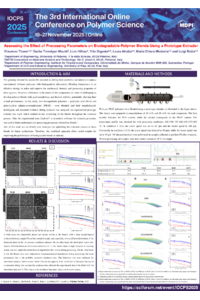
Assessing the Effect of Processing Parameters on Biodegradable Polymer Blends Using a Prototype Extruder
'%3e%3cpath%20d='M12.6647%2010.9104C12.4176%2010.325%2012.0589%209.7933%2011.6088%209.34485C11.16%208.89511%2010.6283%208.53653%2010.0432%208.28891C10.038%208.28629%2010.0327%208.28498%2010.0275%208.28236C10.8437%207.69282%2011.3743%206.73252%2011.3743%205.64907C11.3743%203.85423%209.92005%202.40002%208.12522%202.40002C6.33038%202.40002%204.87618%203.85423%204.87618%205.64907C4.87618%206.73252%205.40677%207.69282%206.22296%208.28367C6.21772%208.28629%206.21248%208.2876%206.20724%208.29022C5.62031%208.53783%205.09365%208.89287%204.64167%209.34616C4.19192%209.79496%203.83334%2010.3266%203.58573%2010.9117C3.34247%2011.4846%203.21128%2012.0987%203.19925%2012.721C3.1989%2012.735%203.20135%2012.7489%203.20646%2012.7619C3.21157%2012.7749%203.21924%2012.7868%203.22901%2012.7968C3.23877%2012.8068%203.25045%2012.8148%203.26334%2012.8202C3.27623%2012.8256%203.29007%2012.8284%203.30406%2012.8284H4.09012C4.14776%2012.8284%204.19362%2012.7825%204.19493%2012.7262C4.22113%2011.7148%204.62726%2010.7676%205.34519%2010.0497C6.08802%209.30686%207.07452%208.89811%208.12522%208.89811C9.17592%208.89811%2010.1624%209.30686%2010.9052%2010.0497C11.6232%2010.7676%2012.0293%2011.7148%2012.0555%2012.7262C12.0568%2012.7839%2012.1027%2012.8284%2012.1603%2012.8284H12.9464C12.9604%2012.8284%2012.9742%2012.8256%2012.9871%2012.8202C13%2012.8148%2013.0117%2012.8068%2013.0214%2012.7968C13.0312%2012.7868%2013.0389%2012.7749%2013.044%2012.7619C13.0491%2012.7489%2013.0515%2012.735%2013.0512%2012.721C13.0381%2012.0947%2012.9084%2011.4856%2012.6647%2010.9104ZM8.12522%207.90243C7.52388%207.90243%206.95792%207.66793%206.53214%207.24215C6.10636%206.81636%205.87185%206.2504%205.87185%205.64907C5.87185%205.04773%206.10636%204.48177%206.53214%204.05599C6.95792%203.63021%207.52388%203.3957%208.12522%203.3957C8.72655%203.3957%209.29252%203.63021%209.7183%204.05599C10.1441%204.48177%2010.3786%205.04773%2010.3786%205.64907C10.3786%206.2504%2010.1441%206.81636%209.7183%207.24215C9.29252%207.66793%208.72655%207.90243%208.12522%207.90243Z'%20fill='%235D1EE1'/%3e%3c/g%3e%3c/svg%3e)
Vincenzo Titone 1,2
Sacha Trevelyan Mould 3
Loic Hilliou 3

Vito Gigante 4

Laura Aliotta 4

Maria Chiara Mistretta 1,2

Luigi Botta 1,2
1. Department of Engineering, University of Palermo, V. le delle Scienze, 90128 Palermo, Italy
2. INSTM Consortium on Materials Science and Technology, Via G. Giusti 9, 50125, Florence, Italy
3. Department of Polymer Engineering, Institute for Polymers and Composites, Universidade do Minho, Campus de Azurém 4800-058, Guimarães, Portugal.
4. Department of Civil and Industrial Engineering, University of Pisa, 56122, Pisa, Italy
Abstract
The growing demand for sustainable materials is driving both academia and industry to replace conventional oil-based polymers with biodegradable alternatives. Blending biopolymers is an effective strategy for tailoring and improving the mechanical, thermal, and processing properties of these systems. However, differences in the nature of the components can make it challenging to develop polymer blends with good morphology and thermal stability, potentially affecting their overall performance. In this study, two biodegradable polymers commonly used in packaging—polylactic acid (PLA) and poly(butylene adipate-co-terephthalate) (PBAT)—were blended, and their morphological, rheological, and structural evolution during extrusion was analyzed. An experimental prototype extruder enabled in-line monitoring of the blends throughout the extrusion process. The results showed that screw speed and feed rate significantly influence material properties. Specifically, low screw speeds and feed rates promote thermo-mechanical degradation, leading to a reduction in molecular weight, without excluding possible branching or cross-linking phenomena due to the presence of PBAT. After the experimental tests, Ludovic®, a simulation software for extrusion processes, was used to better understand how processing parameters affected the blends. The simulation also helped identify strategies to reduce degradation and optimize the extrusion process for future applications. This combined approach offers useful insights to enhance biodegradable blend performance in industry.
Keywords
Biodegradable Polymers
Polymer Blends
Extrusion
Mechanical Properties
Rheology
Sustainability
Poster
sciforum-138164_VT.pdf
New Powder Polymer For 100% Bio-based Cosmetic Formulations
Protecting perishable food by using renewable and biodegradable polyester films