Event submissions
Published
This submission belongs to the session S3. Recent Functional and Structural Applications of Polymer Systems of the event The 3rd International Online Conference on Polymer Science
Published date
14 Nov, 2025
Academic Editor
'%3e%3cpath%20d='M12.6657%2010.9104C12.4185%2010.325%2012.0599%209.79327%2011.6097%209.34482C11.1609%208.89508%2010.6293%208.5365%2010.0442%208.28888C10.0389%208.28626%2010.0337%208.28495%2010.0285%208.28233C10.8446%207.69279%2011.3752%206.73249%2011.3752%205.64904C11.3752%203.8542%209.92103%202.39999%208.1262%202.39999C6.33136%202.39999%204.87715%203.8542%204.87715%205.64904C4.87715%206.73249%205.40774%207.69279%206.22393%208.28364C6.21869%208.28626%206.21345%208.28757%206.20821%208.29019C5.62129%208.5378%205.09463%208.89284%204.64265%209.34613C4.1929%209.79493%203.83432%2010.3266%203.58671%2010.9117C3.34345%2011.4845%203.21226%2012.0987%203.20023%2012.7209C3.19988%2012.7349%203.20233%2012.7488%203.20744%2012.7619C3.21255%2012.7749%203.22022%2012.7867%203.22998%2012.7968C3.23975%2012.8068%203.25142%2012.8147%203.26431%2012.8202C3.2772%2012.8256%203.29105%2012.8284%203.30504%2012.8284H4.09109C4.14874%2012.8284%204.19459%2012.7825%204.1959%2012.7262C4.2221%2011.7148%204.62823%2010.7676%205.34617%2010.0497C6.08899%209.30683%207.0755%208.89808%208.1262%208.89808C9.17689%208.89808%2010.1634%209.30683%2010.9062%2010.0497C11.6242%2010.7676%2012.0303%2011.7148%2012.0565%2012.7262C12.0578%2012.7838%2012.1037%2012.8284%2012.1613%2012.8284H12.9474C12.9613%2012.8284%2012.9752%2012.8256%2012.9881%2012.8202C13.001%2012.8147%2013.0126%2012.8068%2013.0224%2012.7968C13.0322%2012.7867%2013.0398%2012.7749%2013.0449%2012.7619C13.0501%2012.7488%2013.0525%2012.7349%2013.0522%2012.7209C13.0391%2012.0947%2012.9094%2011.4855%2012.6657%2010.9104ZM8.1262%207.9024C7.52486%207.9024%206.9589%207.6679%206.53312%207.24211C6.10733%206.81633%205.87283%206.25037%205.87283%205.64904C5.87283%205.0477%206.10733%204.48174%206.53312%204.05596C6.9589%203.63018%207.52486%203.39567%208.1262%203.39567C8.72753%203.39567%209.29349%203.63018%209.71927%204.05596C10.1451%204.48174%2010.3796%205.0477%2010.3796%205.64904C10.3796%206.25037%2010.1451%206.81633%209.71927%207.24211C9.29349%207.6679%208.72753%207.9024%208.1262%207.9024Z'%20fill='%235D1EE1'/%3e%3c/g%3e%3c/svg%3e) Mazeyar Parvinzadeh Gashti
Mazeyar Parvinzadeh GashtiCitation
Sotiria Eginloglou, Ioanna Koumentakou, Sofia Kavafaki, Ramonna I. Kosheleva, Georgios Maliaris, George Z. Kyzas, Development of PLA/PVA composite scaffolds reinforced with hydroxyapatite for bone tissue engineering applications, in Proceedings of The 3rd International Online Conference on Polymer Science, 19 November–21 November 2025, MDPI: Basel, Switzerland
Share
Email
Facebook
Twitter
LinkedIn
Development of PLA/PVA composite scaffolds reinforced with hydroxyapatite for bone tissue engineering applications
'%3e%3cpath%20d='M12.6647%2010.9104C12.4176%2010.325%2012.0589%209.7933%2011.6088%209.34485C11.16%208.89511%2010.6283%208.53653%2010.0432%208.28891C10.038%208.28629%2010.0327%208.28498%2010.0275%208.28236C10.8437%207.69282%2011.3743%206.73252%2011.3743%205.64907C11.3743%203.85423%209.92005%202.40002%208.12522%202.40002C6.33038%202.40002%204.87618%203.85423%204.87618%205.64907C4.87618%206.73252%205.40677%207.69282%206.22296%208.28367C6.21772%208.28629%206.21248%208.2876%206.20724%208.29022C5.62031%208.53783%205.09365%208.89287%204.64167%209.34616C4.19192%209.79496%203.83334%2010.3266%203.58573%2010.9117C3.34247%2011.4846%203.21128%2012.0987%203.19925%2012.721C3.1989%2012.735%203.20135%2012.7489%203.20646%2012.7619C3.21157%2012.7749%203.21924%2012.7868%203.22901%2012.7968C3.23877%2012.8068%203.25045%2012.8148%203.26334%2012.8202C3.27623%2012.8256%203.29007%2012.8284%203.30406%2012.8284H4.09012C4.14776%2012.8284%204.19362%2012.7825%204.19493%2012.7262C4.22113%2011.7148%204.62726%2010.7676%205.34519%2010.0497C6.08802%209.30686%207.07452%208.89811%208.12522%208.89811C9.17592%208.89811%2010.1624%209.30686%2010.9052%2010.0497C11.6232%2010.7676%2012.0293%2011.7148%2012.0555%2012.7262C12.0568%2012.7839%2012.1027%2012.8284%2012.1603%2012.8284H12.9464C12.9604%2012.8284%2012.9742%2012.8256%2012.9871%2012.8202C13%2012.8148%2013.0117%2012.8068%2013.0214%2012.7968C13.0312%2012.7868%2013.0389%2012.7749%2013.044%2012.7619C13.0491%2012.7489%2013.0515%2012.735%2013.0512%2012.721C13.0381%2012.0947%2012.9084%2011.4856%2012.6647%2010.9104ZM8.12522%207.90243C7.52388%207.90243%206.95792%207.66793%206.53214%207.24215C6.10636%206.81636%205.87185%206.2504%205.87185%205.64907C5.87185%205.04773%206.10636%204.48177%206.53214%204.05599C6.95792%203.63021%207.52388%203.3957%208.12522%203.3957C8.72655%203.3957%209.29252%203.63021%209.7183%204.05599C10.1441%204.48177%2010.3786%205.04773%2010.3786%205.64907C10.3786%206.2504%2010.1441%206.81636%209.7183%207.24215C9.29252%207.66793%208.72655%207.90243%208.12522%207.90243Z'%20fill='%235D1EE1'/%3e%3c/g%3e%3c/svg%3e)
Sotiria Eginloglou 1
Ioanna Koumentakou 1

Sofia Kavafaki 1

Ramonna I. Kosheleva 1

Georgios Maliaris 1

George Z. Kyzas 1
1. Hephaestus Laboratory, School of Chemistry, Faculty of Sciences, Democritus University of Thrace, GR-65404, Kavala, Greece
Abstract
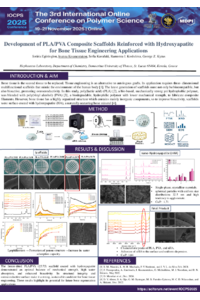
Bone tissue, the second most frequently replaced tissue in the human body, requires over four million surgeries annually, often with considerable risk, driving the advancement of tissue engineering as a promising alternative to autologous grafts through the development of multifunctional, biocompatible, and bioactive 3D scaffolds that promote osteoconductivity and mimic the native bone environment. In this study, poly(lactic acid) (PLA), a bio-based, mechanically strong yet hydrophobic polymer, was blended with poly(vinyl alcohol) (PVA), a biodegradable, hydrophilic polymer with lower mechanical strength, to fabricate composite filaments. Six PLA/PVA ratios were evaluated. Scaffolds were fabricated via Fused Deposition Modeling (FDM) and subsequently freeze-dried to enhance porosity and water absorption. To improve bioactivity, scaffolds were surface-coated with hydroxyapatite (HA), a naturally occurring bone mineral synthesized via a hydrothermal method. Scaffolds were thoroughly characterized through FTIR and XRD (physicochemical analysis), SEM and EDS (morphological analysis), and micro-CT. Their performance under simulated physiological conditions was examined through water absorption and mechanical testing. The freeze-dried scaffold with a 25:75 PLA/PVA ratio showed the highest water absorption capacity of 277.7% after 210 minutes, compared to its non-freeze-dried counterpart, which reached 270.1% in 75 minutes. Compression testing further demonstrated that scaffolds possessed a Young’s modulus of 12.284 MPa, closely approximating that of natural cancellous bone. The synthesized HA for coating had a meso-nanometric average particle size of 32.5 nm and a uniform spherical morphology. Its successful incorporation into the scaffold was confirmed by FTIR, while uniform dispersion across the scaffold surface was verified by SEM imaging. These findings indicate that the freeze-dried PLA/PVA (25:75) scaffold reinforced with hydroxyapatite presents an effective and sustainable approach for bone tissue engineering. Its combination of mechanical strength, high water absorption, and bioactive surface properties makes it a strong candidate for future bone regeneration applications.
Keywords
Scaffolds
3D printing
Bone regeneration
poly(lactic acid)
polyvinyl alcohol
nanohydroxyapatite
Poster
sciforum-138535 IOCPS_ Poster_Eginloglou.pdf
Sustainable composites based on bioplastics and hydrothermally carbonized wood waste
Development of plasticized PLA and reprocessed PLA films with eggshell waste-based fillers for sustainable packaging