Event submissions
Published
This submission belongs to the session S1. Biobased, Biodegradable-compostable, and Recyclable Polymers of the event The 3rd International Online Conference on Polymer Science
Published date
14 Nov, 2025
Academic Editor
'%3e%3cpath%20d='M12.6657%2010.9104C12.4185%2010.325%2012.0599%209.79327%2011.6097%209.34482C11.1609%208.89508%2010.6293%208.5365%2010.0442%208.28888C10.0389%208.28626%2010.0337%208.28495%2010.0285%208.28233C10.8446%207.69279%2011.3752%206.73249%2011.3752%205.64904C11.3752%203.8542%209.92103%202.39999%208.1262%202.39999C6.33136%202.39999%204.87715%203.8542%204.87715%205.64904C4.87715%206.73249%205.40774%207.69279%206.22393%208.28364C6.21869%208.28626%206.21345%208.28757%206.20821%208.29019C5.62129%208.5378%205.09463%208.89284%204.64265%209.34613C4.1929%209.79493%203.83432%2010.3266%203.58671%2010.9117C3.34345%2011.4845%203.21226%2012.0987%203.20023%2012.7209C3.19988%2012.7349%203.20233%2012.7488%203.20744%2012.7619C3.21255%2012.7749%203.22022%2012.7867%203.22998%2012.7968C3.23975%2012.8068%203.25142%2012.8147%203.26431%2012.8202C3.2772%2012.8256%203.29105%2012.8284%203.30504%2012.8284H4.09109C4.14874%2012.8284%204.19459%2012.7825%204.1959%2012.7262C4.2221%2011.7148%204.62823%2010.7676%205.34617%2010.0497C6.08899%209.30683%207.0755%208.89808%208.1262%208.89808C9.17689%208.89808%2010.1634%209.30683%2010.9062%2010.0497C11.6242%2010.7676%2012.0303%2011.7148%2012.0565%2012.7262C12.0578%2012.7838%2012.1037%2012.8284%2012.1613%2012.8284H12.9474C12.9613%2012.8284%2012.9752%2012.8256%2012.9881%2012.8202C13.001%2012.8147%2013.0126%2012.8068%2013.0224%2012.7968C13.0322%2012.7867%2013.0398%2012.7749%2013.0449%2012.7619C13.0501%2012.7488%2013.0525%2012.7349%2013.0522%2012.7209C13.0391%2012.0947%2012.9094%2011.4855%2012.6657%2010.9104ZM8.1262%207.9024C7.52486%207.9024%206.9589%207.6679%206.53312%207.24211C6.10733%206.81633%205.87283%206.25037%205.87283%205.64904C5.87283%205.0477%206.10733%204.48174%206.53312%204.05596C6.9589%203.63018%207.52486%203.39567%208.1262%203.39567C8.72753%203.39567%209.29349%203.63018%209.71927%204.05596C10.1451%204.48174%2010.3796%205.0477%2010.3796%205.64904C10.3796%206.25037%2010.1451%206.81633%209.71927%207.24211C9.29349%207.6679%208.72753%207.9024%208.1262%207.9024Z'%20fill='%235D1EE1'/%3e%3c/g%3e%3c/svg%3e) Valentina Siracusa
Valentina SiracusaCitation
Natalia Kołcz, Karen Dayana Gutiérrez Silva, Anna Masek, Oscar Gil Castell, Jose David Badia Valiente, Abiotic surface degradation induced by ozonation on poly (lactic acid) (PLA)/poly (butylene adipate-co-terephthalate) (PBAT) blends, in Proceedings of The 3rd International Online Conference on Polymer Science, 19 November–21 November 2025, MDPI: Basel, Switzerland
Share
Email
Facebook
Twitter
LinkedIn
Abiotic surface degradation induced by ozonation on poly (lactic acid) (PLA)/poly (butylene adipate-co-terephthalate) (PBAT) blends

Natalia Kołcz 1,2

Karen Dayana Gutiérrez Silva 1

Anna Masek 2
'%3e%3cpath%20d='M12.6647%2010.9104C12.4176%2010.325%2012.0589%209.7933%2011.6088%209.34485C11.16%208.89511%2010.6283%208.53653%2010.0432%208.28891C10.038%208.28629%2010.0327%208.28498%2010.0275%208.28236C10.8437%207.69282%2011.3743%206.73252%2011.3743%205.64907C11.3743%203.85423%209.92005%202.40002%208.12522%202.40002C6.33038%202.40002%204.87618%203.85423%204.87618%205.64907C4.87618%206.73252%205.40677%207.69282%206.22296%208.28367C6.21772%208.28629%206.21248%208.2876%206.20724%208.29022C5.62031%208.53783%205.09365%208.89287%204.64167%209.34616C4.19192%209.79496%203.83334%2010.3266%203.58573%2010.9117C3.34247%2011.4846%203.21128%2012.0987%203.19925%2012.721C3.1989%2012.735%203.20135%2012.7489%203.20646%2012.7619C3.21157%2012.7749%203.21924%2012.7868%203.22901%2012.7968C3.23877%2012.8068%203.25045%2012.8148%203.26334%2012.8202C3.27623%2012.8256%203.29007%2012.8284%203.30406%2012.8284H4.09012C4.14776%2012.8284%204.19362%2012.7825%204.19493%2012.7262C4.22113%2011.7148%204.62726%2010.7676%205.34519%2010.0497C6.08802%209.30686%207.07452%208.89811%208.12522%208.89811C9.17592%208.89811%2010.1624%209.30686%2010.9052%2010.0497C11.6232%2010.7676%2012.0293%2011.7148%2012.0555%2012.7262C12.0568%2012.7839%2012.1027%2012.8284%2012.1603%2012.8284H12.9464C12.9604%2012.8284%2012.9742%2012.8256%2012.9871%2012.8202C13%2012.8148%2013.0117%2012.8068%2013.0214%2012.7968C13.0312%2012.7868%2013.0389%2012.7749%2013.044%2012.7619C13.0491%2012.7489%2013.0515%2012.735%2013.0512%2012.721C13.0381%2012.0947%2012.9084%2011.4856%2012.6647%2010.9104ZM8.12522%207.90243C7.52388%207.90243%206.95792%207.66793%206.53214%207.24215C6.10636%206.81636%205.87185%206.2504%205.87185%205.64907C5.87185%205.04773%206.10636%204.48177%206.53214%204.05599C6.95792%203.63021%207.52388%203.3957%208.12522%203.3957C8.72655%203.3957%209.29252%203.63021%209.7183%204.05599C10.1441%204.48177%2010.3786%205.04773%2010.3786%205.64907C10.3786%206.2504%2010.1441%206.81636%209.7183%207.24215C9.29252%207.66793%208.72655%207.90243%208.12522%207.90243Z'%20fill='%235D1EE1'/%3e%3c/g%3e%3c/svg%3e)
Oscar Gil Castell 1

Jose David Badia Valiente 1
1. Research Group in Materials Technology and Sustainability (MATS), Department of Chemical Engineering, School of Engineering, University of Valencia, Valencia 46010, Spain
2. Institute of Polymer and Dye Technology, Lodz University of Technology, Stefanowskiego 16, 90-537 Lodz, Poland
Abstract
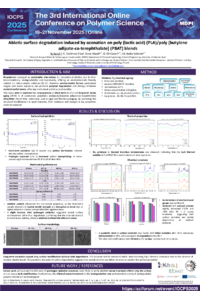
Biopolymers have emerged as sustainable alternatives to conventional plastics, showing advantages like biocompatibility, biodegradability, and non-toxicity [1]. Nevertheless, their aging processes under service life conditions still need a deeper evaluation [2], [3]. This study examined films of three commercial compositions for rigid/flexible packaging based on poly (lactic acid) (PLA)/poly (butylene adipate-co-terephthalate) (PBAT) blends under oxidative degradation conditions.
Commercial PLA/PBAT films, of 100 µm thickness, were exposed to short- (0 - 2 h) and long-term ozone aging (24 - 96 h) in an Anseros SIM 6050 T chamber at 40 oC and 300 pphm of ozone concentration. Analytical characterisation included measurements for surface hydrophilicity (WCA), microscopic morphology (SEM), chemical structure (FTIR-ATR), thermal properties (DSC), and mechanical performance.
Ozonation caused significant variations in surface properties after long-term ozone treatment, demonstrated by a constant decrease in WCA. A 96 h treatment led to abiotic degradation revealed by chemical structure analysis, where carbonyl and carboxyl indices were reduced by 17% and 16%, indicating degradation of oxidised functional groups and products, along with mild chain scission. Surface morphology showed surface changes with initial oxidation, reinforcement and re-degradation tendencies. These changes were limited to surface modifications, as slight bulk changes were reported in thermal properties. Mechanical performance improved, with the aging factor increasing from 0.5 to 0.9 to 1.14 - 1.30, suggesting that structural stability was maintained. Phase distribution within the polymer matrix influenced the extent of abiotic degradation. The progressive increase in additives such as plasticisers and inorganic fillers likely buffered the effects of ozone treatment.
Short- and long-term treatments promoted oxidative degradation of biodegradable film surfaces. Only long-term exposure led to macroscopic surface damage, altering morphology, chemical structure, and hydrophilicity, without affecting deeper layers, while maintaining thermal properties and slightly enhancing mechanical performance.
ACKNOWLEDGEMENTS
Authors acknowledge funding from the Agència Valenciana de la Innovació (AVI) through the INNEST/2022/295 project.
Keywords
PLA/PBAT blends
Abiotic degradation
Ozone aging
Poster
sciforum-138507-poster presentation.pdf
Self-assembled polysaccharide-based multilayer nanofilms of xanthan gum and diethylaminoethyl dextran on gold substrate and their interaction with model biomacromolecules
Development of nanopillar-structured poly(lactic acid) films incorporating grape pomace-derived activated carbon for smart food packaging applications