Event submissions
Published
This submission belongs to the session S1. Biobased, Biodegradable-compostable, and Recyclable Polymers of the event The 3rd International Online Conference on Polymer Science
Published date
14 Nov, 2025
Academic Editor
'%3e%3cpath%20d='M12.6657%2010.9104C12.4185%2010.325%2012.0599%209.79327%2011.6097%209.34482C11.1609%208.89508%2010.6293%208.5365%2010.0442%208.28888C10.0389%208.28626%2010.0337%208.28495%2010.0285%208.28233C10.8446%207.69279%2011.3752%206.73249%2011.3752%205.64904C11.3752%203.8542%209.92103%202.39999%208.1262%202.39999C6.33136%202.39999%204.87715%203.8542%204.87715%205.64904C4.87715%206.73249%205.40774%207.69279%206.22393%208.28364C6.21869%208.28626%206.21345%208.28757%206.20821%208.29019C5.62129%208.5378%205.09463%208.89284%204.64265%209.34613C4.1929%209.79493%203.83432%2010.3266%203.58671%2010.9117C3.34345%2011.4845%203.21226%2012.0987%203.20023%2012.7209C3.19988%2012.7349%203.20233%2012.7488%203.20744%2012.7619C3.21255%2012.7749%203.22022%2012.7867%203.22998%2012.7968C3.23975%2012.8068%203.25142%2012.8147%203.26431%2012.8202C3.2772%2012.8256%203.29105%2012.8284%203.30504%2012.8284H4.09109C4.14874%2012.8284%204.19459%2012.7825%204.1959%2012.7262C4.2221%2011.7148%204.62823%2010.7676%205.34617%2010.0497C6.08899%209.30683%207.0755%208.89808%208.1262%208.89808C9.17689%208.89808%2010.1634%209.30683%2010.9062%2010.0497C11.6242%2010.7676%2012.0303%2011.7148%2012.0565%2012.7262C12.0578%2012.7838%2012.1037%2012.8284%2012.1613%2012.8284H12.9474C12.9613%2012.8284%2012.9752%2012.8256%2012.9881%2012.8202C13.001%2012.8147%2013.0126%2012.8068%2013.0224%2012.7968C13.0322%2012.7867%2013.0398%2012.7749%2013.0449%2012.7619C13.0501%2012.7488%2013.0525%2012.7349%2013.0522%2012.7209C13.0391%2012.0947%2012.9094%2011.4855%2012.6657%2010.9104ZM8.1262%207.9024C7.52486%207.9024%206.9589%207.6679%206.53312%207.24211C6.10733%206.81633%205.87283%206.25037%205.87283%205.64904C5.87283%205.0477%206.10733%204.48174%206.53312%204.05596C6.9589%203.63018%207.52486%203.39567%208.1262%203.39567C8.72753%203.39567%209.29349%203.63018%209.71927%204.05596C10.1451%204.48174%2010.3796%205.0477%2010.3796%205.64904C10.3796%206.25037%2010.1451%206.81633%209.71927%207.24211C9.29349%207.6679%208.72753%207.9024%208.1262%207.9024Z'%20fill='%235D1EE1'/%3e%3c/g%3e%3c/svg%3e) Valentina Siracusa
Valentina SiracusaCitation
Konstantina Koutsogianni, Ioanna Koumentakou, Ramonna I. Kosheleva, Ioannis Giavasis, Nikolaos Kehagias, George Z. Kyzas, Development of nanopillar-structured poly(lactic acid) films incorporating grape pomace-derived activated carbon for smart food packaging applications, in Proceedings of The 3rd International Online Conference on Polymer Science, 19 November–21 November 2025, MDPI: Basel, Switzerland
Share
Email
Facebook
Twitter
LinkedIn
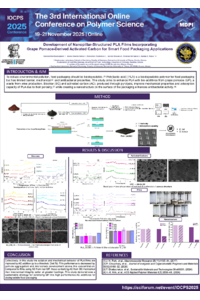
Development of nanopillar-structured poly(lactic acid) films incorporating grape pomace-derived activated carbon for smart food packaging applications

Konstantina Koutsogianni 1
'%3e%3cpath%20d='M12.6647%2010.9104C12.4176%2010.325%2012.0589%209.7933%2011.6088%209.34485C11.16%208.89511%2010.6283%208.53653%2010.0432%208.28891C10.038%208.28629%2010.0327%208.28498%2010.0275%208.28236C10.8437%207.69282%2011.3743%206.73252%2011.3743%205.64907C11.3743%203.85423%209.92005%202.40002%208.12522%202.40002C6.33038%202.40002%204.87618%203.85423%204.87618%205.64907C4.87618%206.73252%205.40677%207.69282%206.22296%208.28367C6.21772%208.28629%206.21248%208.2876%206.20724%208.29022C5.62031%208.53783%205.09365%208.89287%204.64167%209.34616C4.19192%209.79496%203.83334%2010.3266%203.58573%2010.9117C3.34247%2011.4846%203.21128%2012.0987%203.19925%2012.721C3.1989%2012.735%203.20135%2012.7489%203.20646%2012.7619C3.21157%2012.7749%203.21924%2012.7868%203.22901%2012.7968C3.23877%2012.8068%203.25045%2012.8148%203.26334%2012.8202C3.27623%2012.8256%203.29007%2012.8284%203.30406%2012.8284H4.09012C4.14776%2012.8284%204.19362%2012.7825%204.19493%2012.7262C4.22113%2011.7148%204.62726%2010.7676%205.34519%2010.0497C6.08802%209.30686%207.07452%208.89811%208.12522%208.89811C9.17592%208.89811%2010.1624%209.30686%2010.9052%2010.0497C11.6232%2010.7676%2012.0293%2011.7148%2012.0555%2012.7262C12.0568%2012.7839%2012.1027%2012.8284%2012.1603%2012.8284H12.9464C12.9604%2012.8284%2012.9742%2012.8256%2012.9871%2012.8202C13%2012.8148%2013.0117%2012.8068%2013.0214%2012.7968C13.0312%2012.7868%2013.0389%2012.7749%2013.044%2012.7619C13.0491%2012.7489%2013.0515%2012.735%2013.0512%2012.721C13.0381%2012.0947%2012.9084%2011.4856%2012.6647%2010.9104ZM8.12522%207.90243C7.52388%207.90243%206.95792%207.66793%206.53214%207.24215C6.10636%206.81636%205.87185%206.2504%205.87185%205.64907C5.87185%205.04773%206.10636%204.48177%206.53214%204.05599C6.95792%203.63021%207.52388%203.3957%208.12522%203.3957C8.72655%203.3957%209.29252%203.63021%209.7183%204.05599C10.1441%204.48177%2010.3786%205.04773%2010.3786%205.64907C10.3786%206.2504%2010.1441%206.81636%209.7183%207.24215C9.29252%207.66793%208.72655%207.90243%208.12522%207.90243Z'%20fill='%235D1EE1'/%3e%3c/g%3e%3c/svg%3e)
Ioanna Koumentakou 1

Ramonna I. Kosheleva 1

Ioannis Giavasis 2
Nikolaos Kehagias 3

George Z. Kyzas 4
1. Hephaestus Laboratory, School of Chemistry, Faculty of Sciences, Democritus University of Thrace, Kavala, Greece
2. Laboratory of Food Microbiology, Department of Food Technology, University of Thessaly, Karditsa, Greece
3. Institute of Nanoscience and Nanotechnology, NCSR Demokritos, Athens, Greece
4. Hephaestus Laboratory, School of Chemistry, Faculty of Sciences, Democritus University of Thrace, GR-65404, Kavala, Greece
Abstract
To address environmental concerns in the food packaging industry, there is a growing demand for biodegradable materials with enhanced functional properties. Poly(lactic acid) (PLA) is a promising biodegradable polymer for food packaging, yet it exhibits limitations in barrier performance, mechanical strength, and antibacterial activity. This study focuses on enhancing PLA films by incorporating activated carbon (AC) derived from grape pomace (GP), an abundant byproduct of wine production, thereby promoting a sustainable and circular bioeconomy approach. Biochar (BC) was produced via pyrolysis of GP at 350, 450, 550, and 650 °C for 1 and 2 hours. The optimal BC (obtained at 550 °C for 1 hour) exhibited a porous morphology suitable for further activation. ACs were then synthesized from both raw GP and BC at 450 °C and 550 °C for 1 hour. The most effective variants, AC_550_1h and ACBC_550_1h, were selected based on their superior porosity and used to fabricate PLA films at different loadings (1, 2, 3, 4, and 5 wt.%). The films were characterized using FTIR, XRD, SEM, EDS, and optical profilometry, and evaluated for their adsorption capacity (water and ethanol) and mechanical properties. The optimal formulation, PLA_3ACBC, exhibited enhanced elasticity and adsorption capacity, along with the successful formation of surface nanopillars—confirmed via profilometry. These nanopillars significantly improved antibacterial performance against E. coli and S. aureus compared to smooth, unmodified films. The results show that AC addition enhances the sorption and mechanical behavior of PLA films up to a threshold (3 wt.%). Beyond this concentration, particle aggregation and microcrack formation reduce film performance. Films incorporating AC from BC retained their mechanical integrity better at higher loadings than those using AC from raw GP. This study demonstrates a sustainable strategy for valorizing grape pomace into high-performance activated carbon additives for biodegradable food packaging.
Keywords
biomass
biochar
activated carbon
porosity
adsorption
nanopillars
antibacterial
PLA
food packaging
Poster
sciforum-138529 POSTER.pdf
Abiotic surface degradation induced by ozonation on poly (lactic acid) (PLA)/poly (butylene adipate-co-terephthalate) (PBAT) blends
Marine Degradation of Biodegradable Plastics: A One-Year Field Study in the Mediterranean Sea