Event submissions
Published
This submission belongs to the session S1. Biobased, Biodegradable-compostable, and Recyclable Polymers of the event The 3rd International Online Conference on Polymer Science
Published date
14 Nov, 2025
Academic Editor
'%3e%3cpath%20d='M12.6657%2010.9104C12.4185%2010.325%2012.0599%209.79327%2011.6097%209.34482C11.1609%208.89508%2010.6293%208.5365%2010.0442%208.28888C10.0389%208.28626%2010.0337%208.28495%2010.0285%208.28233C10.8446%207.69279%2011.3752%206.73249%2011.3752%205.64904C11.3752%203.8542%209.92103%202.39999%208.1262%202.39999C6.33136%202.39999%204.87715%203.8542%204.87715%205.64904C4.87715%206.73249%205.40774%207.69279%206.22393%208.28364C6.21869%208.28626%206.21345%208.28757%206.20821%208.29019C5.62129%208.5378%205.09463%208.89284%204.64265%209.34613C4.1929%209.79493%203.83432%2010.3266%203.58671%2010.9117C3.34345%2011.4845%203.21226%2012.0987%203.20023%2012.7209C3.19988%2012.7349%203.20233%2012.7488%203.20744%2012.7619C3.21255%2012.7749%203.22022%2012.7867%203.22998%2012.7968C3.23975%2012.8068%203.25142%2012.8147%203.26431%2012.8202C3.2772%2012.8256%203.29105%2012.8284%203.30504%2012.8284H4.09109C4.14874%2012.8284%204.19459%2012.7825%204.1959%2012.7262C4.2221%2011.7148%204.62823%2010.7676%205.34617%2010.0497C6.08899%209.30683%207.0755%208.89808%208.1262%208.89808C9.17689%208.89808%2010.1634%209.30683%2010.9062%2010.0497C11.6242%2010.7676%2012.0303%2011.7148%2012.0565%2012.7262C12.0578%2012.7838%2012.1037%2012.8284%2012.1613%2012.8284H12.9474C12.9613%2012.8284%2012.9752%2012.8256%2012.9881%2012.8202C13.001%2012.8147%2013.0126%2012.8068%2013.0224%2012.7968C13.0322%2012.7867%2013.0398%2012.7749%2013.0449%2012.7619C13.0501%2012.7488%2013.0525%2012.7349%2013.0522%2012.7209C13.0391%2012.0947%2012.9094%2011.4855%2012.6657%2010.9104ZM8.1262%207.9024C7.52486%207.9024%206.9589%207.6679%206.53312%207.24211C6.10733%206.81633%205.87283%206.25037%205.87283%205.64904C5.87283%205.0477%206.10733%204.48174%206.53312%204.05596C6.9589%203.63018%207.52486%203.39567%208.1262%203.39567C8.72753%203.39567%209.29349%203.63018%209.71927%204.05596C10.1451%204.48174%2010.3796%205.0477%2010.3796%205.64904C10.3796%206.25037%2010.1451%206.81633%209.71927%207.24211C9.29349%207.6679%208.72753%207.9024%208.1262%207.9024Z'%20fill='%235D1EE1'/%3e%3c/g%3e%3c/svg%3e) Valentina Siracusa
Valentina SiracusaCitation
Cristian Danilo Vargas, Yuliany Guillín, William Hidalgo, Turning trash into treasure: PHB bioplastic production from agro-industrial waste by native Bacillus strains, in Proceedings of The 3rd International Online Conference on Polymer Science, 19 November–21 November 2025, MDPI: Basel, Switzerland
Share
Email
Facebook
Twitter
LinkedIn
Turning trash into treasure: PHB bioplastic production from agro-industrial waste by native Bacillus strains
'%3e%3cpath%20d='M12.6647%2010.9104C12.4176%2010.325%2012.0589%209.7933%2011.6088%209.34485C11.16%208.89511%2010.6283%208.53653%2010.0432%208.28891C10.038%208.28629%2010.0327%208.28498%2010.0275%208.28236C10.8437%207.69282%2011.3743%206.73252%2011.3743%205.64907C11.3743%203.85423%209.92005%202.40002%208.12522%202.40002C6.33038%202.40002%204.87618%203.85423%204.87618%205.64907C4.87618%206.73252%205.40677%207.69282%206.22296%208.28367C6.21772%208.28629%206.21248%208.2876%206.20724%208.29022C5.62031%208.53783%205.09365%208.89287%204.64167%209.34616C4.19192%209.79496%203.83334%2010.3266%203.58573%2010.9117C3.34247%2011.4846%203.21128%2012.0987%203.19925%2012.721C3.1989%2012.735%203.20135%2012.7489%203.20646%2012.7619C3.21157%2012.7749%203.21924%2012.7868%203.22901%2012.7968C3.23877%2012.8068%203.25045%2012.8148%203.26334%2012.8202C3.27623%2012.8256%203.29007%2012.8284%203.30406%2012.8284H4.09012C4.14776%2012.8284%204.19362%2012.7825%204.19493%2012.7262C4.22113%2011.7148%204.62726%2010.7676%205.34519%2010.0497C6.08802%209.30686%207.07452%208.89811%208.12522%208.89811C9.17592%208.89811%2010.1624%209.30686%2010.9052%2010.0497C11.6232%2010.7676%2012.0293%2011.7148%2012.0555%2012.7262C12.0568%2012.7839%2012.1027%2012.8284%2012.1603%2012.8284H12.9464C12.9604%2012.8284%2012.9742%2012.8256%2012.9871%2012.8202C13%2012.8148%2013.0117%2012.8068%2013.0214%2012.7968C13.0312%2012.7868%2013.0389%2012.7749%2013.044%2012.7619C13.0491%2012.7489%2013.0515%2012.735%2013.0512%2012.721C13.0381%2012.0947%2012.9084%2011.4856%2012.6647%2010.9104ZM8.12522%207.90243C7.52388%207.90243%206.95792%207.66793%206.53214%207.24215C6.10636%206.81636%205.87185%206.2504%205.87185%205.64907C5.87185%205.04773%206.10636%204.48177%206.53214%204.05599C6.95792%203.63021%207.52388%203.3957%208.12522%203.3957C8.72655%203.3957%209.29252%203.63021%209.7183%204.05599C10.1441%204.48177%2010.3786%205.04773%2010.3786%205.64907C10.3786%206.2504%2010.1441%206.81636%209.7183%207.24215C9.29252%207.66793%208.72655%207.90243%208.12522%207.90243Z'%20fill='%235D1EE1'/%3e%3c/g%3e%3c/svg%3e)
Cristian Danilo Vargas 1
Yuliany Guillín 2
William Hidalgo 1,2
1. Grupo de Investigación en Compuestos Orgánicos de Interés Medicinal (CODEIM), Universidad Industrial de Santander (UIS), Bucaramanga, 680002, Colombia
2. Grupo de Investigación en Bioquímica y Microbiología (GIBIM), Universidad Industrial de Santander (UIS), Bucaramanga, 680002, Colombia
Abstract
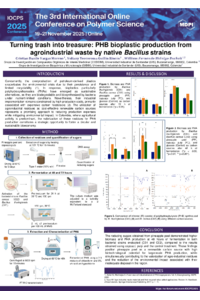
Given the growing accumulation of waste from agricultural, domestic, and industrial activities, and the continued dependence on fossil-based plastics, a sustainable alternative based on the bacterial biotransformation of waste for the production of polyhydroxyalkanoate (PHA) bioplastics is proposed. This research focuses on evaluating agro-industrial waste generated in Santander, Colombia, as a raw material for the production of PHAs, within a circular economy framework that aims to repurpose waste and give it a second useful life. A methodology was designed based on the fermentation of two native bacterial strains, Bacillus thuringiensis and Bacillus cereus, using waste such as pineapple peels and copoazú pulp. The process consisted of two stages. In the first stage, PHA production by each strain was evaluated using the waste products, with concentrations based on their reducing sugar content (10 g/L). In the second stage, fermentation parameters such as time, agitation, waste concentration, inoculum concentration, and pH, were optimized using the waste–strain combination that showed the highest yield in the initial evaluation. The preliminary results show that the highest yield of polyhydroxybutyrate (PHB), the predominant PHA produced, was obtained using pineapple peels and Bacillus thuringiensis, with an accumulation of 71.8 ± 4.5%. Meanwhile, Bacillus cereus showed a biopolymer accumulation of 68.19 ± 14.02%. This demonstrates the potential of pineapple peels as a carbon source for the production of biopolymers, highlighting their viability as an economic and environmental alternative to synthetic plastics. In addition, it contributes to the recovery of agro-industrial waste and the reduction in the environmental impact associated with its poor management.
Keywords
PHA
Bacillus thuringiensis
Bacillus cereus
biopolymers
Poster
2aaf53811c9ef38b2d0001a52e4b6dba 12.pdf
Multiple Recycling Cycle Analysis of 3D-printed Recycled Polycarbonate Using Fused Granulate Fabrication
Development of Sustainable Packaging with Enhanced Properties: Utilizing Coffee Waste-Derived Plasticizer, Eggshells, and Natural Rubber in PHBV Bioplastic Blends