Event submissions
Published
This submission belongs to the session S3. Recent Functional and Structural Applications of Polymer Systems of the event The 3rd International Online Conference on Polymer Science
Published date
14 Nov, 2025
Academic Editor
'%3e%3cpath%20d='M12.6657%2010.9104C12.4185%2010.325%2012.0599%209.79327%2011.6097%209.34482C11.1609%208.89508%2010.6293%208.5365%2010.0442%208.28888C10.0389%208.28626%2010.0337%208.28495%2010.0285%208.28233C10.8446%207.69279%2011.3752%206.73249%2011.3752%205.64904C11.3752%203.8542%209.92103%202.39999%208.1262%202.39999C6.33136%202.39999%204.87715%203.8542%204.87715%205.64904C4.87715%206.73249%205.40774%207.69279%206.22393%208.28364C6.21869%208.28626%206.21345%208.28757%206.20821%208.29019C5.62129%208.5378%205.09463%208.89284%204.64265%209.34613C4.1929%209.79493%203.83432%2010.3266%203.58671%2010.9117C3.34345%2011.4845%203.21226%2012.0987%203.20023%2012.7209C3.19988%2012.7349%203.20233%2012.7488%203.20744%2012.7619C3.21255%2012.7749%203.22022%2012.7867%203.22998%2012.7968C3.23975%2012.8068%203.25142%2012.8147%203.26431%2012.8202C3.2772%2012.8256%203.29105%2012.8284%203.30504%2012.8284H4.09109C4.14874%2012.8284%204.19459%2012.7825%204.1959%2012.7262C4.2221%2011.7148%204.62823%2010.7676%205.34617%2010.0497C6.08899%209.30683%207.0755%208.89808%208.1262%208.89808C9.17689%208.89808%2010.1634%209.30683%2010.9062%2010.0497C11.6242%2010.7676%2012.0303%2011.7148%2012.0565%2012.7262C12.0578%2012.7838%2012.1037%2012.8284%2012.1613%2012.8284H12.9474C12.9613%2012.8284%2012.9752%2012.8256%2012.9881%2012.8202C13.001%2012.8147%2013.0126%2012.8068%2013.0224%2012.7968C13.0322%2012.7867%2013.0398%2012.7749%2013.0449%2012.7619C13.0501%2012.7488%2013.0525%2012.7349%2013.0522%2012.7209C13.0391%2012.0947%2012.9094%2011.4855%2012.6657%2010.9104ZM8.1262%207.9024C7.52486%207.9024%206.9589%207.6679%206.53312%207.24211C6.10733%206.81633%205.87283%206.25037%205.87283%205.64904C5.87283%205.0477%206.10733%204.48174%206.53312%204.05596C6.9589%203.63018%207.52486%203.39567%208.1262%203.39567C8.72753%203.39567%209.29349%203.63018%209.71927%204.05596C10.1451%204.48174%2010.3796%205.0477%2010.3796%205.64904C10.3796%206.25037%2010.1451%206.81633%209.71927%207.24211C9.29349%207.6679%208.72753%207.9024%208.1262%207.9024Z'%20fill='%235D1EE1'/%3e%3c/g%3e%3c/svg%3e) Mazeyar Parvinzadeh Gashti
Mazeyar Parvinzadeh GashtiCitation
Yadu Ram Panthi, Ambika Pandey, Jirí Pfleger, Carbazole-Functionalized Memristors for AI-Driven Development: Unlocking Resistive Memory and Synapse-Mimicking Functionality for Next-Gen Computing, in Proceedings of The 3rd International Online Conference on Polymer Science, 19 November–21 November 2025, MDPI: Basel, Switzerland
Share
Email
Facebook
Twitter
LinkedIn
Carbazole-Functionalized Memristors for AI-Driven Development: Unlocking Resistive Memory and Synapse-Mimicking Functionality for Next-Gen Computing

Yadu Ram Panthi 1
'%3e%3cpath%20d='M12.6647%2010.9104C12.4176%2010.325%2012.0589%209.7933%2011.6088%209.34485C11.16%208.89511%2010.6283%208.53653%2010.0432%208.28891C10.038%208.28629%2010.0327%208.28498%2010.0275%208.28236C10.8437%207.69282%2011.3743%206.73252%2011.3743%205.64907C11.3743%203.85423%209.92005%202.40002%208.12522%202.40002C6.33038%202.40002%204.87618%203.85423%204.87618%205.64907C4.87618%206.73252%205.40677%207.69282%206.22296%208.28367C6.21772%208.28629%206.21248%208.2876%206.20724%208.29022C5.62031%208.53783%205.09365%208.89287%204.64167%209.34616C4.19192%209.79496%203.83334%2010.3266%203.58573%2010.9117C3.34247%2011.4846%203.21128%2012.0987%203.19925%2012.721C3.1989%2012.735%203.20135%2012.7489%203.20646%2012.7619C3.21157%2012.7749%203.21924%2012.7868%203.22901%2012.7968C3.23877%2012.8068%203.25045%2012.8148%203.26334%2012.8202C3.27623%2012.8256%203.29007%2012.8284%203.30406%2012.8284H4.09012C4.14776%2012.8284%204.19362%2012.7825%204.19493%2012.7262C4.22113%2011.7148%204.62726%2010.7676%205.34519%2010.0497C6.08802%209.30686%207.07452%208.89811%208.12522%208.89811C9.17592%208.89811%2010.1624%209.30686%2010.9052%2010.0497C11.6232%2010.7676%2012.0293%2011.7148%2012.0555%2012.7262C12.0568%2012.7839%2012.1027%2012.8284%2012.1603%2012.8284H12.9464C12.9604%2012.8284%2012.9742%2012.8256%2012.9871%2012.8202C13%2012.8148%2013.0117%2012.8068%2013.0214%2012.7968C13.0312%2012.7868%2013.0389%2012.7749%2013.044%2012.7619C13.0491%2012.7489%2013.0515%2012.735%2013.0512%2012.721C13.0381%2012.0947%2012.9084%2011.4856%2012.6647%2010.9104ZM8.12522%207.90243C7.52388%207.90243%206.95792%207.66793%206.53214%207.24215C6.10636%206.81636%205.87185%206.2504%205.87185%205.64907C5.87185%205.04773%206.10636%204.48177%206.53214%204.05599C6.95792%203.63021%207.52388%203.3957%208.12522%203.3957C8.72655%203.3957%209.29252%203.63021%209.7183%204.05599C10.1441%204.48177%2010.3786%205.04773%2010.3786%205.64907C10.3786%206.2504%2010.1441%206.81636%209.7183%207.24215C9.29252%207.66793%208.72655%207.90243%208.12522%207.90243Z'%20fill='%235D1EE1'/%3e%3c/g%3e%3c/svg%3e)
Ambika Pandey 1,2

Jirí Pfleger 1
1. Institute of Macromolecular Chemistry, Czech Academy of Sciences, Prague, Czech Republic
2. Faculty of Mathematics and Physics, Charles University, Prague, Czech Republic
Abstract
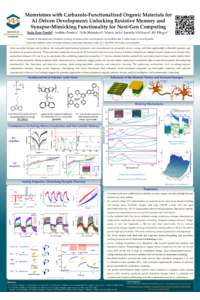
The synthesis and characterization of a series of carbazole-based polymers are investigated, focusing on their potential application in AI-driven bistable memory devices and neuromorphic computing architectures. These polymers incorporate carbazole moieties into their sidechains, facilitating π–π interactions and enhancing charge transport. When deposited as thin films between ITO and Al or Au electrodes, these materials demonstrate clear memristive behavior through voltage-induced conductance switching. The devices exhibit bistable conductivity with a pronounced hysteresis, retaining ON/OFF states for extended periods—several hours—when subjected to electric fields above a certain threshold, as detailed in recent reports [1–3].
In addition to their non-volatile memory characteristics, these carbazole-functionalized layers mimic key features of biological synapses under low to moderate biasing. Through the repeated application of voltage pulses, the devices show short-term plasticity (STP) and long-term plasticity (LTP), paired-pulse facilitation (PPF) and depression (PPD), spike-timing-dependent plasticity (STDP), and Hebbian associative learning—traits essential for hardware-based neural networks and cognitive computing. These neuromorphic behaviors are enabled by underlying physical mechanisms such as voltage-triggered conformational transitions, charge carrier trapping and detrapping, and redox-based switching, which have been elucidated using spectroscopic and electrical measurements [1–3].
This work underscores the promise of carbazole-functionalized polymers as active materials for organic memristors. Their multifunctionality—spanning stable memory storage and dynamic synaptic emulation—makes them excellent candidates for next-generation, low-power neuromorphic systems and adaptive artificial intelligence applications. The integration of these organic materials offers a scalable and tunable approach to bridging the gap between biological computation and electronic devices.
References:
1] Y. R. Panthi, A. Pandey, A. Šturcová, and J. Pfleger, et al., Mater. Adv., 2024, 5, 6388–6398.
[2] A. Pandey, A. Chernyshev, Y. R. Panthi, J. Pfleger et al., Polymers, 2024, 16, 542.
[3] Y. R. Panthi, J. Pfleger, A. Pandey, et al., J. Mater. Chem. C, 2023, 11, 17093–17105.
Keywords
Organic electronics
memristor
emulation of synaptic plasticity
carbazole-based polymer
Poster
sciforum-135520 Panthi_Poster_ICOP2025_Online.pdf
Development of Sustainable Packaging with Enhanced Properties: Utilizing Coffee Waste-Derived Plasticizer, Eggshells, and Natural Rubber in PHBV Bioplastic Blends
Selective Removal of Direct Green-6 from Textile Wastewater Using Molecularly Imprinted Polymers