Event submissions
Published
This submission belongs to the session S5. Polymer Physics and Theory of the event The 3rd International Online Conference on Polymer Science
Published date
14 Nov, 2025
Academic Editor
'%3e%3cpath%20d='M12.6657%2010.9104C12.4185%2010.325%2012.0599%209.79327%2011.6097%209.34482C11.1609%208.89508%2010.6293%208.5365%2010.0442%208.28888C10.0389%208.28626%2010.0337%208.28495%2010.0285%208.28233C10.8446%207.69279%2011.3752%206.73249%2011.3752%205.64904C11.3752%203.8542%209.92103%202.39999%208.1262%202.39999C6.33136%202.39999%204.87715%203.8542%204.87715%205.64904C4.87715%206.73249%205.40774%207.69279%206.22393%208.28364C6.21869%208.28626%206.21345%208.28757%206.20821%208.29019C5.62129%208.5378%205.09463%208.89284%204.64265%209.34613C4.1929%209.79493%203.83432%2010.3266%203.58671%2010.9117C3.34345%2011.4845%203.21226%2012.0987%203.20023%2012.7209C3.19988%2012.7349%203.20233%2012.7488%203.20744%2012.7619C3.21255%2012.7749%203.22022%2012.7867%203.22998%2012.7968C3.23975%2012.8068%203.25142%2012.8147%203.26431%2012.8202C3.2772%2012.8256%203.29105%2012.8284%203.30504%2012.8284H4.09109C4.14874%2012.8284%204.19459%2012.7825%204.1959%2012.7262C4.2221%2011.7148%204.62823%2010.7676%205.34617%2010.0497C6.08899%209.30683%207.0755%208.89808%208.1262%208.89808C9.17689%208.89808%2010.1634%209.30683%2010.9062%2010.0497C11.6242%2010.7676%2012.0303%2011.7148%2012.0565%2012.7262C12.0578%2012.7838%2012.1037%2012.8284%2012.1613%2012.8284H12.9474C12.9613%2012.8284%2012.9752%2012.8256%2012.9881%2012.8202C13.001%2012.8147%2013.0126%2012.8068%2013.0224%2012.7968C13.0322%2012.7867%2013.0398%2012.7749%2013.0449%2012.7619C13.0501%2012.7488%2013.0525%2012.7349%2013.0522%2012.7209C13.0391%2012.0947%2012.9094%2011.4855%2012.6657%2010.9104ZM8.1262%207.9024C7.52486%207.9024%206.9589%207.6679%206.53312%207.24211C6.10733%206.81633%205.87283%206.25037%205.87283%205.64904C5.87283%205.0477%206.10733%204.48174%206.53312%204.05596C6.9589%203.63018%207.52486%203.39567%208.1262%203.39567C8.72753%203.39567%209.29349%203.63018%209.71927%204.05596C10.1451%204.48174%2010.3796%205.0477%2010.3796%205.64904C10.3796%206.25037%2010.1451%206.81633%209.71927%207.24211C9.29349%207.6679%208.72753%207.9024%208.1262%207.9024Z'%20fill='%235D1EE1'/%3e%3c/g%3e%3c/svg%3e) Fahmi Zairi
Fahmi ZairiCitation
Pınar Güloğlu, David Rais, Jiří Vohlídal, Jiří Pfleger, Comparison of the ultrafast phenomena between eosin Y (EY) and palladium (II) octaethylporphyrin (PdOEP) as sensitizers and bis(terpyridine-4'-yl) terthiophene as an annihilator on thin films for optoelectronic applications, in Proceedings of The 3rd International Online Conference on Polymer Science, 19 November–21 November 2025, MDPI: Basel, Switzerland
Share
Email
Facebook
Twitter
LinkedIn
Comparison of the ultrafast phenomena between eosin Y (EY) and palladium (II) octaethylporphyrin (PdOEP) as sensitizers and bis(terpyridine-4'-yl) terthiophene as an annihilator on thin films for optoelectronic applications
'%3e%3cpath%20d='M12.6647%2010.9104C12.4176%2010.325%2012.0589%209.7933%2011.6088%209.34485C11.16%208.89511%2010.6283%208.53653%2010.0432%208.28891C10.038%208.28629%2010.0327%208.28498%2010.0275%208.28236C10.8437%207.69282%2011.3743%206.73252%2011.3743%205.64907C11.3743%203.85423%209.92005%202.40002%208.12522%202.40002C6.33038%202.40002%204.87618%203.85423%204.87618%205.64907C4.87618%206.73252%205.40677%207.69282%206.22296%208.28367C6.21772%208.28629%206.21248%208.2876%206.20724%208.29022C5.62031%208.53783%205.09365%208.89287%204.64167%209.34616C4.19192%209.79496%203.83334%2010.3266%203.58573%2010.9117C3.34247%2011.4846%203.21128%2012.0987%203.19925%2012.721C3.1989%2012.735%203.20135%2012.7489%203.20646%2012.7619C3.21157%2012.7749%203.21924%2012.7868%203.22901%2012.7968C3.23877%2012.8068%203.25045%2012.8148%203.26334%2012.8202C3.27623%2012.8256%203.29007%2012.8284%203.30406%2012.8284H4.09012C4.14776%2012.8284%204.19362%2012.7825%204.19493%2012.7262C4.22113%2011.7148%204.62726%2010.7676%205.34519%2010.0497C6.08802%209.30686%207.07452%208.89811%208.12522%208.89811C9.17592%208.89811%2010.1624%209.30686%2010.9052%2010.0497C11.6232%2010.7676%2012.0293%2011.7148%2012.0555%2012.7262C12.0568%2012.7839%2012.1027%2012.8284%2012.1603%2012.8284H12.9464C12.9604%2012.8284%2012.9742%2012.8256%2012.9871%2012.8202C13%2012.8148%2013.0117%2012.8068%2013.0214%2012.7968C13.0312%2012.7868%2013.0389%2012.7749%2013.044%2012.7619C13.0491%2012.7489%2013.0515%2012.735%2013.0512%2012.721C13.0381%2012.0947%2012.9084%2011.4856%2012.6647%2010.9104ZM8.12522%207.90243C7.52388%207.90243%206.95792%207.66793%206.53214%207.24215C6.10636%206.81636%205.87185%206.2504%205.87185%205.64907C5.87185%205.04773%206.10636%204.48177%206.53214%204.05599C6.95792%203.63021%207.52388%203.3957%208.12522%203.3957C8.72655%203.3957%209.29252%203.63021%209.7183%204.05599C10.1441%204.48177%2010.3786%205.04773%2010.3786%205.64907C10.3786%206.2504%2010.1441%206.81636%209.7183%207.24215C9.29252%207.66793%208.72655%207.90243%208.12522%207.90243Z'%20fill='%235D1EE1'/%3e%3c/g%3e%3c/svg%3e)
Pınar Güloğlu 1
David Rais 1
Jiří Vohlídal 2

Jiří Pfleger 1
1. Institute of Macromolecular Chemistry, Czech Academy of Sciences, Heyrovského nám. 2, 162 06 Prague 6, Czech Republic
2. Department of Physical and Macromolecular Chemistry, Faculty of Science, Charles University, Hlavova 2030, 128 40 Prague 2, Czech Republic
Abstract
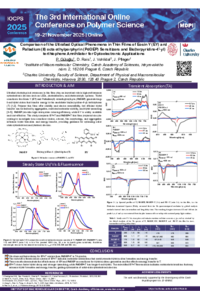
This study presents a comparative investigation of ultrafast photophysical processes in thin-film of eosin Y (EY) and palladium (II) octaethylporphyrin (PdOEP) as triplet sensitizers, combined with bis(terpyridine-4'-yl) terthiophene (T) as an annihilator. Thin films were fabricated by spin-coating on quartz substrates using chloroform (CHCl3) and hexafluoroisopropanol (HFIP) solvents. Excitation wavelengths were chosen based on the absorption maxima of the individual and mixed components.
Steady-state spectroscopy revealed distinct fluorescence and absorption features, with emission maxima ranging from 600 to 750 nm. Transient absorption spectroscopy (TAS) further confirmed efficient triplet energy transfer from both sensitizers to T, as evidenced by the characteristic ground-state bleaching (GSB) and excited-state absorption (ESA) signals spanning the 400-700 nm range. Global analysis of TAS data revealed multiexponential decay dynamics, with EY+T and PdOEP+T mixtures showing significantly extended triplet lifetimes compared to isolated components. Specifically, the EY+T system (1:4 ratio in HFIP, spin-coated) exhibited a rapid initial decay followed by a long-lived state exceeding 6 ns, while PdOEP+T (1:4 ratio in HFIP, spin-coated) displayed broader ESA bands related to triplet–triplet transitions.
These results demonstrate the effectiveness of EY and PdOEP as sensitizers for triplet state generation and energy transfer to T. The insights gained provide valuable guidance for optimizing triplet–triplet annihilation mechanisms in next-generation optoelectronic and photonic devices.
Keywords
EosinY(EY)
Palladium (II) octaethylporphyrin (PdOEP),transient absorption,photon upconversion
energy transfer
optoelectronic applications
Poster
IOCPS_2025_Poster_Sciforum_147733_Dr.Guloglu.pdf
Ultrafast Excited-State Dynamics and Aggregation Behavior of 2,5-Bis(2,2':6',2''-Terpyridine-4'-yl)-Thieno[3,2-b]Thiophene: Experimental and DFT Study
Natural and Petroleum-Based Resins: Impact on SBR Dynamics by Solid-State NMR Spectroscopy and Relaxometry