Event submissions
Published
This submission belongs to the session S1. Biobased, Biodegradable-compostable, and Recyclable Polymers of the event The 3rd International Online Conference on Polymer Science
Published date
14 Nov, 2025
Academic Editor
'%3e%3cpath%20d='M12.6657%2010.9104C12.4185%2010.325%2012.0599%209.79327%2011.6097%209.34482C11.1609%208.89508%2010.6293%208.5365%2010.0442%208.28888C10.0389%208.28626%2010.0337%208.28495%2010.0285%208.28233C10.8446%207.69279%2011.3752%206.73249%2011.3752%205.64904C11.3752%203.8542%209.92103%202.39999%208.1262%202.39999C6.33136%202.39999%204.87715%203.8542%204.87715%205.64904C4.87715%206.73249%205.40774%207.69279%206.22393%208.28364C6.21869%208.28626%206.21345%208.28757%206.20821%208.29019C5.62129%208.5378%205.09463%208.89284%204.64265%209.34613C4.1929%209.79493%203.83432%2010.3266%203.58671%2010.9117C3.34345%2011.4845%203.21226%2012.0987%203.20023%2012.7209C3.19988%2012.7349%203.20233%2012.7488%203.20744%2012.7619C3.21255%2012.7749%203.22022%2012.7867%203.22998%2012.7968C3.23975%2012.8068%203.25142%2012.8147%203.26431%2012.8202C3.2772%2012.8256%203.29105%2012.8284%203.30504%2012.8284H4.09109C4.14874%2012.8284%204.19459%2012.7825%204.1959%2012.7262C4.2221%2011.7148%204.62823%2010.7676%205.34617%2010.0497C6.08899%209.30683%207.0755%208.89808%208.1262%208.89808C9.17689%208.89808%2010.1634%209.30683%2010.9062%2010.0497C11.6242%2010.7676%2012.0303%2011.7148%2012.0565%2012.7262C12.0578%2012.7838%2012.1037%2012.8284%2012.1613%2012.8284H12.9474C12.9613%2012.8284%2012.9752%2012.8256%2012.9881%2012.8202C13.001%2012.8147%2013.0126%2012.8068%2013.0224%2012.7968C13.0322%2012.7867%2013.0398%2012.7749%2013.0449%2012.7619C13.0501%2012.7488%2013.0525%2012.7349%2013.0522%2012.7209C13.0391%2012.0947%2012.9094%2011.4855%2012.6657%2010.9104ZM8.1262%207.9024C7.52486%207.9024%206.9589%207.6679%206.53312%207.24211C6.10733%206.81633%205.87283%206.25037%205.87283%205.64904C5.87283%205.0477%206.10733%204.48174%206.53312%204.05596C6.9589%203.63018%207.52486%203.39567%208.1262%203.39567C8.72753%203.39567%209.29349%203.63018%209.71927%204.05596C10.1451%204.48174%2010.3796%205.0477%2010.3796%205.64904C10.3796%206.25037%2010.1451%206.81633%209.71927%207.24211C9.29349%207.6679%208.72753%207.9024%208.1262%207.9024Z'%20fill='%235D1EE1'/%3e%3c/g%3e%3c/svg%3e) Valentina Siracusa
Valentina SiracusaCitation
Alejandro Funes-López, Rocío Cuervo-Rodríguez, Alexandra Muñoz-Bonilla, Marta Fernández-García, Bio-Based Copolymers with Tunable Cationic Charge Densities for Antimicrobial Applications, in Proceedings of The 3rd International Online Conference on Polymer Science, 19 November–21 November 2025, MDPI: Basel, Switzerland
Share
Email
Facebook
Twitter
LinkedIn
Bio-Based Copolymers with Tunable Cationic Charge Densities for Antimicrobial Applications
'%3e%3cpath%20d='M12.6647%2010.9104C12.4176%2010.325%2012.0589%209.7933%2011.6088%209.34485C11.16%208.89511%2010.6283%208.53653%2010.0432%208.28891C10.038%208.28629%2010.0327%208.28498%2010.0275%208.28236C10.8437%207.69282%2011.3743%206.73252%2011.3743%205.64907C11.3743%203.85423%209.92005%202.40002%208.12522%202.40002C6.33038%202.40002%204.87618%203.85423%204.87618%205.64907C4.87618%206.73252%205.40677%207.69282%206.22296%208.28367C6.21772%208.28629%206.21248%208.2876%206.20724%208.29022C5.62031%208.53783%205.09365%208.89287%204.64167%209.34616C4.19192%209.79496%203.83334%2010.3266%203.58573%2010.9117C3.34247%2011.4846%203.21128%2012.0987%203.19925%2012.721C3.1989%2012.735%203.20135%2012.7489%203.20646%2012.7619C3.21157%2012.7749%203.21924%2012.7868%203.22901%2012.7968C3.23877%2012.8068%203.25045%2012.8148%203.26334%2012.8202C3.27623%2012.8256%203.29007%2012.8284%203.30406%2012.8284H4.09012C4.14776%2012.8284%204.19362%2012.7825%204.19493%2012.7262C4.22113%2011.7148%204.62726%2010.7676%205.34519%2010.0497C6.08802%209.30686%207.07452%208.89811%208.12522%208.89811C9.17592%208.89811%2010.1624%209.30686%2010.9052%2010.0497C11.6232%2010.7676%2012.0293%2011.7148%2012.0555%2012.7262C12.0568%2012.7839%2012.1027%2012.8284%2012.1603%2012.8284H12.9464C12.9604%2012.8284%2012.9742%2012.8256%2012.9871%2012.8202C13%2012.8148%2013.0117%2012.8068%2013.0214%2012.7968C13.0312%2012.7868%2013.0389%2012.7749%2013.044%2012.7619C13.0491%2012.7489%2013.0515%2012.735%2013.0512%2012.721C13.0381%2012.0947%2012.9084%2011.4856%2012.6647%2010.9104ZM8.12522%207.90243C7.52388%207.90243%206.95792%207.66793%206.53214%207.24215C6.10636%206.81636%205.87185%206.2504%205.87185%205.64907C5.87185%205.04773%206.10636%204.48177%206.53214%204.05599C6.95792%203.63021%207.52388%203.3957%208.12522%203.3957C8.72655%203.3957%209.29252%203.63021%209.7183%204.05599C10.1441%204.48177%2010.3786%205.04773%2010.3786%205.64907C10.3786%206.2504%2010.1441%206.81636%209.7183%207.24215C9.29252%207.66793%208.72655%207.90243%208.12522%207.90243Z'%20fill='%235D1EE1'/%3e%3c/g%3e%3c/svg%3e)
Alejandro Funes-López 1
Rocío Cuervo-Rodríguez 2

Alexandra Muñoz-Bonilla 1

Marta Fernández-García 1
1. Grupo de Ingeniería Macromolecular, Instituto de Ciecnia y Tecnología de Polímeros (ICTP), Consejo Superior de Investigaciones Científicas (CSIC). Calle de Juan de la Cierva, 3, Chamartín, 28006 Madrid, Madrid, España.
2. Departamento de Química Orgánica, Facultad de Ciecnias Químicas (FCCQQ), Universidad Complutense de Madrid (UCM). Plaza de las Ciencias, 2, Moncloa - Aravaca, 28040 Madrid, Madrid, España.
Abstract
The development of polymers derived from renewable resources is a critical research priority, motivated by the urgent need to reduce dependence on petroleum-based plastics. In this study, we present a sustainable copolymer system based on two bio-sourced monomers: MTA, a vitamin B1 derivative (sulfurol), [1] and PrI, a naturally derived modified itaconic acid [2]. Capitalizing on the chemical versatility of itaconic acid, we incorporated click chemistry-compatible functional groups to enable the covalent conjugation of natural bioactive compounds (sulfurol and menthol), imparting antimicrobial and antioxidant properties. Furthermore, the sulfurol moiety permits post-functionalization of the copolymer, introducing tunable cationic charge densities to modulate bioactivity. The copolymers were comprehensively characterized to assess their functional properties. Antimicrobial activity was evaluated against both Gram-positive and Gram-negative bacterial strains using minimum inhibitory concentration (MIC) assays [2]. The MIC values varied between 8 and 500 µg/mL, depending on the copolymer composition and the specific microorganism tested. Antioxidant performance was analyzed via DPPH radical scavenging assays [3], which demonstrated significant activity at a polymer concentration of 0.25 mg/mL. The Trolox equivalent antioxidant capacity (TEAC) was determined to be in the range of 0.4–0.6 µmol/mg, confirming the copolymers’ free radical quenching ability. Biocompatibility was assessed using Normal Human Dermal Fibroblasts (NHDFs) and the Alamar Blue viability assay. The results indicated excellent cell viability, suggesting that these copolymers are highly compatible with biological tissues and suitable for biomedical applications.
References
[1] Hevilla, V., Sonseca, A. et al. Eur. Polym. J. 2023, 186, 111875
[2] Chiloeches, A., Funes, A. et al. Polym. Chem., 2021, 12, 3190-3200;
[3] Rumpf, J., Burger, R. et al. Int. J. Biol. Macromol. 2023, 233, 123470.
Acknowledgments
A. Funes gratefully acknowledges the financial support received from MICINN through project PID2022-136516OB-I00.
Keywords
Sustainable polymers
Itaconic acid
Sulfurol
Antimicrobial
Antioxidant
Biocompatible
Poster
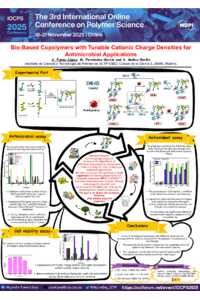
Poster IOCPS AFL.pdf
Partially Bio-based Aliphatic Diisocyanate Crosslinker as a Reactive Diluent in 2K Polyurethane Resins
Sustainable formulations made of a furan-based copolyester and nisin for flexible antimicrobial packaging applications