Event submissions
Published
This submission belongs to the session S1. Biobased, Biodegradable-compostable, and Recyclable Polymers of the event The 3rd International Online Conference on Polymer Science
Published date
14 Nov, 2025
Academic Editor
'%3e%3cpath%20d='M12.6657%2010.9104C12.4185%2010.325%2012.0599%209.79327%2011.6097%209.34482C11.1609%208.89508%2010.6293%208.5365%2010.0442%208.28888C10.0389%208.28626%2010.0337%208.28495%2010.0285%208.28233C10.8446%207.69279%2011.3752%206.73249%2011.3752%205.64904C11.3752%203.8542%209.92103%202.39999%208.1262%202.39999C6.33136%202.39999%204.87715%203.8542%204.87715%205.64904C4.87715%206.73249%205.40774%207.69279%206.22393%208.28364C6.21869%208.28626%206.21345%208.28757%206.20821%208.29019C5.62129%208.5378%205.09463%208.89284%204.64265%209.34613C4.1929%209.79493%203.83432%2010.3266%203.58671%2010.9117C3.34345%2011.4845%203.21226%2012.0987%203.20023%2012.7209C3.19988%2012.7349%203.20233%2012.7488%203.20744%2012.7619C3.21255%2012.7749%203.22022%2012.7867%203.22998%2012.7968C3.23975%2012.8068%203.25142%2012.8147%203.26431%2012.8202C3.2772%2012.8256%203.29105%2012.8284%203.30504%2012.8284H4.09109C4.14874%2012.8284%204.19459%2012.7825%204.1959%2012.7262C4.2221%2011.7148%204.62823%2010.7676%205.34617%2010.0497C6.08899%209.30683%207.0755%208.89808%208.1262%208.89808C9.17689%208.89808%2010.1634%209.30683%2010.9062%2010.0497C11.6242%2010.7676%2012.0303%2011.7148%2012.0565%2012.7262C12.0578%2012.7838%2012.1037%2012.8284%2012.1613%2012.8284H12.9474C12.9613%2012.8284%2012.9752%2012.8256%2012.9881%2012.8202C13.001%2012.8147%2013.0126%2012.8068%2013.0224%2012.7968C13.0322%2012.7867%2013.0398%2012.7749%2013.0449%2012.7619C13.0501%2012.7488%2013.0525%2012.7349%2013.0522%2012.7209C13.0391%2012.0947%2012.9094%2011.4855%2012.6657%2010.9104ZM8.1262%207.9024C7.52486%207.9024%206.9589%207.6679%206.53312%207.24211C6.10733%206.81633%205.87283%206.25037%205.87283%205.64904C5.87283%205.0477%206.10733%204.48174%206.53312%204.05596C6.9589%203.63018%207.52486%203.39567%208.1262%203.39567C8.72753%203.39567%209.29349%203.63018%209.71927%204.05596C10.1451%204.48174%2010.3796%205.0477%2010.3796%205.64904C10.3796%206.25037%2010.1451%206.81633%209.71927%207.24211C9.29349%207.6679%208.72753%207.9024%208.1262%207.9024Z'%20fill='%235D1EE1'/%3e%3c/g%3e%3c/svg%3e) Valentina Siracusa
Valentina SiracusaCitation
Rosa Barranco García, Mercedes Fernández San Martín, Coro Echeverria, Alexandra Muñoz-Bonilla, Marta Fernández-García, Development of Sustainable Antimicrobial Cellulose Additives for Melt Electrowritten PLA Fibers: From Synthesis to Extensional Rheology, in Proceedings of The 3rd International Online Conference on Polymer Science, 19 November–21 November 2025, MDPI: Basel, Switzerland
Share
Email
Facebook
Twitter
LinkedIn
Development of Sustainable Antimicrobial Cellulose Additives for Melt Electrowritten PLA Fibers: From Synthesis to Extensional Rheology
'%3e%3cpath%20d='M12.6647%2010.9104C12.4176%2010.325%2012.0589%209.7933%2011.6088%209.34485C11.16%208.89511%2010.6283%208.53653%2010.0432%208.28891C10.038%208.28629%2010.0327%208.28498%2010.0275%208.28236C10.8437%207.69282%2011.3743%206.73252%2011.3743%205.64907C11.3743%203.85423%209.92005%202.40002%208.12522%202.40002C6.33038%202.40002%204.87618%203.85423%204.87618%205.64907C4.87618%206.73252%205.40677%207.69282%206.22296%208.28367C6.21772%208.28629%206.21248%208.2876%206.20724%208.29022C5.62031%208.53783%205.09365%208.89287%204.64167%209.34616C4.19192%209.79496%203.83334%2010.3266%203.58573%2010.9117C3.34247%2011.4846%203.21128%2012.0987%203.19925%2012.721C3.1989%2012.735%203.20135%2012.7489%203.20646%2012.7619C3.21157%2012.7749%203.21924%2012.7868%203.22901%2012.7968C3.23877%2012.8068%203.25045%2012.8148%203.26334%2012.8202C3.27623%2012.8256%203.29007%2012.8284%203.30406%2012.8284H4.09012C4.14776%2012.8284%204.19362%2012.7825%204.19493%2012.7262C4.22113%2011.7148%204.62726%2010.7676%205.34519%2010.0497C6.08802%209.30686%207.07452%208.89811%208.12522%208.89811C9.17592%208.89811%2010.1624%209.30686%2010.9052%2010.0497C11.6232%2010.7676%2012.0293%2011.7148%2012.0555%2012.7262C12.0568%2012.7839%2012.1027%2012.8284%2012.1603%2012.8284H12.9464C12.9604%2012.8284%2012.9742%2012.8256%2012.9871%2012.8202C13%2012.8148%2013.0117%2012.8068%2013.0214%2012.7968C13.0312%2012.7868%2013.0389%2012.7749%2013.044%2012.7619C13.0491%2012.7489%2013.0515%2012.735%2013.0512%2012.721C13.0381%2012.0947%2012.9084%2011.4856%2012.6647%2010.9104ZM8.12522%207.90243C7.52388%207.90243%206.95792%207.66793%206.53214%207.24215C6.10636%206.81636%205.87185%206.2504%205.87185%205.64907C5.87185%205.04773%206.10636%204.48177%206.53214%204.05599C6.95792%203.63021%207.52388%203.3957%208.12522%203.3957C8.72655%203.3957%209.29252%203.63021%209.7183%204.05599C10.1441%204.48177%2010.3786%205.04773%2010.3786%205.64907C10.3786%206.2504%2010.1441%206.81636%209.7183%207.24215C9.29252%207.66793%208.72655%207.90243%208.12522%207.90243Z'%20fill='%235D1EE1'/%3e%3c/g%3e%3c/svg%3e)
Rosa Barranco García 1
Mercedes Fernández San Martín 2

Coro Echeverria 3

Alexandra Muñoz-Bonilla 1

Marta Fernández-García 1
1. Instituto de Ciencia y Tecnología de Polímeros (ICTP-CSIC), Juan de la Cierva 3, 28006 Madrid, Spain
2. POLYMAT and Department of Polymers and Advanced Materials: Physics, Chemistry and Technology, Faculty of Chemistry, University of the Basque Country UPV/EHU, Paseo Manuel de Lardizábal 3, Donostia-San Sebastián, 20018, Spain
3. Instituto de Ciencia y Tecnología de Polímeros (ICTP-CSIC) & Interdisciplinary Platform for Sustainable Plastics towards a Circular Economy, SusPlast-CSIC, Madrid, Spain
Abstract
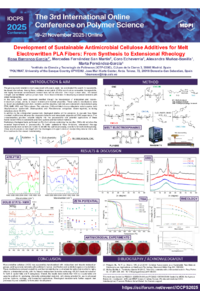
Addressing the dual challenges of plastic sustainability and antibiotic resistance, this work develops cationic cellulose nanocrystals (CNCs) with potent inherent antimicrobial activity. Functionalization of CNCs with triazole-imidazolium groups (CNC-TrMI) achieved a 56% degree of substitution, confirmed by ssNMR and elemental analysis. The resulting CNC-TrMI exhibited exceptional biocidal efficacy (>99.99% reduction) against both Gram-positive (Staphylococcus epidermidis) and Gram-negative (Pseudomonas aeruginosa) bacteria, surpassing methylimidazolium-modified CNC (CNC-MI) in efficacy against Gram-negative strains. While modifications reduced crystallinity (81% → 45%) and thermal stability (193 °C ≤ d5% ≤270 °C), CNC-TrMI’s retained thermal profile enables polymer processing.
The ultimate objective is to integrate these CNCs as sustainable antimicrobial agents into biobased poly(lactic acid) (PLA) matrices for processing via melt electrowriting (MEW). To achieve this, capillary rheology was first employed to screen and select the optimal PLA matrix among variants with differing D-isomer content. This rheological analysis directly correlates the uniaxial extensional viscoelastic response of PLA with its MEW processability, enabling reliable fabrication of biobased fibers and the subsequent incorporation of antimicrobial agents.
The synergy of CNC-TrMI’s non-leaching antimicrobial action (>4-log reduction), PLA’s biodegradability, and MEW’s precision patterning offers a sustainable platform for advanced biomedical textiles (e.g., wound dressings) and active packaging. Overall, this approach demonstrates how fundamental rheology guides the reliable integration of functional biobased additives into advanced manufacturing processes, supporting circular economy principles.
Keywords
Cellulose
Antimicrobial polymers
biobased polymers
PLA
Rheology
Poster
sciforum-139065 Development of Sustainable Antimicrobial Cellulose Additives for Melt Electrowritten PLA Fibers- From Synthesis to Extensional Rheology Rosa Barranco Garcia.pdf
Sustainable formulations made of a furan-based copolyester and nisin for flexible antimicrobial packaging applications
From milk to 3D printing: A sustainable journey of upcycled proteins