Event submissions
Published
This submission belongs to the session S1. Biobased, Biodegradable-compostable, and Recyclable Polymers of the event The 3rd International Online Conference on Polymer Science
Published date
17 Nov, 2025
Academic Editor
'%3e%3cpath%20d='M12.6657%2010.9104C12.4185%2010.325%2012.0599%209.79327%2011.6097%209.34482C11.1609%208.89508%2010.6293%208.5365%2010.0442%208.28888C10.0389%208.28626%2010.0337%208.28495%2010.0285%208.28233C10.8446%207.69279%2011.3752%206.73249%2011.3752%205.64904C11.3752%203.8542%209.92103%202.39999%208.1262%202.39999C6.33136%202.39999%204.87715%203.8542%204.87715%205.64904C4.87715%206.73249%205.40774%207.69279%206.22393%208.28364C6.21869%208.28626%206.21345%208.28757%206.20821%208.29019C5.62129%208.5378%205.09463%208.89284%204.64265%209.34613C4.1929%209.79493%203.83432%2010.3266%203.58671%2010.9117C3.34345%2011.4845%203.21226%2012.0987%203.20023%2012.7209C3.19988%2012.7349%203.20233%2012.7488%203.20744%2012.7619C3.21255%2012.7749%203.22022%2012.7867%203.22998%2012.7968C3.23975%2012.8068%203.25142%2012.8147%203.26431%2012.8202C3.2772%2012.8256%203.29105%2012.8284%203.30504%2012.8284H4.09109C4.14874%2012.8284%204.19459%2012.7825%204.1959%2012.7262C4.2221%2011.7148%204.62823%2010.7676%205.34617%2010.0497C6.08899%209.30683%207.0755%208.89808%208.1262%208.89808C9.17689%208.89808%2010.1634%209.30683%2010.9062%2010.0497C11.6242%2010.7676%2012.0303%2011.7148%2012.0565%2012.7262C12.0578%2012.7838%2012.1037%2012.8284%2012.1613%2012.8284H12.9474C12.9613%2012.8284%2012.9752%2012.8256%2012.9881%2012.8202C13.001%2012.8147%2013.0126%2012.8068%2013.0224%2012.7968C13.0322%2012.7867%2013.0398%2012.7749%2013.0449%2012.7619C13.0501%2012.7488%2013.0525%2012.7349%2013.0522%2012.7209C13.0391%2012.0947%2012.9094%2011.4855%2012.6657%2010.9104ZM8.1262%207.9024C7.52486%207.9024%206.9589%207.6679%206.53312%207.24211C6.10733%206.81633%205.87283%206.25037%205.87283%205.64904C5.87283%205.0477%206.10733%204.48174%206.53312%204.05596C6.9589%203.63018%207.52486%203.39567%208.1262%203.39567C8.72753%203.39567%209.29349%203.63018%209.71927%204.05596C10.1451%204.48174%2010.3796%205.0477%2010.3796%205.64904C10.3796%206.25037%2010.1451%206.81633%209.71927%207.24211C9.29349%207.6679%208.72753%207.9024%208.1262%207.9024Z'%20fill='%235D1EE1'/%3e%3c/g%3e%3c/svg%3e) Valentina Siracusa
Valentina SiracusaCitation
Melisa Juliana Gonzalez Castillo, William Fernando Hidalgo Bucheli, Julian Ricardo González Corredor, Yuly Andrea Prada Vargas, Cristian Danilo Vargas Moreno, Exploiting starch and cellulose biodegradation for microbial polyhydroxyalkanoate (PHA) production, in Proceedings of The 3rd International Online Conference on Polymer Science, 19 November–21 November 2025, MDPI: Basel, Switzerland
Share
Email
Facebook
Twitter
LinkedIn
Exploiting starch and cellulose biodegradation for microbial polyhydroxyalkanoate (PHA) production
'%3e%3cpath%20d='M12.6647%2010.9104C12.4176%2010.325%2012.0589%209.7933%2011.6088%209.34485C11.16%208.89511%2010.6283%208.53653%2010.0432%208.28891C10.038%208.28629%2010.0327%208.28498%2010.0275%208.28236C10.8437%207.69282%2011.3743%206.73252%2011.3743%205.64907C11.3743%203.85423%209.92005%202.40002%208.12522%202.40002C6.33038%202.40002%204.87618%203.85423%204.87618%205.64907C4.87618%206.73252%205.40677%207.69282%206.22296%208.28367C6.21772%208.28629%206.21248%208.2876%206.20724%208.29022C5.62031%208.53783%205.09365%208.89287%204.64167%209.34616C4.19192%209.79496%203.83334%2010.3266%203.58573%2010.9117C3.34247%2011.4846%203.21128%2012.0987%203.19925%2012.721C3.1989%2012.735%203.20135%2012.7489%203.20646%2012.7619C3.21157%2012.7749%203.21924%2012.7868%203.22901%2012.7968C3.23877%2012.8068%203.25045%2012.8148%203.26334%2012.8202C3.27623%2012.8256%203.29007%2012.8284%203.30406%2012.8284H4.09012C4.14776%2012.8284%204.19362%2012.7825%204.19493%2012.7262C4.22113%2011.7148%204.62726%2010.7676%205.34519%2010.0497C6.08802%209.30686%207.07452%208.89811%208.12522%208.89811C9.17592%208.89811%2010.1624%209.30686%2010.9052%2010.0497C11.6232%2010.7676%2012.0293%2011.7148%2012.0555%2012.7262C12.0568%2012.7839%2012.1027%2012.8284%2012.1603%2012.8284H12.9464C12.9604%2012.8284%2012.9742%2012.8256%2012.9871%2012.8202C13%2012.8148%2013.0117%2012.8068%2013.0214%2012.7968C13.0312%2012.7868%2013.0389%2012.7749%2013.044%2012.7619C13.0491%2012.7489%2013.0515%2012.735%2013.0512%2012.721C13.0381%2012.0947%2012.9084%2011.4856%2012.6647%2010.9104ZM8.12522%207.90243C7.52388%207.90243%206.95792%207.66793%206.53214%207.24215C6.10636%206.81636%205.87185%206.2504%205.87185%205.64907C5.87185%205.04773%206.10636%204.48177%206.53214%204.05599C6.95792%203.63021%207.52388%203.3957%208.12522%203.3957C8.72655%203.3957%209.29252%203.63021%209.7183%204.05599C10.1441%204.48177%2010.3786%205.04773%2010.3786%205.64907C10.3786%206.2504%2010.1441%206.81636%209.7183%207.24215C9.29252%207.66793%208.72655%207.90243%208.12522%207.90243Z'%20fill='%235D1EE1'/%3e%3c/g%3e%3c/svg%3e)
Melisa Juliana Gonzalez Castillo 1
William Fernando Hidalgo Bucheli 1
Julian Ricardo González Corredor 1
Yuly Andrea Prada Vargas 1
Cristian Danilo Vargas Moreno 1
1. Chemistry, Industrial University of Santander, Bucaramanga 680002, Colombia
Abstract
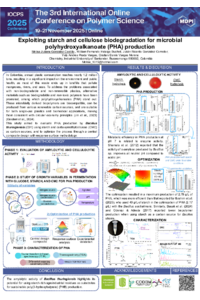
In Colombia, annual plastic consumption reaches nearly 1.2 million tons, generating a significant impact on the environment and public health, as most of this waste ends up in landfills that pollute mangroves, rivers, and seas. To address the problems associated with non-biodegradable and non-renewable plastics, alternative materials such as biodegradable and non-toxic polymers have been promoted, among which polyhydroxyalkanoates (PHA) stand out. These microbially derived biopolymers are biocompatible, can be produced from various renewable carbon sources, and are suitable for both single-use plastics and biomedical applications, making them consistent with circular economy principles.
This study aimed to evaluate PHA production by Bacillus thuringiensis (C01) using starch and carboxymethylcellulose (CMC) as carbon sources, and to optimize the process through a central composite design with response surface methodology. Initially, fermentation growth variables were assessed using glucose as a control, followed by evaluation of the experimental substrates under optimized conditions. With CMC, a PHA production of 0.09 g/L was obtained, with a yield of 49.5% (w/w). In contrast, optimization with starch (14.168 g/L starch, 3.616 g/L ammonium sulfate, yeast extract in a 1:1 ratio, and an inoculum of approximately 6×10⁸ CFU/mL) resulted in 3.71 g/L biomass and 2.78 g/L PHA, corresponding to a yield of 74.9% (w/w). These findings demonstrate the ability of Bacillus thuringiensis to degrade starch and channel it into PHA synthesis.
FTIR, TGA, DSC, and MALDI-TOF analyses confirmed that the biopolymer obtained was poly-3-hydroxybutyrate (P(3HB)). In conclusion, the amylolytic activity of Bacillus thuringiensis highlights its potential for using starch-rich agroindustrial residues as substrates for sustainable PHA production.
Keywords
Polyhydroxyalkanoates
polyhydroxybutyrate
biopolymer
optimization
Bacillus thuringiensis
starch
carboxymethylcellulose
microorganisms
Poster
POSTER-POLYMER-PHA.pdf
Technologies for obtaining new biocomposites based on polylactide with natural fillers of waste origin manufactured using the injection molding method
Utilization of Aromatic Spent from Essential Oil Industry for Production of Biodegradable Packaging Films