Event submissions
Published
This submission belongs to the session S1. Biobased, Biodegradable-compostable, and Recyclable Polymers of the event The 3rd International Online Conference on Polymer Science
Published date
17 Nov, 2025
Academic Editor
'%3e%3cpath%20d='M12.6657%2010.9104C12.4185%2010.325%2012.0599%209.79327%2011.6097%209.34482C11.1609%208.89508%2010.6293%208.5365%2010.0442%208.28888C10.0389%208.28626%2010.0337%208.28495%2010.0285%208.28233C10.8446%207.69279%2011.3752%206.73249%2011.3752%205.64904C11.3752%203.8542%209.92103%202.39999%208.1262%202.39999C6.33136%202.39999%204.87715%203.8542%204.87715%205.64904C4.87715%206.73249%205.40774%207.69279%206.22393%208.28364C6.21869%208.28626%206.21345%208.28757%206.20821%208.29019C5.62129%208.5378%205.09463%208.89284%204.64265%209.34613C4.1929%209.79493%203.83432%2010.3266%203.58671%2010.9117C3.34345%2011.4845%203.21226%2012.0987%203.20023%2012.7209C3.19988%2012.7349%203.20233%2012.7488%203.20744%2012.7619C3.21255%2012.7749%203.22022%2012.7867%203.22998%2012.7968C3.23975%2012.8068%203.25142%2012.8147%203.26431%2012.8202C3.2772%2012.8256%203.29105%2012.8284%203.30504%2012.8284H4.09109C4.14874%2012.8284%204.19459%2012.7825%204.1959%2012.7262C4.2221%2011.7148%204.62823%2010.7676%205.34617%2010.0497C6.08899%209.30683%207.0755%208.89808%208.1262%208.89808C9.17689%208.89808%2010.1634%209.30683%2010.9062%2010.0497C11.6242%2010.7676%2012.0303%2011.7148%2012.0565%2012.7262C12.0578%2012.7838%2012.1037%2012.8284%2012.1613%2012.8284H12.9474C12.9613%2012.8284%2012.9752%2012.8256%2012.9881%2012.8202C13.001%2012.8147%2013.0126%2012.8068%2013.0224%2012.7968C13.0322%2012.7867%2013.0398%2012.7749%2013.0449%2012.7619C13.0501%2012.7488%2013.0525%2012.7349%2013.0522%2012.7209C13.0391%2012.0947%2012.9094%2011.4855%2012.6657%2010.9104ZM8.1262%207.9024C7.52486%207.9024%206.9589%207.6679%206.53312%207.24211C6.10733%206.81633%205.87283%206.25037%205.87283%205.64904C5.87283%205.0477%206.10733%204.48174%206.53312%204.05596C6.9589%203.63018%207.52486%203.39567%208.1262%203.39567C8.72753%203.39567%209.29349%203.63018%209.71927%204.05596C10.1451%204.48174%2010.3796%205.0477%2010.3796%205.64904C10.3796%206.25037%2010.1451%206.81633%209.71927%207.24211C9.29349%207.6679%208.72753%207.9024%208.1262%207.9024Z'%20fill='%235D1EE1'/%3e%3c/g%3e%3c/svg%3e) Valentina Siracusa
Valentina SiracusaCitation
Solange Magalhães, Kinga Grenda, Bruno Medronho, Luís Alves, Maria da Graça Rasteiro, Biomass-Derived Flocculants for Wastewater Treatment, in Proceedings of The 3rd International Online Conference on Polymer Science, 19 November–21 November 2025, MDPI: Basel, Switzerland
Share
Email
Facebook
Twitter
LinkedIn
Biomass-Derived Flocculants for Wastewater Treatment

Solange Magalhães 1
'%3e%3cpath%20d='M12.6647%2010.9104C12.4176%2010.325%2012.0589%209.7933%2011.6088%209.34485C11.16%208.89511%2010.6283%208.53653%2010.0432%208.28891C10.038%208.28629%2010.0327%208.28498%2010.0275%208.28236C10.8437%207.69282%2011.3743%206.73252%2011.3743%205.64907C11.3743%203.85423%209.92005%202.40002%208.12522%202.40002C6.33038%202.40002%204.87618%203.85423%204.87618%205.64907C4.87618%206.73252%205.40677%207.69282%206.22296%208.28367C6.21772%208.28629%206.21248%208.2876%206.20724%208.29022C5.62031%208.53783%205.09365%208.89287%204.64167%209.34616C4.19192%209.79496%203.83334%2010.3266%203.58573%2010.9117C3.34247%2011.4846%203.21128%2012.0987%203.19925%2012.721C3.1989%2012.735%203.20135%2012.7489%203.20646%2012.7619C3.21157%2012.7749%203.21924%2012.7868%203.22901%2012.7968C3.23877%2012.8068%203.25045%2012.8148%203.26334%2012.8202C3.27623%2012.8256%203.29007%2012.8284%203.30406%2012.8284H4.09012C4.14776%2012.8284%204.19362%2012.7825%204.19493%2012.7262C4.22113%2011.7148%204.62726%2010.7676%205.34519%2010.0497C6.08802%209.30686%207.07452%208.89811%208.12522%208.89811C9.17592%208.89811%2010.1624%209.30686%2010.9052%2010.0497C11.6232%2010.7676%2012.0293%2011.7148%2012.0555%2012.7262C12.0568%2012.7839%2012.1027%2012.8284%2012.1603%2012.8284H12.9464C12.9604%2012.8284%2012.9742%2012.8256%2012.9871%2012.8202C13%2012.8148%2013.0117%2012.8068%2013.0214%2012.7968C13.0312%2012.7868%2013.0389%2012.7749%2013.044%2012.7619C13.0491%2012.7489%2013.0515%2012.735%2013.0512%2012.721C13.0381%2012.0947%2012.9084%2011.4856%2012.6647%2010.9104ZM8.12522%207.90243C7.52388%207.90243%206.95792%207.66793%206.53214%207.24215C6.10636%206.81636%205.87185%206.2504%205.87185%205.64907C5.87185%205.04773%206.10636%204.48177%206.53214%204.05599C6.95792%203.63021%207.52388%203.3957%208.12522%203.3957C8.72655%203.3957%209.29252%203.63021%209.7183%204.05599C10.1441%204.48177%2010.3786%205.04773%2010.3786%205.64907C10.3786%206.2504%2010.1441%206.81636%209.7183%207.24215C9.29252%207.66793%208.72655%207.90243%208.12522%207.90243Z'%20fill='%235D1EE1'/%3e%3c/g%3e%3c/svg%3e)
Kinga Grenda 2

Bruno Medronho 3

Luís Alves 4

Maria da Graça Rasteiro 4
1. Department of Chemical Engineering, University of Coimbra, CERES (Chemical Engineering and Renewable Resources for Sustainability), Rua Sílvio Lima, 3030-790 Coimbra, Portugal
2. Department of Chemistry and Chemical Engineering, Chalmers University of Technology Technology, Göteborg, Sweden
3. (MED) Mediterranean Institute for Agriculture, Environment and Development), CHANGE (Global Change and Sustainability Institute), Universidade do Algarve, Faculdade de Ciências e Tecnologia, Campus de Gambelas, Ed. 8, 8005-139 Faro, Portugal.
4. University of Coimbra, CERES (Chemical Engineering and Renewable Resources for Sustainability), Department of Chemical Engineering, Rua Sílvio Lima, 3030-790 Coimbra, Portugal.
Abstract
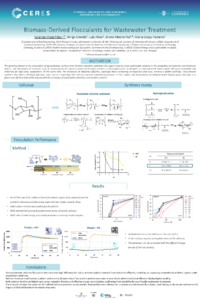
The selective extraction and recovery of different molecules of interest from lignocellulosic materials from forestry residues are increasing every day, driving society towards more sustainable approaches and materials. For this purpose, the development of new sustainable and ecologically benign extraction methodologies has grown significantly. Deep eutectic solvents (DESs) appear as a promising alternative for the processing of biomass [1, 2]. In the present study, cellulose-rich fractions obtained from the fractionation of Acacia wood, an invasive species in Portugal, were used to prepare cationic and hydrophobically modified cationic bioflocculants used for wastewater treatment with a focus on microplastics removal [3].
On the other hand, Eucalyptus bleached pulp was also used to prepare anionic and cationic bioflocculants used to treat effluents from the textile industry [4]. The bioflocculant preparation route follows a two-step process, with the introduction of reactive aldehyde groups in the cellulose molecules, followed by cationization or anionization. The hydrophobic variation was obtained by a third step, by esterification of the C6 OH groups of cellulose with fatty acids obtained from vegetable oils.
All the obtained bioflocculants revealed high performance, according to the results obtained in Laser Diffraction Spectroscopy, at the same level as or even superior to synthetic alternatives, cationic and anionic polyacrylamides, with lower environmental impact.
- Magalhães, S., et al., Enhancing Cellulose and Lignin Fractionation from Acacia Wood: Optimized Parameters Using a Deep Eutectic Solvent System and Solvent Recovery. Molecules, 2024. 29(15): p. 3495.
- Magalhães, S., et al., Acacia Wood Fractionation Using Deep Eutectic Solvents: Extraction, Recovery, and Characterization of the Different Fractions. ACS Omega, 2022. 7(30): p. 26005-26014.
- Magalhães, S., et al., Tailored cellulose-based flocculants for microplastics removal: Mechanistic insights, pH influence, and efficiency optimization. Powder Technology, 2025. 456: p. 120838.
- Grenda, K., et al., Environmentally friendly cellulose-based polyelectrolytes in wastewater treatment. Water Science and Technology, 2017. 76(6): p. 1490-1499.
Keywords
Biomass
flocculants
wastewater
environmental impact
Poster
sciforum-139324 Poster-IOCPS2025.pdf
Integrated biorefinery of Jatropha curcas L. seed: Valorization of Kernel into Biofuels and Molasses, and Seed Coat into Biopolymers and Cellulose Nanofibrils.
Polyhydroxyalkanoate Biosynthesis from Sugarcane Bagasse by Paramecium caudatum Isolated from Industrial Wastewater