Event submissions
Published
This submission belongs to the session S1. Biobased, Biodegradable-compostable, and Recyclable Polymers of the event The 3rd International Online Conference on Polymer Science
Published date
17 Nov, 2025
Academic Editor
'%3e%3cpath%20d='M12.6657%2010.9104C12.4185%2010.325%2012.0599%209.79327%2011.6097%209.34482C11.1609%208.89508%2010.6293%208.5365%2010.0442%208.28888C10.0389%208.28626%2010.0337%208.28495%2010.0285%208.28233C10.8446%207.69279%2011.3752%206.73249%2011.3752%205.64904C11.3752%203.8542%209.92103%202.39999%208.1262%202.39999C6.33136%202.39999%204.87715%203.8542%204.87715%205.64904C4.87715%206.73249%205.40774%207.69279%206.22393%208.28364C6.21869%208.28626%206.21345%208.28757%206.20821%208.29019C5.62129%208.5378%205.09463%208.89284%204.64265%209.34613C4.1929%209.79493%203.83432%2010.3266%203.58671%2010.9117C3.34345%2011.4845%203.21226%2012.0987%203.20023%2012.7209C3.19988%2012.7349%203.20233%2012.7488%203.20744%2012.7619C3.21255%2012.7749%203.22022%2012.7867%203.22998%2012.7968C3.23975%2012.8068%203.25142%2012.8147%203.26431%2012.8202C3.2772%2012.8256%203.29105%2012.8284%203.30504%2012.8284H4.09109C4.14874%2012.8284%204.19459%2012.7825%204.1959%2012.7262C4.2221%2011.7148%204.62823%2010.7676%205.34617%2010.0497C6.08899%209.30683%207.0755%208.89808%208.1262%208.89808C9.17689%208.89808%2010.1634%209.30683%2010.9062%2010.0497C11.6242%2010.7676%2012.0303%2011.7148%2012.0565%2012.7262C12.0578%2012.7838%2012.1037%2012.8284%2012.1613%2012.8284H12.9474C12.9613%2012.8284%2012.9752%2012.8256%2012.9881%2012.8202C13.001%2012.8147%2013.0126%2012.8068%2013.0224%2012.7968C13.0322%2012.7867%2013.0398%2012.7749%2013.0449%2012.7619C13.0501%2012.7488%2013.0525%2012.7349%2013.0522%2012.7209C13.0391%2012.0947%2012.9094%2011.4855%2012.6657%2010.9104ZM8.1262%207.9024C7.52486%207.9024%206.9589%207.6679%206.53312%207.24211C6.10733%206.81633%205.87283%206.25037%205.87283%205.64904C5.87283%205.0477%206.10733%204.48174%206.53312%204.05596C6.9589%203.63018%207.52486%203.39567%208.1262%203.39567C8.72753%203.39567%209.29349%203.63018%209.71927%204.05596C10.1451%204.48174%2010.3796%205.0477%2010.3796%205.64904C10.3796%206.25037%2010.1451%206.81633%209.71927%207.24211C9.29349%207.6679%208.72753%207.9024%208.1262%207.9024Z'%20fill='%235D1EE1'/%3e%3c/g%3e%3c/svg%3e) Valentina Siracusa
Valentina SiracusaCitation
Amanda Cunha, José Barreto, Nicole Soares, Ingridy D. S. Silva, Carlos Luna, Edcleide Araújo, Renate Wellen, Tin-Catalysed vs Non-Catalysed Curing of Epoxidized Soybean Oil: Insights from Isoconversional Analysis, in Proceedings of The 3rd International Online Conference on Polymer Science, 19 November–21 November 2025, MDPI: Basel, Switzerland
Share
Email
Facebook
Twitter
LinkedIn
Tin-Catalysed vs Non-Catalysed Curing of Epoxidized Soybean Oil: Insights from Isoconversional Analysis
'%3e%3cpath%20d='M12.6647%2010.9104C12.4176%2010.325%2012.0589%209.7933%2011.6088%209.34485C11.16%208.89511%2010.6283%208.53653%2010.0432%208.28891C10.038%208.28629%2010.0327%208.28498%2010.0275%208.28236C10.8437%207.69282%2011.3743%206.73252%2011.3743%205.64907C11.3743%203.85423%209.92005%202.40002%208.12522%202.40002C6.33038%202.40002%204.87618%203.85423%204.87618%205.64907C4.87618%206.73252%205.40677%207.69282%206.22296%208.28367C6.21772%208.28629%206.21248%208.2876%206.20724%208.29022C5.62031%208.53783%205.09365%208.89287%204.64167%209.34616C4.19192%209.79496%203.83334%2010.3266%203.58573%2010.9117C3.34247%2011.4846%203.21128%2012.0987%203.19925%2012.721C3.1989%2012.735%203.20135%2012.7489%203.20646%2012.7619C3.21157%2012.7749%203.21924%2012.7868%203.22901%2012.7968C3.23877%2012.8068%203.25045%2012.8148%203.26334%2012.8202C3.27623%2012.8256%203.29007%2012.8284%203.30406%2012.8284H4.09012C4.14776%2012.8284%204.19362%2012.7825%204.19493%2012.7262C4.22113%2011.7148%204.62726%2010.7676%205.34519%2010.0497C6.08802%209.30686%207.07452%208.89811%208.12522%208.89811C9.17592%208.89811%2010.1624%209.30686%2010.9052%2010.0497C11.6232%2010.7676%2012.0293%2011.7148%2012.0555%2012.7262C12.0568%2012.7839%2012.1027%2012.8284%2012.1603%2012.8284H12.9464C12.9604%2012.8284%2012.9742%2012.8256%2012.9871%2012.8202C13%2012.8148%2013.0117%2012.8068%2013.0214%2012.7968C13.0312%2012.7868%2013.0389%2012.7749%2013.044%2012.7619C13.0491%2012.7489%2013.0515%2012.735%2013.0512%2012.721C13.0381%2012.0947%2012.9084%2011.4856%2012.6647%2010.9104ZM8.12522%207.90243C7.52388%207.90243%206.95792%207.66793%206.53214%207.24215C6.10636%206.81636%205.87185%206.2504%205.87185%205.64907C5.87185%205.04773%206.10636%204.48177%206.53214%204.05599C6.95792%203.63021%207.52388%203.3957%208.12522%203.3957C8.72655%203.3957%209.29252%203.63021%209.7183%204.05599C10.1441%204.48177%2010.3786%205.04773%2010.3786%205.64907C10.3786%206.2504%2010.1441%206.81636%209.7183%207.24215C9.29252%207.66793%208.72655%207.90243%208.12522%207.90243Z'%20fill='%235D1EE1'/%3e%3c/g%3e%3c/svg%3e)
Amanda Cunha 1
José Barreto 2
Nicole Soares 2
Ingridy D. S. Silva 2
Carlos Luna 1
Edcleide Araújo 1

Renate Wellen 1,2
1. Academic Unit of Materials Engineering, Campus I, Federal University of Campina Grande (UFCG), Campina Grande, 58429-900, PB, Brazil
2. Materials Engineering Department, Campus I, Federal University of Paraíba (UFPB), João Pessoa, 58051-900, PB, Brazil
Abstract
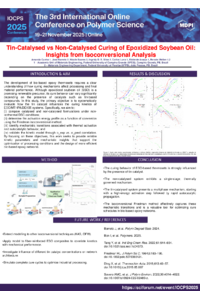
The pursuit of sustainable polymeric materials has driven the development of epoxy systems derived from renewable sources, such as epoxidized soybean oil (ESO). Understanding their curing kinetics is essential for process control and optimisation of final properties. In this study, the curing behaviour of ESO/MTHPA/DEH 35 (epoxidized soybean oil/methyl tetrahydrophthalic anhydride/2,4,6-tris(dimethylaminomethyl) phenol) systems—with and without a tin-based catalyst (Tin) (Tin(II) 2-ethylhexanoate)—was evaluated using the isoconversional Friedman method. Samples were analysed via Differential Scanning Calorimetry (DSC) at heating rates of 5, 10, and 20 °C/min. Data were processed using the differential form of the conversion equation (α) to obtain the apparent activation energy (Ea) as a function of conversion. Model validation was achieved by comparing experimental and calculated conversion values (αexp vs αprev), and by linear regressions of ln(dα/dt) versus 1000/T. The Friedman model adequately described the kinetic behaviour of both systems. The Tin-containing formulation started curing at higher temperatures (~140–150 °C), indicating a greater initial energy barrier. The Ea(α) curve showed high values (~80 kJ/mol) for α < 0.2, attributed to the formation of high-energy catalytic complexes. For α > 0.2, a sharp decrease in Ea (< 20 kJ/mol) indicated the onset of autocatalytic propagation. In contrast, the system without Tin exhibited stable Ea values (~45–55 kJ/mol), suggesting a more homogeneous and thermally controlled process. Regression coefficients (R² > 0.98) and sigmoid fits (deviation < ±10%) confirmed the model’s validity. Overall, the Friedman method proved effective for describing the curing kinetics of these bio-based epoxy systems. The presence of Tin led to a multifaceted and accelerated curing mechanism, while its absence resulted in a simpler, thermally governed process with lower chemical complexity.
Keywords
bio-based epoxy resins
curing kinetics
epoxidized soybean oil (ESO)
Friedman isoconversional method
Poster
sciforum-138569 Amanda Cunha- IOPS.pdf
Polyhydroxyalkanoate Biosynthesis from Sugarcane Bagasse by Paramecium caudatum Isolated from Industrial Wastewater
Design and Optimization of Electrostatically Assembled Protein–Polysaccharide Nanostructures for Nutrient and Drug Delivery Systems