Event submissions
Published
This submission belongs to the session S1. Biobased, Biodegradable-compostable, and Recyclable Polymers of the event The 3rd International Online Conference on Polymer Science
Published date
17 Nov, 2025
Academic Editor
'%3e%3cpath%20d='M12.6657%2010.9104C12.4185%2010.325%2012.0599%209.79327%2011.6097%209.34482C11.1609%208.89508%2010.6293%208.5365%2010.0442%208.28888C10.0389%208.28626%2010.0337%208.28495%2010.0285%208.28233C10.8446%207.69279%2011.3752%206.73249%2011.3752%205.64904C11.3752%203.8542%209.92103%202.39999%208.1262%202.39999C6.33136%202.39999%204.87715%203.8542%204.87715%205.64904C4.87715%206.73249%205.40774%207.69279%206.22393%208.28364C6.21869%208.28626%206.21345%208.28757%206.20821%208.29019C5.62129%208.5378%205.09463%208.89284%204.64265%209.34613C4.1929%209.79493%203.83432%2010.3266%203.58671%2010.9117C3.34345%2011.4845%203.21226%2012.0987%203.20023%2012.7209C3.19988%2012.7349%203.20233%2012.7488%203.20744%2012.7619C3.21255%2012.7749%203.22022%2012.7867%203.22998%2012.7968C3.23975%2012.8068%203.25142%2012.8147%203.26431%2012.8202C3.2772%2012.8256%203.29105%2012.8284%203.30504%2012.8284H4.09109C4.14874%2012.8284%204.19459%2012.7825%204.1959%2012.7262C4.2221%2011.7148%204.62823%2010.7676%205.34617%2010.0497C6.08899%209.30683%207.0755%208.89808%208.1262%208.89808C9.17689%208.89808%2010.1634%209.30683%2010.9062%2010.0497C11.6242%2010.7676%2012.0303%2011.7148%2012.0565%2012.7262C12.0578%2012.7838%2012.1037%2012.8284%2012.1613%2012.8284H12.9474C12.9613%2012.8284%2012.9752%2012.8256%2012.9881%2012.8202C13.001%2012.8147%2013.0126%2012.8068%2013.0224%2012.7968C13.0322%2012.7867%2013.0398%2012.7749%2013.0449%2012.7619C13.0501%2012.7488%2013.0525%2012.7349%2013.0522%2012.7209C13.0391%2012.0947%2012.9094%2011.4855%2012.6657%2010.9104ZM8.1262%207.9024C7.52486%207.9024%206.9589%207.6679%206.53312%207.24211C6.10733%206.81633%205.87283%206.25037%205.87283%205.64904C5.87283%205.0477%206.10733%204.48174%206.53312%204.05596C6.9589%203.63018%207.52486%203.39567%208.1262%203.39567C8.72753%203.39567%209.29349%203.63018%209.71927%204.05596C10.1451%204.48174%2010.3796%205.0477%2010.3796%205.64904C10.3796%206.25037%2010.1451%206.81633%209.71927%207.24211C9.29349%207.6679%208.72753%207.9024%208.1262%207.9024Z'%20fill='%235D1EE1'/%3e%3c/g%3e%3c/svg%3e) Valentina Siracusa
Valentina SiracusaCitation
Aristeidis Papagiannopoulos, Design and Optimization of Electrostatically Assembled Protein–Polysaccharide Nanostructures for Nutrient and Drug Delivery Systems, in Proceedings of The 3rd International Online Conference on Polymer Science, 19 November–21 November 2025, MDPI: Basel, Switzerland
Share
Email
Facebook
Twitter
LinkedIn
Design and Optimization of Electrostatically Assembled Protein–Polysaccharide Nanostructures for Nutrient and Drug Delivery Systems

Aristeidis Papagiannopoulos 1
1. Theoretical and Physical Chemistry Institute, National Hellenic Research Foundation, Athens 11635, Greece.
Abstract
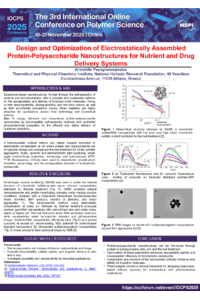
Biopolymer-based nanostructures, derived from the self-assembly of proteins and polysaccharides, represent a versatile and sustainable platform for the delivery of bioactive small molecules. Their inherent biocompatibility, biodegradability, nontoxicity, and eco-friendly and sustainable preparation make them ideal candidates for applications in both food technology and biomedicine.
Through light scattering, small-angle scattering, microscopy, and spectroscopy techniques, we investigate the formation and morphology of the protein–polysaccharide nanostructures and the binding, loading capacity, and stability of hydrophobic compounds.
We present our recent works in the preparation and characterization of protein/polysaccharide nanoparticles formed through electrostatic complexation and thermal treatment, using proteins such as bovine serum albumin, trypsin, and hemoglobin and polysaccharides such as chondroitin sulfate, xanthan, and hyaluronic acid. Particular emphasis is placed on the interactions of these nanostructures with low-molecular-weight compounds, including the model nutraceuticals β-carotene and curcumin. The role of nanoparticle composition and structure in modulating the affinity for hydrophobic and amphiphilic molecules is explored.
Our results suggest that fine-tuning the protein-to-polysaccharide ratio, pH, and thermal treatment parameters can optimize nanocarrier stability and small molecule encapsulation. These findings contribute to the rational design of biopolymer-based delivery systems and demonstrate their potential for targeted release of functional compounds in nutraceutical and pharmaceutical formulations.
Keywords
biopolymers
self-assembly
fluorescence spectroscopy
renewable polymers
protein denaturation
electrostatic complexation
Poster
Papag_Poster.pdf
Tin-Catalysed vs Non-Catalysed Curing of Epoxidized Soybean Oil: Insights from Isoconversional Analysis
Pine Bark as a Renewable Feedstock for the Production of Rigid Polyurethane Foam