Event submissions
Published
This submission belongs to the session S1. Biobased, Biodegradable-compostable, and Recyclable Polymers of the event The 3rd International Online Conference on Polymer Science
Published date
17 Nov, 2025
Academic Editor
'%3e%3cpath%20d='M12.6657%2010.9104C12.4185%2010.325%2012.0599%209.79327%2011.6097%209.34482C11.1609%208.89508%2010.6293%208.5365%2010.0442%208.28888C10.0389%208.28626%2010.0337%208.28495%2010.0285%208.28233C10.8446%207.69279%2011.3752%206.73249%2011.3752%205.64904C11.3752%203.8542%209.92103%202.39999%208.1262%202.39999C6.33136%202.39999%204.87715%203.8542%204.87715%205.64904C4.87715%206.73249%205.40774%207.69279%206.22393%208.28364C6.21869%208.28626%206.21345%208.28757%206.20821%208.29019C5.62129%208.5378%205.09463%208.89284%204.64265%209.34613C4.1929%209.79493%203.83432%2010.3266%203.58671%2010.9117C3.34345%2011.4845%203.21226%2012.0987%203.20023%2012.7209C3.19988%2012.7349%203.20233%2012.7488%203.20744%2012.7619C3.21255%2012.7749%203.22022%2012.7867%203.22998%2012.7968C3.23975%2012.8068%203.25142%2012.8147%203.26431%2012.8202C3.2772%2012.8256%203.29105%2012.8284%203.30504%2012.8284H4.09109C4.14874%2012.8284%204.19459%2012.7825%204.1959%2012.7262C4.2221%2011.7148%204.62823%2010.7676%205.34617%2010.0497C6.08899%209.30683%207.0755%208.89808%208.1262%208.89808C9.17689%208.89808%2010.1634%209.30683%2010.9062%2010.0497C11.6242%2010.7676%2012.0303%2011.7148%2012.0565%2012.7262C12.0578%2012.7838%2012.1037%2012.8284%2012.1613%2012.8284H12.9474C12.9613%2012.8284%2012.9752%2012.8256%2012.9881%2012.8202C13.001%2012.8147%2013.0126%2012.8068%2013.0224%2012.7968C13.0322%2012.7867%2013.0398%2012.7749%2013.0449%2012.7619C13.0501%2012.7488%2013.0525%2012.7349%2013.0522%2012.7209C13.0391%2012.0947%2012.9094%2011.4855%2012.6657%2010.9104ZM8.1262%207.9024C7.52486%207.9024%206.9589%207.6679%206.53312%207.24211C6.10733%206.81633%205.87283%206.25037%205.87283%205.64904C5.87283%205.0477%206.10733%204.48174%206.53312%204.05596C6.9589%203.63018%207.52486%203.39567%208.1262%203.39567C8.72753%203.39567%209.29349%203.63018%209.71927%204.05596C10.1451%204.48174%2010.3796%205.0477%2010.3796%205.64904C10.3796%206.25037%2010.1451%206.81633%209.71927%207.24211C9.29349%207.6679%208.72753%207.9024%208.1262%207.9024Z'%20fill='%235D1EE1'/%3e%3c/g%3e%3c/svg%3e) Valentina Siracusa
Valentina SiracusaCitation
Karen Gutiérrez-Silva, Maria Camila Arango, José D Badia, Rafael Ballesteros-Garrido, Josep Pasqual Cerisuelo, Amparo Cháfer, Solvolytic Depolymerization of PA6 from Marine Waste Using Structurally Diverse Deep Eutectic Solvents, in Proceedings of The 3rd International Online Conference on Polymer Science, 19 November–21 November 2025, MDPI: Basel, Switzerland
Share
Email
Facebook
Twitter
LinkedIn
Solvolytic Depolymerization of PA6 from Marine Waste Using Structurally Diverse Deep Eutectic Solvents

Karen Gutiérrez-Silva 1
'%3e%3cpath%20d='M12.6647%2010.9104C12.4176%2010.325%2012.0589%209.7933%2011.6088%209.34485C11.16%208.89511%2010.6283%208.53653%2010.0432%208.28891C10.038%208.28629%2010.0327%208.28498%2010.0275%208.28236C10.8437%207.69282%2011.3743%206.73252%2011.3743%205.64907C11.3743%203.85423%209.92005%202.40002%208.12522%202.40002C6.33038%202.40002%204.87618%203.85423%204.87618%205.64907C4.87618%206.73252%205.40677%207.69282%206.22296%208.28367C6.21772%208.28629%206.21248%208.2876%206.20724%208.29022C5.62031%208.53783%205.09365%208.89287%204.64167%209.34616C4.19192%209.79496%203.83334%2010.3266%203.58573%2010.9117C3.34247%2011.4846%203.21128%2012.0987%203.19925%2012.721C3.1989%2012.735%203.20135%2012.7489%203.20646%2012.7619C3.21157%2012.7749%203.21924%2012.7868%203.22901%2012.7968C3.23877%2012.8068%203.25045%2012.8148%203.26334%2012.8202C3.27623%2012.8256%203.29007%2012.8284%203.30406%2012.8284H4.09012C4.14776%2012.8284%204.19362%2012.7825%204.19493%2012.7262C4.22113%2011.7148%204.62726%2010.7676%205.34519%2010.0497C6.08802%209.30686%207.07452%208.89811%208.12522%208.89811C9.17592%208.89811%2010.1624%209.30686%2010.9052%2010.0497C11.6232%2010.7676%2012.0293%2011.7148%2012.0555%2012.7262C12.0568%2012.7839%2012.1027%2012.8284%2012.1603%2012.8284H12.9464C12.9604%2012.8284%2012.9742%2012.8256%2012.9871%2012.8202C13%2012.8148%2013.0117%2012.8068%2013.0214%2012.7968C13.0312%2012.7868%2013.0389%2012.7749%2013.044%2012.7619C13.0491%2012.7489%2013.0515%2012.735%2013.0512%2012.721C13.0381%2012.0947%2012.9084%2011.4856%2012.6647%2010.9104ZM8.12522%207.90243C7.52388%207.90243%206.95792%207.66793%206.53214%207.24215C6.10636%206.81636%205.87185%206.2504%205.87185%205.64907C5.87185%205.04773%206.10636%204.48177%206.53214%204.05599C6.95792%203.63021%207.52388%203.3957%208.12522%203.3957C8.72655%203.3957%209.29252%203.63021%209.7183%204.05599C10.1441%204.48177%2010.3786%205.04773%2010.3786%205.64907C10.3786%206.2504%2010.1441%206.81636%209.7183%207.24215C9.29252%207.66793%208.72655%207.90243%208.12522%207.90243Z'%20fill='%235D1EE1'/%3e%3c/g%3e%3c/svg%3e)
Maria Camila Arango 1

José D Badia 1
Rafael Ballesteros-Garrido 2
Josep Pasqual Cerisuelo 1

Amparo Cháfer 1
1. Research Group in Materials Technology and Sustainability (MATS), Department of Chemical Engineering, School of Engineering, Universitat de València, Av. Universitat s/n, Burjassot, Valencia 46100, Spain
2. Department of Organic Chemistry, Universitat de València, C/ Dr Moliner 50, Burjassot, Valencia 46100, Spain
Abstract
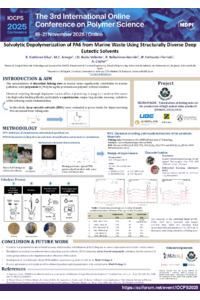
The accumulation of discarded fishing nets in coastal zones significantly contributes to marine pollution, with polyamide 6 (PA6) being the predominant polymer in these residues 1. Chemical recycling through depolymerization offers a promising strategy to transform this waste into high-value building blocks, particularly ε-caprolactam, supporting circular economy initiatives while reducing ocean contamination.
Neoteric solvents have the potential to act as catalytic cosolvents for other purposes 2. In this study, deep eutectic solvents (DESs) were evaluated as green media for depolymerizing PA6 recovered from fishing nets. The tested DESs included choline chloride (ChCl)/urea, ChCl/glycerol, ChCl/monoethanolamine (MEA), and ChCl/diethanolamine (DEA) under mild conditions (160–180°C). The catalytic effects of 4-(dimethylamino)pyridine (DMAP), solvolysis time, and the reaction system were investigated to determine their effectiveness in promoting depolymerization. After solvolysis, the crude reaction mixture was filtered to assess conversion, and attenuated total reflectance Fourier-transform infrared (ATR-FTIR) spectroscopy was used to monitor the depolymerization process by identifying the functional groups associated with PA6 chain cleavage.
Although several DESs facilitated polymer dissolution, those containing MEA and DEA exhibited significantly higher depolymerization efficiencies. This enhanced performance was attributed to their dual function, acting not only as solvents but also as nucleophilic agents capable of attacking amide bonds, thereby promoting solvolysis reactions under the tested conditions. The findings of this screening enable the selection of MEA- and DEA-ChCl-based DESs as the most promising candidates for subsequent optimization through experimental design. This approach will contribute to advancing chemical recycling pathways for fishing net waste by enabling the recovery of high-value building blocks for future production of new polyamides and advanced materials, thus supporting environmental sustainability while generating added value within the polymer recycling chain.
Keywords
Deep eutectic solvents
PA6
solvolytic depolymerization
chemical recycling
Fishing Nets
Poster
sciforum-138510.pdf
Effects of long exposure to dielectric barrier discharge on commercial blend films of poly(butylene adipate-co-terephthalate) (PBAT) and thermoplastic starch (TPS)
Recyclable, degradable and high-performance bio-based vinylogous urethane vitrimers