Event submissions
Published
This submission belongs to the session S3. Recent Functional and Structural Applications of Polymer Systems of the event The 3rd International Online Conference on Polymer Science
Published date
17 Nov, 2025
Academic Editor
'%3e%3cpath%20d='M12.6657%2010.9104C12.4185%2010.325%2012.0599%209.79327%2011.6097%209.34482C11.1609%208.89508%2010.6293%208.5365%2010.0442%208.28888C10.0389%208.28626%2010.0337%208.28495%2010.0285%208.28233C10.8446%207.69279%2011.3752%206.73249%2011.3752%205.64904C11.3752%203.8542%209.92103%202.39999%208.1262%202.39999C6.33136%202.39999%204.87715%203.8542%204.87715%205.64904C4.87715%206.73249%205.40774%207.69279%206.22393%208.28364C6.21869%208.28626%206.21345%208.28757%206.20821%208.29019C5.62129%208.5378%205.09463%208.89284%204.64265%209.34613C4.1929%209.79493%203.83432%2010.3266%203.58671%2010.9117C3.34345%2011.4845%203.21226%2012.0987%203.20023%2012.7209C3.19988%2012.7349%203.20233%2012.7488%203.20744%2012.7619C3.21255%2012.7749%203.22022%2012.7867%203.22998%2012.7968C3.23975%2012.8068%203.25142%2012.8147%203.26431%2012.8202C3.2772%2012.8256%203.29105%2012.8284%203.30504%2012.8284H4.09109C4.14874%2012.8284%204.19459%2012.7825%204.1959%2012.7262C4.2221%2011.7148%204.62823%2010.7676%205.34617%2010.0497C6.08899%209.30683%207.0755%208.89808%208.1262%208.89808C9.17689%208.89808%2010.1634%209.30683%2010.9062%2010.0497C11.6242%2010.7676%2012.0303%2011.7148%2012.0565%2012.7262C12.0578%2012.7838%2012.1037%2012.8284%2012.1613%2012.8284H12.9474C12.9613%2012.8284%2012.9752%2012.8256%2012.9881%2012.8202C13.001%2012.8147%2013.0126%2012.8068%2013.0224%2012.7968C13.0322%2012.7867%2013.0398%2012.7749%2013.0449%2012.7619C13.0501%2012.7488%2013.0525%2012.7349%2013.0522%2012.7209C13.0391%2012.0947%2012.9094%2011.4855%2012.6657%2010.9104ZM8.1262%207.9024C7.52486%207.9024%206.9589%207.6679%206.53312%207.24211C6.10733%206.81633%205.87283%206.25037%205.87283%205.64904C5.87283%205.0477%206.10733%204.48174%206.53312%204.05596C6.9589%203.63018%207.52486%203.39567%208.1262%203.39567C8.72753%203.39567%209.29349%203.63018%209.71927%204.05596C10.1451%204.48174%2010.3796%205.0477%2010.3796%205.64904C10.3796%206.25037%2010.1451%206.81633%209.71927%207.24211C9.29349%207.6679%208.72753%207.9024%208.1262%207.9024Z'%20fill='%235D1EE1'/%3e%3c/g%3e%3c/svg%3e) Mazeyar Parvinzadeh Gashti
Mazeyar Parvinzadeh GashtiCitation
Carolina Muñoz-Núñez, Alexandra Muñoz-Bonilla, Marta Fernández-García, Bioactive Chitosan Films via Methylimidazole Functionalization: Antimicrobial and Antioxidant Enhancement, in Proceedings of The 3rd International Online Conference on Polymer Science, 19 November–21 November 2025, MDPI: Basel, Switzerland
Share
Email
Facebook
Twitter
LinkedIn
Bioactive Chitosan Films via Methylimidazole Functionalization: Antimicrobial and Antioxidant Enhancement
'%3e%3cpath%20d='M12.6647%2010.9104C12.4176%2010.325%2012.0589%209.7933%2011.6088%209.34485C11.16%208.89511%2010.6283%208.53653%2010.0432%208.28891C10.038%208.28629%2010.0327%208.28498%2010.0275%208.28236C10.8437%207.69282%2011.3743%206.73252%2011.3743%205.64907C11.3743%203.85423%209.92005%202.40002%208.12522%202.40002C6.33038%202.40002%204.87618%203.85423%204.87618%205.64907C4.87618%206.73252%205.40677%207.69282%206.22296%208.28367C6.21772%208.28629%206.21248%208.2876%206.20724%208.29022C5.62031%208.53783%205.09365%208.89287%204.64167%209.34616C4.19192%209.79496%203.83334%2010.3266%203.58573%2010.9117C3.34247%2011.4846%203.21128%2012.0987%203.19925%2012.721C3.1989%2012.735%203.20135%2012.7489%203.20646%2012.7619C3.21157%2012.7749%203.21924%2012.7868%203.22901%2012.7968C3.23877%2012.8068%203.25045%2012.8148%203.26334%2012.8202C3.27623%2012.8256%203.29007%2012.8284%203.30406%2012.8284H4.09012C4.14776%2012.8284%204.19362%2012.7825%204.19493%2012.7262C4.22113%2011.7148%204.62726%2010.7676%205.34519%2010.0497C6.08802%209.30686%207.07452%208.89811%208.12522%208.89811C9.17592%208.89811%2010.1624%209.30686%2010.9052%2010.0497C11.6232%2010.7676%2012.0293%2011.7148%2012.0555%2012.7262C12.0568%2012.7839%2012.1027%2012.8284%2012.1603%2012.8284H12.9464C12.9604%2012.8284%2012.9742%2012.8256%2012.9871%2012.8202C13%2012.8148%2013.0117%2012.8068%2013.0214%2012.7968C13.0312%2012.7868%2013.0389%2012.7749%2013.044%2012.7619C13.0491%2012.7489%2013.0515%2012.735%2013.0512%2012.721C13.0381%2012.0947%2012.9084%2011.4856%2012.6647%2010.9104ZM8.12522%207.90243C7.52388%207.90243%206.95792%207.66793%206.53214%207.24215C6.10636%206.81636%205.87185%206.2504%205.87185%205.64907C5.87185%205.04773%206.10636%204.48177%206.53214%204.05599C6.95792%203.63021%207.52388%203.3957%208.12522%203.3957C8.72655%203.3957%209.29252%203.63021%209.7183%204.05599C10.1441%204.48177%2010.3786%205.04773%2010.3786%205.64907C10.3786%206.2504%2010.1441%206.81636%209.7183%207.24215C9.29252%207.66793%208.72655%207.90243%208.12522%207.90243Z'%20fill='%235D1EE1'/%3e%3c/g%3e%3c/svg%3e)
Carolina Muñoz-Núñez 1

Alexandra Muñoz-Bonilla 1

Marta Fernández-García 1
1. Institute of Polymer Science and Technology (ICTP-CSIC), Madrid 28006, Spain
Abstract
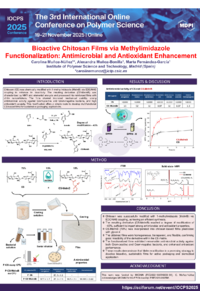
Chitosan (CS) is a biocompatible and biodegradable polysaccharide with high potential for functional material development, especially in the design of active films for biomedical or packaging applications. However, its limited solubility and moderate bioactivity restrict the applicability. In this study, a novel CS derivative was synthesized via N-acylation using 1-methylimidazole (MeIm), aiming to enhance the intrinsic antimicrobial and antioxidant properties of this native polymer. An acidic group was added into MeIm (MeImB) and then, the functionalization with the polymer was performed under aqueous conditions employing an EDC/NHS coupling, targeting the primary amino groups of CS to introduce the imidazole ring moieties covalently. Structural characterization of the modified polymer (CS-MeImB) was performed by solid state NMR and elemental analysis, confirming successful functionalization
The resulting derivative (CS-MeImB) was processed into thin CS based films by solvent casting in acidic aqueous media, and using glycerol as plasticizer. In addition, a chitin nanowhiskers (Nw) were prepared and added to reinforce these films. The characterization of these Nw and the resulting films was performed by thermogravimetric analysis (TGA) and X-ray diffraction analysis (DRX), confirming successful integration, while mechanical tests showed good flexibility and improved stability.
The incorporation of the MeIm group significantly enhanced the bioactivity of the films. Antimicrobial assays demonstrated strong inhibition against both Gram-positive (Staphylococcus aureus, Enterococcus faecalis) and Gram-negative (Escherichia coli, Pseudomonas aeruginosa) bacteria. Moreover, antioxidant activity evaluated via DPPH assay revealed a notable radical scavenging ability, which was markedly higher than that of native chitosan, reaching complete inhibition at lower concentrations.
These results suggest that the integration of 1-methylimidazole into the CS matrix is a promising strategy to create multifunctional biopolymer films with improved production for sustainable applications in food packaging requiring antimicrobial and antioxidant activity.
Keywords
chitosan
antimicrobial
films
antioxidant
imidazole
Poster
Carolina Muñoz IOCPS.pdf
Catalyst-free synthesis of high-strength, reprocessable, degradable, and shape memory biobased Poly(β-hydroxyurethane)s