Event submissions
Published
 10.3390/ecsoc-29-27163 (registering DOI)
 This submission belongs to the session S1. General Organic Synthesis of the event The 29th International Electronic Conference on Synthetic Organic Chemistry
Published date
18 Nov, 2025
Academic Editor
'%3e%3cpath%20d='M12.6657%2010.9104C12.4185%2010.325%2012.0599%209.79327%2011.6097%209.34482C11.1609%208.89508%2010.6293%208.5365%2010.0442%208.28888C10.0389%208.28626%2010.0337%208.28495%2010.0285%208.28233C10.8446%207.69279%2011.3752%206.73249%2011.3752%205.64904C11.3752%203.8542%209.92103%202.39999%208.1262%202.39999C6.33136%202.39999%204.87715%203.8542%204.87715%205.64904C4.87715%206.73249%205.40774%207.69279%206.22393%208.28364C6.21869%208.28626%206.21345%208.28757%206.20821%208.29019C5.62129%208.5378%205.09463%208.89284%204.64265%209.34613C4.1929%209.79493%203.83432%2010.3266%203.58671%2010.9117C3.34345%2011.4845%203.21226%2012.0987%203.20023%2012.7209C3.19988%2012.7349%203.20233%2012.7488%203.20744%2012.7619C3.21255%2012.7749%203.22022%2012.7867%203.22998%2012.7968C3.23975%2012.8068%203.25142%2012.8147%203.26431%2012.8202C3.2772%2012.8256%203.29105%2012.8284%203.30504%2012.8284H4.09109C4.14874%2012.8284%204.19459%2012.7825%204.1959%2012.7262C4.2221%2011.7148%204.62823%2010.7676%205.34617%2010.0497C6.08899%209.30683%207.0755%208.89808%208.1262%208.89808C9.17689%208.89808%2010.1634%209.30683%2010.9062%2010.0497C11.6242%2010.7676%2012.0303%2011.7148%2012.0565%2012.7262C12.0578%2012.7838%2012.1037%2012.8284%2012.1613%2012.8284H12.9474C12.9613%2012.8284%2012.9752%2012.8256%2012.9881%2012.8202C13.001%2012.8147%2013.0126%2012.8068%2013.0224%2012.7968C13.0322%2012.7867%2013.0398%2012.7749%2013.0449%2012.7619C13.0501%2012.7488%2013.0525%2012.7349%2013.0522%2012.7209C13.0391%2012.0947%2012.9094%2011.4855%2012.6657%2010.9104ZM8.1262%207.9024C7.52486%207.9024%206.9589%207.6679%206.53312%207.24211C6.10733%206.81633%205.87283%206.25037%205.87283%205.64904C5.87283%205.0477%206.10733%204.48174%206.53312%204.05596C6.9589%203.63018%207.52486%203.39567%208.1262%203.39567C8.72753%203.39567%209.29349%203.63018%209.71927%204.05596C10.1451%204.48174%2010.3796%205.0477%2010.3796%205.64904C10.3796%206.25037%2010.1451%206.81633%209.71927%207.24211C9.29349%207.6679%208.72753%207.9024%208.1262%207.9024Z'%20fill='%235D1EE1'/%3e%3c/g%3e%3c/svg%3e) Julio A. Seijas
Julio A. SeijasCitation
Namrata Sanjay Gaidhane, B. K. Magar, D. W. Shinde, J. N. Sangshetti, Design, Synthesis, molecular docking and biological evaluation of some novel 1,2,3,4-tetrahydropyrimidine-2-(1H)-ones (DHPMs) analogues: Antibacterial, antifungal and antioxidant activity., in Proceedings of The 29th International Electronic Conference on Synthetic Organic Chemistry, 14 November–28 November 2025, MDPI: Basel, Switzerland, doi: 10.3390/ecsoc-29-27163
Share
Email
Facebook
Twitter
LinkedIn
Design, Synthesis, molecular docking and biological evaluation of some novel 1,2,3,4-tetrahydropyrimidine-2-(1H)-ones (DHPMs) analogues: Antibacterial, antifungal and antioxidant activity.
'%3e%3cpath%20d='M12.6647%2010.9104C12.4176%2010.325%2012.0589%209.7933%2011.6088%209.34485C11.16%208.89511%2010.6283%208.53653%2010.0432%208.28891C10.038%208.28629%2010.0327%208.28498%2010.0275%208.28236C10.8437%207.69282%2011.3743%206.73252%2011.3743%205.64907C11.3743%203.85423%209.92005%202.40002%208.12522%202.40002C6.33038%202.40002%204.87618%203.85423%204.87618%205.64907C4.87618%206.73252%205.40677%207.69282%206.22296%208.28367C6.21772%208.28629%206.21248%208.2876%206.20724%208.29022C5.62031%208.53783%205.09365%208.89287%204.64167%209.34616C4.19192%209.79496%203.83334%2010.3266%203.58573%2010.9117C3.34247%2011.4846%203.21128%2012.0987%203.19925%2012.721C3.1989%2012.735%203.20135%2012.7489%203.20646%2012.7619C3.21157%2012.7749%203.21924%2012.7868%203.22901%2012.7968C3.23877%2012.8068%203.25045%2012.8148%203.26334%2012.8202C3.27623%2012.8256%203.29007%2012.8284%203.30406%2012.8284H4.09012C4.14776%2012.8284%204.19362%2012.7825%204.19493%2012.7262C4.22113%2011.7148%204.62726%2010.7676%205.34519%2010.0497C6.08802%209.30686%207.07452%208.89811%208.12522%208.89811C9.17592%208.89811%2010.1624%209.30686%2010.9052%2010.0497C11.6232%2010.7676%2012.0293%2011.7148%2012.0555%2012.7262C12.0568%2012.7839%2012.1027%2012.8284%2012.1603%2012.8284H12.9464C12.9604%2012.8284%2012.9742%2012.8256%2012.9871%2012.8202C13%2012.8148%2013.0117%2012.8068%2013.0214%2012.7968C13.0312%2012.7868%2013.0389%2012.7749%2013.044%2012.7619C13.0491%2012.7489%2013.0515%2012.735%2013.0512%2012.721C13.0381%2012.0947%2012.9084%2011.4856%2012.6647%2010.9104ZM8.12522%207.90243C7.52388%207.90243%206.95792%207.66793%206.53214%207.24215C6.10636%206.81636%205.87185%206.2504%205.87185%205.64907C5.87185%205.04773%206.10636%204.48177%206.53214%204.05599C6.95792%203.63021%207.52388%203.3957%208.12522%203.3957C8.72655%203.3957%209.29252%203.63021%209.7183%204.05599C10.1441%204.48177%2010.3786%205.04773%2010.3786%205.64907C10.3786%206.2504%2010.1441%206.81636%209.7183%207.24215C9.29252%207.66793%208.72655%207.90243%208.12522%207.90243Z'%20fill='%235D1EE1'/%3e%3c/g%3e%3c/svg%3e)
Namrata Sanjay Gaidhane 1
B. K. Magar 1
D. W. Shinde 1
J. N. Sangshetti 2
1. Department of Chemistry, Shivaji Arts, Commerce and Science College, Kannad 413103, MS, India
2. Y. B. Chavan College of Pharmacy, Chhatrapati Sambhajinagar 431001, MS, India
Abstract
Introduction and Aim
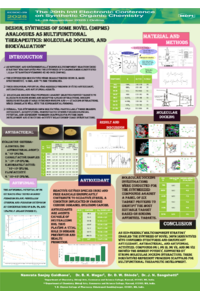
An efficient and eco-friendly synthetic approach was developed for the preparation of tetrahydropyrimidine carboxamide derivatives using a multicomponent reaction (MCR) strategy. This method offers advantages such as high yields, mild conditions, short reaction times, structural stability, and reusability of reagents. The synthesized 1,2,3,4-tetrahydropyrimidine carboxamides were evaluated for their antifungal, antibacterial, and antioxidant activities. Molecular docking studies were also performed to analyze their binding modes and interaction profiles with biological targets.
Materials and Methods
A novel series of 5-carboxamide-substituted 1,2,3,4-tetrahydropyrimidine-2(1H)-ones (DHPMs) was synthesized via MCR. Reaction conditions were optimized to enhance yield and reduce reaction time. Based on preliminary biological screening, selected compounds were subjected to molecular docking using known THPC inhibitors as references. These studies aimed to understand receptor-ligand interactions and support the in vitro findings.
Results
The synthesized THPC derivatives were characterized by IR, mass spectrometry, ¹³C NMR, and ¹H NMR spectroscopy. The compounds were evaluated for in vitro antioxidant, antibacterial, and antifungal activities. Antibacterial activity was tested against Staphylococcus aureus, Streptococcus pyogenes, Escherichia coli, and Pseudomonas aeruginosa. Several derivatives exhibited significant antimicrobial activity, comparable or superior to standard drugs. Molecular docking revealed stable hydrogen bonding and π–π interactions with target proteins.
Conclusion
The synthesized tetrahydropyrimidine carboxamide derivatives, particularly those with heterocyclic substitutions, demonstrated potent biological activity. Molecular docking confirmed favorable interactions, supporting their potential as leads in drug development. This integrated approach provides a foundation for further structure–activity relationship (SAR) studies.
Keywords
Tetrahydropyrimidine carboxamide derivatives
6-Methyl-4-(4-morpholinophenyl)-N-2-oxo-1,2,3,4-tetrahydropyrimidine-5-carboxamide (DPPH)
antibacterial activity
antifungal activity
antioxidant activity
molecular docking.
Manuscript
chemproc-Type of the Paper-done.pdf
Poster
Presentation SCIFORUM (1).pdf
Influence of the Cucurbit[7]uril Structure on Photophysical Properties of the Encapsulated Styryl Dye
Design, Synthesis, Spectral Characterization, and Antidepressant Evaluation of 2,4-Diphenylquinoline Derivatives