Event submissions
Published
This submission belongs to the session A. Ocean Engineering of the event The 1st International Online Conference on Marine Science and Engineering
Published date
19 Nov, 2025
Academic Editor
'%3e%3cpath%20d='M12.6657%2010.9104C12.4185%2010.325%2012.0599%209.79327%2011.6097%209.34482C11.1609%208.89508%2010.6293%208.5365%2010.0442%208.28888C10.0389%208.28626%2010.0337%208.28495%2010.0285%208.28233C10.8446%207.69279%2011.3752%206.73249%2011.3752%205.64904C11.3752%203.8542%209.92103%202.39999%208.1262%202.39999C6.33136%202.39999%204.87715%203.8542%204.87715%205.64904C4.87715%206.73249%205.40774%207.69279%206.22393%208.28364C6.21869%208.28626%206.21345%208.28757%206.20821%208.29019C5.62129%208.5378%205.09463%208.89284%204.64265%209.34613C4.1929%209.79493%203.83432%2010.3266%203.58671%2010.9117C3.34345%2011.4845%203.21226%2012.0987%203.20023%2012.7209C3.19988%2012.7349%203.20233%2012.7488%203.20744%2012.7619C3.21255%2012.7749%203.22022%2012.7867%203.22998%2012.7968C3.23975%2012.8068%203.25142%2012.8147%203.26431%2012.8202C3.2772%2012.8256%203.29105%2012.8284%203.30504%2012.8284H4.09109C4.14874%2012.8284%204.19459%2012.7825%204.1959%2012.7262C4.2221%2011.7148%204.62823%2010.7676%205.34617%2010.0497C6.08899%209.30683%207.0755%208.89808%208.1262%208.89808C9.17689%208.89808%2010.1634%209.30683%2010.9062%2010.0497C11.6242%2010.7676%2012.0303%2011.7148%2012.0565%2012.7262C12.0578%2012.7838%2012.1037%2012.8284%2012.1613%2012.8284H12.9474C12.9613%2012.8284%2012.9752%2012.8256%2012.9881%2012.8202C13.001%2012.8147%2013.0126%2012.8068%2013.0224%2012.7968C13.0322%2012.7867%2013.0398%2012.7749%2013.0449%2012.7619C13.0501%2012.7488%2013.0525%2012.7349%2013.0522%2012.7209C13.0391%2012.0947%2012.9094%2011.4855%2012.6657%2010.9104ZM8.1262%207.9024C7.52486%207.9024%206.9589%207.6679%206.53312%207.24211C6.10733%206.81633%205.87283%206.25037%205.87283%205.64904C5.87283%205.0477%206.10733%204.48174%206.53312%204.05596C6.9589%203.63018%207.52486%203.39567%208.1262%203.39567C8.72753%203.39567%209.29349%203.63018%209.71927%204.05596C10.1451%204.48174%2010.3796%205.0477%2010.3796%205.64904C10.3796%206.25037%2010.1451%206.81633%209.71927%207.24211C9.29349%207.6679%208.72753%207.9024%208.1262%207.9024Z'%20fill='%235D1EE1'/%3e%3c/g%3e%3c/svg%3e) Dong-Sheng Jeng
Dong-Sheng JengCitation
Mahmoud Ibrahim Ibrahim, Renato Mendes, João Sousa, CHIME: A CFD–HEKF Framework for Hydrodynamic Modelling and Manoeuvring Analysis of Axisymmetric AUVs, in Proceedings of The 1st International Online Conference on Marine Science and Engineering, 24 November–26 November 2025, MDPI: Basel, Switzerland
Share
Email
Facebook
Twitter
LinkedIn
CHIME: A CFD–HEKF Framework for Hydrodynamic Modelling and Manoeuvring Analysis of Axisymmetric AUVs
'%3e%3cpath%20d='M12.6647%2010.9104C12.4176%2010.325%2012.0589%209.7933%2011.6088%209.34485C11.16%208.89511%2010.6283%208.53653%2010.0432%208.28891C10.038%208.28629%2010.0327%208.28498%2010.0275%208.28236C10.8437%207.69282%2011.3743%206.73252%2011.3743%205.64907C11.3743%203.85423%209.92005%202.40002%208.12522%202.40002C6.33038%202.40002%204.87618%203.85423%204.87618%205.64907C4.87618%206.73252%205.40677%207.69282%206.22296%208.28367C6.21772%208.28629%206.21248%208.2876%206.20724%208.29022C5.62031%208.53783%205.09365%208.89287%204.64167%209.34616C4.19192%209.79496%203.83334%2010.3266%203.58573%2010.9117C3.34247%2011.4846%203.21128%2012.0987%203.19925%2012.721C3.1989%2012.735%203.20135%2012.7489%203.20646%2012.7619C3.21157%2012.7749%203.21924%2012.7868%203.22901%2012.7968C3.23877%2012.8068%203.25045%2012.8148%203.26334%2012.8202C3.27623%2012.8256%203.29007%2012.8284%203.30406%2012.8284H4.09012C4.14776%2012.8284%204.19362%2012.7825%204.19493%2012.7262C4.22113%2011.7148%204.62726%2010.7676%205.34519%2010.0497C6.08802%209.30686%207.07452%208.89811%208.12522%208.89811C9.17592%208.89811%2010.1624%209.30686%2010.9052%2010.0497C11.6232%2010.7676%2012.0293%2011.7148%2012.0555%2012.7262C12.0568%2012.7839%2012.1027%2012.8284%2012.1603%2012.8284H12.9464C12.9604%2012.8284%2012.9742%2012.8256%2012.9871%2012.8202C13%2012.8148%2013.0117%2012.8068%2013.0214%2012.7968C13.0312%2012.7868%2013.0389%2012.7749%2013.044%2012.7619C13.0491%2012.7489%2013.0515%2012.735%2013.0512%2012.721C13.0381%2012.0947%2012.9084%2011.4856%2012.6647%2010.9104ZM8.12522%207.90243C7.52388%207.90243%206.95792%207.66793%206.53214%207.24215C6.10636%206.81636%205.87185%206.2504%205.87185%205.64907C5.87185%205.04773%206.10636%204.48177%206.53214%204.05599C6.95792%203.63021%207.52388%203.3957%208.12522%203.3957C8.72655%203.3957%209.29252%203.63021%209.7183%204.05599C10.1441%204.48177%2010.3786%205.04773%2010.3786%205.64907C10.3786%206.2504%2010.1441%206.81636%209.7183%207.24215C9.29252%207.66793%208.72655%207.90243%208.12522%207.90243Z'%20fill='%235D1EE1'/%3e%3c/g%3e%3c/svg%3e)
Mahmoud Ibrahim Ibrahim 1,2
Renato Mendes 1,3

João Sousa 1
1. Laboratório de Sistemas e Tecnologia Subaquática (LSTS), LAETA, Faculdade de Engenharia, Universidade do Porto, 4200-465 Porto, Portugal
2. Department of Naval Architecture and Marine Engineering, Faculty of Engineering, Alexandria University, Alexandria 21544, Egypt
3. +ATLANTIC CoLAB, 1200-225 Lisbon, Portugal
Abstract
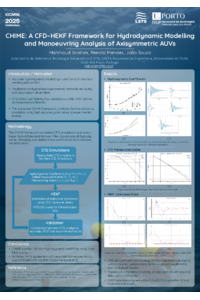
In this study, conducted at the Laboratório de Sistemas e Tecnologia Subaquática (LSTS), we tackle the limitations of traditional hydrodynamic modelling approaches by introducing the CFD–HEKF Integrated Modelling and Estimation (CHIME) methodology. The framework derives all hydrodynamic coefficients solely from simulation data, eliminating the need for experimental trials. The approach combines high-fidelity Computational Fluid Dynamics (CFD) simulations with a nonlinear Hybrid Extended Kalman Filter (HEKF) estimator. First, six-Degree-of-Freedom (6 DoF) steady-state CFD simulations of the ISURUS AUV were performed using ANSYS Fluent to extract drag, lift, and fin derivatives. Added-mass coefficients were then calculated through transient simulations using dynamic mesh under free oscillation in three modes. Subsequently, diving and turning manoeuvres were simulated, and the resulting states were input into a MATLAB-based HEKF estimator to estimate unknown damping and added-mass terms. A mesh sensitivity analysis determined that a medium grid (~500,000 cells) provided the optimal trade-off between accuracy and computational cost. Turbulence modelling confirmed that the k–kl–ω model effectively captured laminar-to-transitional regimes. The CFD-derived hydrodynamic coefficients and HEKF-estimated results were benchmarked against analytical and experimental results from the literature. The results reveal that CFD-derived drag, lift, and fin coefficients are within 2% error of experimental values, while added-mass coefficients showed significant improvement over analytical methods. The manoeuvre results, including circular path, tactical diameter, yaw, pitch, and depth, matched field trials within 1-3% error. In contrast, MATLAB simulations using analytical coefficients consistently performed worse. The HEKF-based results demonstrated alignment of states and trajectory within 3% error of CFD results, with a maximum of 10% error of experimental results. The CHIME methodology offers a simulation-only, high-accuracy alternative for full hydrodynamic characterisation of axisymmetric AUVs. The approach provides a streamlined, cost-effective foundation for improving onboard state estimation and integrating it into real-time navigation and control systems.
Keywords
AUV
LSTS
CFD
Hydrodynamic Modelling
Manoeuvrability
Added Mass
Kalman Filter
CHIME Framework
System Identification
Hydrodynamic Coefficients
Poster
CHIME A CFD–HEKF Framework for Hydrodynamic Modelling and Manoeuvring Analysis of Axisymmetric AUVs.pdf
Evaluation of Reduction and Validation Strategies in the Prediction of Extreme Ocean Events
Engineering Sustainable Escape Lighting Systems for Marine Vessels: A Photovoltaic and ATS-Based Approach