Event submissions
Published
This submission belongs to the session C. Physical Oceanography of the event The 1st International Online Conference on Marine Science and Engineering
Published date
19 Nov, 2025
Academic Editor
'%3e%3cpath%20d='M12.6657%2010.9104C12.4185%2010.325%2012.0599%209.79327%2011.6097%209.34482C11.1609%208.89508%2010.6293%208.5365%2010.0442%208.28888C10.0389%208.28626%2010.0337%208.28495%2010.0285%208.28233C10.8446%207.69279%2011.3752%206.73249%2011.3752%205.64904C11.3752%203.8542%209.92103%202.39999%208.1262%202.39999C6.33136%202.39999%204.87715%203.8542%204.87715%205.64904C4.87715%206.73249%205.40774%207.69279%206.22393%208.28364C6.21869%208.28626%206.21345%208.28757%206.20821%208.29019C5.62129%208.5378%205.09463%208.89284%204.64265%209.34613C4.1929%209.79493%203.83432%2010.3266%203.58671%2010.9117C3.34345%2011.4845%203.21226%2012.0987%203.20023%2012.7209C3.19988%2012.7349%203.20233%2012.7488%203.20744%2012.7619C3.21255%2012.7749%203.22022%2012.7867%203.22998%2012.7968C3.23975%2012.8068%203.25142%2012.8147%203.26431%2012.8202C3.2772%2012.8256%203.29105%2012.8284%203.30504%2012.8284H4.09109C4.14874%2012.8284%204.19459%2012.7825%204.1959%2012.7262C4.2221%2011.7148%204.62823%2010.7676%205.34617%2010.0497C6.08899%209.30683%207.0755%208.89808%208.1262%208.89808C9.17689%208.89808%2010.1634%209.30683%2010.9062%2010.0497C11.6242%2010.7676%2012.0303%2011.7148%2012.0565%2012.7262C12.0578%2012.7838%2012.1037%2012.8284%2012.1613%2012.8284H12.9474C12.9613%2012.8284%2012.9752%2012.8256%2012.9881%2012.8202C13.001%2012.8147%2013.0126%2012.8068%2013.0224%2012.7968C13.0322%2012.7867%2013.0398%2012.7749%2013.0449%2012.7619C13.0501%2012.7488%2013.0525%2012.7349%2013.0522%2012.7209C13.0391%2012.0947%2012.9094%2011.4855%2012.6657%2010.9104ZM8.1262%207.9024C7.52486%207.9024%206.9589%207.6679%206.53312%207.24211C6.10733%206.81633%205.87283%206.25037%205.87283%205.64904C5.87283%205.0477%206.10733%204.48174%206.53312%204.05596C6.9589%203.63018%207.52486%203.39567%208.1262%203.39567C8.72753%203.39567%209.29349%203.63018%209.71927%204.05596C10.1451%204.48174%2010.3796%205.0477%2010.3796%205.64904C10.3796%206.25037%2010.1451%206.81633%209.71927%207.24211C9.29349%207.6679%208.72753%207.9024%208.1262%207.9024Z'%20fill='%235D1EE1'/%3e%3c/g%3e%3c/svg%3e) Jean-Louis Pinault
Jean-Louis PinaultCitation
Dezheng Liu, Kailin Wu, Haotian Wu, Liangwne Jia, Impacts of Anthropogenically Driven Changes in Sediment Dynamics on Depositional Records in the Pearl River Estuary, China, in Proceedings of The 1st International Online Conference on Marine Science and Engineering, 24 November–26 November 2025, MDPI: Basel, Switzerland
Share
Email
Facebook
Twitter
LinkedIn
Impacts of Anthropogenically Driven Changes in Sediment Dynamics on Depositional Records in the Pearl River Estuary, China
'%3e%3cpath%20d='M12.6647%2010.9104C12.4176%2010.325%2012.0589%209.7933%2011.6088%209.34485C11.16%208.89511%2010.6283%208.53653%2010.0432%208.28891C10.038%208.28629%2010.0327%208.28498%2010.0275%208.28236C10.8437%207.69282%2011.3743%206.73252%2011.3743%205.64907C11.3743%203.85423%209.92005%202.40002%208.12522%202.40002C6.33038%202.40002%204.87618%203.85423%204.87618%205.64907C4.87618%206.73252%205.40677%207.69282%206.22296%208.28367C6.21772%208.28629%206.21248%208.2876%206.20724%208.29022C5.62031%208.53783%205.09365%208.89287%204.64167%209.34616C4.19192%209.79496%203.83334%2010.3266%203.58573%2010.9117C3.34247%2011.4846%203.21128%2012.0987%203.19925%2012.721C3.1989%2012.735%203.20135%2012.7489%203.20646%2012.7619C3.21157%2012.7749%203.21924%2012.7868%203.22901%2012.7968C3.23877%2012.8068%203.25045%2012.8148%203.26334%2012.8202C3.27623%2012.8256%203.29007%2012.8284%203.30406%2012.8284H4.09012C4.14776%2012.8284%204.19362%2012.7825%204.19493%2012.7262C4.22113%2011.7148%204.62726%2010.7676%205.34519%2010.0497C6.08802%209.30686%207.07452%208.89811%208.12522%208.89811C9.17592%208.89811%2010.1624%209.30686%2010.9052%2010.0497C11.6232%2010.7676%2012.0293%2011.7148%2012.0555%2012.7262C12.0568%2012.7839%2012.1027%2012.8284%2012.1603%2012.8284H12.9464C12.9604%2012.8284%2012.9742%2012.8256%2012.9871%2012.8202C13%2012.8148%2013.0117%2012.8068%2013.0214%2012.7968C13.0312%2012.7868%2013.0389%2012.7749%2013.044%2012.7619C13.0491%2012.7489%2013.0515%2012.735%2013.0512%2012.721C13.0381%2012.0947%2012.9084%2011.4856%2012.6647%2010.9104ZM8.12522%207.90243C7.52388%207.90243%206.95792%207.66793%206.53214%207.24215C6.10636%206.81636%205.87185%206.2504%205.87185%205.64907C5.87185%205.04773%206.10636%204.48177%206.53214%204.05599C6.95792%203.63021%207.52388%203.3957%208.12522%203.3957C8.72655%203.3957%209.29252%203.63021%209.7183%204.05599C10.1441%204.48177%2010.3786%205.04773%2010.3786%205.64907C10.3786%206.2504%2010.1441%206.81636%209.7183%207.24215C9.29252%207.66793%208.72655%207.90243%208.12522%207.90243Z'%20fill='%235D1EE1'/%3e%3c/g%3e%3c/svg%3e)
Dezheng Liu 1
Kailin Wu 2
Haotian Wu 3
Liangwne Jia 1
1. Institute of Estuary and Coast, Sun Yat-sen University, Zhuhai 519082, China
2. The Key Laboratory of Coast and Island Development of Ministry of Education, Nanjing University, Nanjing 210023, China
3. Hydrology and Water Resources Department, Nanjing Hydraulic Research Institute, Nanjing 210017, China
Abstract
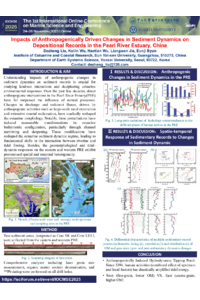
Extensive research has established that both anthropogenic activities and river--tide interactions are significant factors affecting the sediment dynamics in estuarine and coastal regions. Particularly, it is considered that the narrowing and deepening of estuarine topography and decline in upstream discharge and sediment supply by anthropogenic activities (including reservoirs or dam construction, coastal reclamation, sand excavation, and channel dredging) may exert profound changes in the sediment dynamics characteristics of the Pearl River Estuary (PRE), a key region within the Guangdong-Hong Kong-Macao Greater Bay Area. To investigate the resulting impacts on sedimentary records, this study analyzed grain size distribution and loss-on-ignition (organic matter; OM) content from sediment cores collected from both eastern and western regions of the LE, the largest sub-estuary of the PRE, based on a 210Pb-based chronological framework. The results reveal shifts in estuarine dynamics around 1994, marked by a 33 % reduction in sediment flux and amplified tidal energy, transforming the originally river-dominated estuary into a tide-dominated regime. Spatial heterogeneity in sedimentary responses was observed. In the eastern Lingdingyang Estuary (LE), sediment coarsening and improved sorting due to intensified tidal currents, while the western LE showed mixed deposition and poorer sorting linked to constrained ebb flows and sediment trapping effects. Furthermore, OM enrichment was strongly correlated with clay content, particularly in the western LE, indicating flocculation processes under tidal influence. OM accumulation increased westward but declined in the east. Our findings demonstrate that anthropogenic interventions dominate over natural processes in controlling estuarine sediment dynamics and provide essential understandings for sustainable management of the PRE and the Greater Bay Area while also offering a valuable reference for other heavily modified estuary systems worldwide.
Keywords
sedimentary dynamic
anthropogenic activities
anthropopressure
Lingdingyang Estuary
Poster
IOCMSE 2025 sciforum-128880.pdf
Analysis of the Main Physical Properties of Seawater Along the Coast of Angola
Coastal Polynyas of the White Sea: temporal and spatial variability