Event submissions
Published
This submission belongs to the session S1. Mucosal Vaccines for Respiratory Disease of the event The 3rd International Online Conference on Vaccines
Published date
21 Nov, 2025
Academic Editor
'%3e%3cpath%20d='M12.6657%2010.9104C12.4185%2010.325%2012.0599%209.79327%2011.6097%209.34482C11.1609%208.89508%2010.6293%208.5365%2010.0442%208.28888C10.0389%208.28626%2010.0337%208.28495%2010.0285%208.28233C10.8446%207.69279%2011.3752%206.73249%2011.3752%205.64904C11.3752%203.8542%209.92103%202.39999%208.1262%202.39999C6.33136%202.39999%204.87715%203.8542%204.87715%205.64904C4.87715%206.73249%205.40774%207.69279%206.22393%208.28364C6.21869%208.28626%206.21345%208.28757%206.20821%208.29019C5.62129%208.5378%205.09463%208.89284%204.64265%209.34613C4.1929%209.79493%203.83432%2010.3266%203.58671%2010.9117C3.34345%2011.4845%203.21226%2012.0987%203.20023%2012.7209C3.19988%2012.7349%203.20233%2012.7488%203.20744%2012.7619C3.21255%2012.7749%203.22022%2012.7867%203.22998%2012.7968C3.23975%2012.8068%203.25142%2012.8147%203.26431%2012.8202C3.2772%2012.8256%203.29105%2012.8284%203.30504%2012.8284H4.09109C4.14874%2012.8284%204.19459%2012.7825%204.1959%2012.7262C4.2221%2011.7148%204.62823%2010.7676%205.34617%2010.0497C6.08899%209.30683%207.0755%208.89808%208.1262%208.89808C9.17689%208.89808%2010.1634%209.30683%2010.9062%2010.0497C11.6242%2010.7676%2012.0303%2011.7148%2012.0565%2012.7262C12.0578%2012.7838%2012.1037%2012.8284%2012.1613%2012.8284H12.9474C12.9613%2012.8284%2012.9752%2012.8256%2012.9881%2012.8202C13.001%2012.8147%2013.0126%2012.8068%2013.0224%2012.7968C13.0322%2012.7867%2013.0398%2012.7749%2013.0449%2012.7619C13.0501%2012.7488%2013.0525%2012.7349%2013.0522%2012.7209C13.0391%2012.0947%2012.9094%2011.4855%2012.6657%2010.9104ZM8.1262%207.9024C7.52486%207.9024%206.9589%207.6679%206.53312%207.24211C6.10733%206.81633%205.87283%206.25037%205.87283%205.64904C5.87283%205.0477%206.10733%204.48174%206.53312%204.05596C6.9589%203.63018%207.52486%203.39567%208.1262%203.39567C8.72753%203.39567%209.29349%203.63018%209.71927%204.05596C10.1451%204.48174%2010.3796%205.0477%2010.3796%205.64904C10.3796%206.25037%2010.1451%206.81633%209.71927%207.24211C9.29349%207.6679%208.72753%207.9024%208.1262%207.9024Z'%20fill='%235D1EE1'/%3e%3c/g%3e%3c/svg%3e) Peter Delputte
Peter DelputteCitation
Mahsa Asgari, Martin Bachmann, Alessandro Pardini, Boran Li, Lan Yang, Evaluation of a novel cat allergy vaccine platform based on EMV-VLPs, in Proceedings of The 3rd International Online Conference on Vaccines, 26 November–28 November 2025, MDPI: Basel, Switzerland
Share
Email
Facebook
Twitter
LinkedIn
Evaluation of a novel cat allergy vaccine platform based on EMV-VLPs
'%3e%3cpath%20d='M12.6647%2010.9104C12.4176%2010.325%2012.0589%209.7933%2011.6088%209.34485C11.16%208.89511%2010.6283%208.53653%2010.0432%208.28891C10.038%208.28629%2010.0327%208.28498%2010.0275%208.28236C10.8437%207.69282%2011.3743%206.73252%2011.3743%205.64907C11.3743%203.85423%209.92005%202.40002%208.12522%202.40002C6.33038%202.40002%204.87618%203.85423%204.87618%205.64907C4.87618%206.73252%205.40677%207.69282%206.22296%208.28367C6.21772%208.28629%206.21248%208.2876%206.20724%208.29022C5.62031%208.53783%205.09365%208.89287%204.64167%209.34616C4.19192%209.79496%203.83334%2010.3266%203.58573%2010.9117C3.34247%2011.4846%203.21128%2012.0987%203.19925%2012.721C3.1989%2012.735%203.20135%2012.7489%203.20646%2012.7619C3.21157%2012.7749%203.21924%2012.7868%203.22901%2012.7968C3.23877%2012.8068%203.25045%2012.8148%203.26334%2012.8202C3.27623%2012.8256%203.29007%2012.8284%203.30406%2012.8284H4.09012C4.14776%2012.8284%204.19362%2012.7825%204.19493%2012.7262C4.22113%2011.7148%204.62726%2010.7676%205.34519%2010.0497C6.08802%209.30686%207.07452%208.89811%208.12522%208.89811C9.17592%208.89811%2010.1624%209.30686%2010.9052%2010.0497C11.6232%2010.7676%2012.0293%2011.7148%2012.0555%2012.7262C12.0568%2012.7839%2012.1027%2012.8284%2012.1603%2012.8284H12.9464C12.9604%2012.8284%2012.9742%2012.8256%2012.9871%2012.8202C13%2012.8148%2013.0117%2012.8068%2013.0214%2012.7968C13.0312%2012.7868%2013.0389%2012.7749%2013.044%2012.7619C13.0491%2012.7489%2013.0515%2012.735%2013.0512%2012.721C13.0381%2012.0947%2012.9084%2011.4856%2012.6647%2010.9104ZM8.12522%207.90243C7.52388%207.90243%206.95792%207.66793%206.53214%207.24215C6.10636%206.81636%205.87185%206.2504%205.87185%205.64907C5.87185%205.04773%206.10636%204.48177%206.53214%204.05599C6.95792%203.63021%207.52388%203.3957%208.12522%203.3957C8.72655%203.3957%209.29252%203.63021%209.7183%204.05599C10.1441%204.48177%2010.3786%205.04773%2010.3786%205.64907C10.3786%206.2504%2010.1441%206.81636%209.7183%207.24215C9.29252%207.66793%208.72655%207.90243%208.12522%207.90243Z'%20fill='%235D1EE1'/%3e%3c/g%3e%3c/svg%3e)
Mahsa Asgari 1,2

Martin Bachmann 1,2,3
Alessandro Pardini 1,2,4
Boran Li 1,2,4
Lan Yang 1,2
1. Department of BioMedical Research, University of Bern, Bern, Switzerland.
2. Department of Rheumatology and Immunology, University Hospital Bern, Bern, Switzerland.
3. Nuffield Department of Medicine, Centre for Cellular and Molecular Physiology (CCMP), The Jenner Institute, University of Oxford, Oxford, UK
4. Graduate School of Cellular and Biomedical Sciences, University of Bern, Bern, Switzerland.
Abstract
Introduction:
Cat allergies are predominantly caused by the major cat allergen Fel d 1. Vaccination against Fel d 1 is an emerging approach for cat allergy immunotherapy, with the goal of generating strong Fel d 1-specific IgG responses, which protect from allergy. In this study, we assessed the immunogenicity of a novel vaccine based on Eggplant Mosaic Virus (EMV) virus-like particles (VLPs) engineered to display Fel d 1. Our aim was to compare the impact of administration routes and prime-boost strategies on immune responses in mice.
Methods:
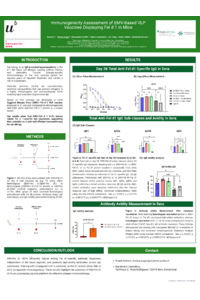
Fel d 1 was genetically fused to the EMV capsid protein and expressed in E. coli. Mice were immunized with EMV-Fel d 1 VLPs, control EMV VLPs alone, or recombinant Fel d 1 protein using homologous or heterologous prime-boost regimens via subcutaneous or intranasal routes. Serum samples were collected to evaluate the Fel d 1-specific IgG responses using ELISA.
Results:
We found that both homologous and heterologous vaccination strategies led to strong Fel d 1-specific IgG responses, with levels increasing after the booster dose. The average log(OD₅₀) value rose from ~2.2 on day 14 (after prime) to ~3.6 on day 28 (after boost). By day 28, the IgG1, IgG2b, and IgG3 subclasses were prominently elevated, whereas IgG2a levels remained comparatively low. The avidity of Fel d 1-specific IgG improved following the booster doses. Interestingly, priming with the EMV-Fel d 1 VLPs resulted in robust IgG responses, regardless of the boosting agent—even when boosted with recombinant Fel d 1 protein.
Conclusion:
EMV-Fel d 1 VLP vaccines triggered robust and specific IgG responses, regardless of the prime-boost strategy used. These results support the continued development of EMV-based VLP platforms as a promising approach for cat allergy immunotherapy.
Keywords
Fel d1
Cat Allergy
Virus Like Particles(VLPs)
EMV(Eggplant Mosaic Virus)
Immunotherapy
Poster
Mahsa Asgari.pdf
Hepatitis B birth dose vaccination coverage in Brazil (2016–2025): a temporal analysis based on national health data
Development and Preliminary Characterization of a Baculovirus Pseudotyped with Andes Virus Envelope Glycoproteins