Event submissions
Published
This submission belongs to the session S2. Vectored Vaccines of the event The 3rd International Online Conference on Vaccines
Published date
21 Nov, 2025
Academic Editor
'%3e%3cpath%20d='M12.6657%2010.9104C12.4185%2010.325%2012.0599%209.79327%2011.6097%209.34482C11.1609%208.89508%2010.6293%208.5365%2010.0442%208.28888C10.0389%208.28626%2010.0337%208.28495%2010.0285%208.28233C10.8446%207.69279%2011.3752%206.73249%2011.3752%205.64904C11.3752%203.8542%209.92103%202.39999%208.1262%202.39999C6.33136%202.39999%204.87715%203.8542%204.87715%205.64904C4.87715%206.73249%205.40774%207.69279%206.22393%208.28364C6.21869%208.28626%206.21345%208.28757%206.20821%208.29019C5.62129%208.5378%205.09463%208.89284%204.64265%209.34613C4.1929%209.79493%203.83432%2010.3266%203.58671%2010.9117C3.34345%2011.4845%203.21226%2012.0987%203.20023%2012.7209C3.19988%2012.7349%203.20233%2012.7488%203.20744%2012.7619C3.21255%2012.7749%203.22022%2012.7867%203.22998%2012.7968C3.23975%2012.8068%203.25142%2012.8147%203.26431%2012.8202C3.2772%2012.8256%203.29105%2012.8284%203.30504%2012.8284H4.09109C4.14874%2012.8284%204.19459%2012.7825%204.1959%2012.7262C4.2221%2011.7148%204.62823%2010.7676%205.34617%2010.0497C6.08899%209.30683%207.0755%208.89808%208.1262%208.89808C9.17689%208.89808%2010.1634%209.30683%2010.9062%2010.0497C11.6242%2010.7676%2012.0303%2011.7148%2012.0565%2012.7262C12.0578%2012.7838%2012.1037%2012.8284%2012.1613%2012.8284H12.9474C12.9613%2012.8284%2012.9752%2012.8256%2012.9881%2012.8202C13.001%2012.8147%2013.0126%2012.8068%2013.0224%2012.7968C13.0322%2012.7867%2013.0398%2012.7749%2013.0449%2012.7619C13.0501%2012.7488%2013.0525%2012.7349%2013.0522%2012.7209C13.0391%2012.0947%2012.9094%2011.4855%2012.6657%2010.9104ZM8.1262%207.9024C7.52486%207.9024%206.9589%207.6679%206.53312%207.24211C6.10733%206.81633%205.87283%206.25037%205.87283%205.64904C5.87283%205.0477%206.10733%204.48174%206.53312%204.05596C6.9589%203.63018%207.52486%203.39567%208.1262%203.39567C8.72753%203.39567%209.29349%203.63018%209.71927%204.05596C10.1451%204.48174%2010.3796%205.0477%2010.3796%205.64904C10.3796%206.25037%2010.1451%206.81633%209.71927%207.24211C9.29349%207.6679%208.72753%207.9024%208.1262%207.9024Z'%20fill='%235D1EE1'/%3e%3c/g%3e%3c/svg%3e) Ultan Power
Ultan PowerCitation
Belén Berta Angélica Jerez Monsalves, Bryan Mangui Catota, Pablo Ignacio Castro Henriquez, Fátima Reyes López, Viana Manrique Suarez, Nicolas Pinto Gutiérrez, Frank Camacho Casanova, Oliberto Sánchez Ramos, Development and Preliminary Characterization of a Baculovirus Pseudotyped with Andes Virus Envelope Glycoproteins, in Proceedings of The 3rd International Online Conference on Vaccines, 26 November–28 November 2025, MDPI: Basel, Switzerland
Share
Email
Facebook
Twitter
LinkedIn
Development and Preliminary Characterization of a Baculovirus Pseudotyped with Andes Virus Envelope Glycoproteins
'%3e%3cpath%20d='M12.6647%2010.9104C12.4176%2010.325%2012.0589%209.7933%2011.6088%209.34485C11.16%208.89511%2010.6283%208.53653%2010.0432%208.28891C10.038%208.28629%2010.0327%208.28498%2010.0275%208.28236C10.8437%207.69282%2011.3743%206.73252%2011.3743%205.64907C11.3743%203.85423%209.92005%202.40002%208.12522%202.40002C6.33038%202.40002%204.87618%203.85423%204.87618%205.64907C4.87618%206.73252%205.40677%207.69282%206.22296%208.28367C6.21772%208.28629%206.21248%208.2876%206.20724%208.29022C5.62031%208.53783%205.09365%208.89287%204.64167%209.34616C4.19192%209.79496%203.83334%2010.3266%203.58573%2010.9117C3.34247%2011.4846%203.21128%2012.0987%203.19925%2012.721C3.1989%2012.735%203.20135%2012.7489%203.20646%2012.7619C3.21157%2012.7749%203.21924%2012.7868%203.22901%2012.7968C3.23877%2012.8068%203.25045%2012.8148%203.26334%2012.8202C3.27623%2012.8256%203.29007%2012.8284%203.30406%2012.8284H4.09012C4.14776%2012.8284%204.19362%2012.7825%204.19493%2012.7262C4.22113%2011.7148%204.62726%2010.7676%205.34519%2010.0497C6.08802%209.30686%207.07452%208.89811%208.12522%208.89811C9.17592%208.89811%2010.1624%209.30686%2010.9052%2010.0497C11.6232%2010.7676%2012.0293%2011.7148%2012.0555%2012.7262C12.0568%2012.7839%2012.1027%2012.8284%2012.1603%2012.8284H12.9464C12.9604%2012.8284%2012.9742%2012.8256%2012.9871%2012.8202C13%2012.8148%2013.0117%2012.8068%2013.0214%2012.7968C13.0312%2012.7868%2013.0389%2012.7749%2013.044%2012.7619C13.0491%2012.7489%2013.0515%2012.735%2013.0512%2012.721C13.0381%2012.0947%2012.9084%2011.4856%2012.6647%2010.9104ZM8.12522%207.90243C7.52388%207.90243%206.95792%207.66793%206.53214%207.24215C6.10636%206.81636%205.87185%206.2504%205.87185%205.64907C5.87185%205.04773%206.10636%204.48177%206.53214%204.05599C6.95792%203.63021%207.52388%203.3957%208.12522%203.3957C8.72655%203.3957%209.29252%203.63021%209.7183%204.05599C10.1441%204.48177%2010.3786%205.04773%2010.3786%205.64907C10.3786%206.2504%2010.1441%206.81636%209.7183%207.24215C9.29252%207.66793%208.72655%207.90243%208.12522%207.90243Z'%20fill='%235D1EE1'/%3e%3c/g%3e%3c/svg%3e)
Belén Berta Angélica Jerez Monsalves 1
Bryan Mangui Catota 1,2
Pablo Ignacio Castro Henriquez 1
Fátima Reyes López 1,2

Viana Manrique Suarez 1,3
Nicolas Pinto Gutiérrez 1
Frank Camacho Casanova 2
Oliberto Sánchez Ramos 1
1. Recombinant Biopharmaceutical Laboratory, Department of Pharmacology, Faculty of Biological Sciences, University of Concepción, 4070409, Chile
2. Bioprocesses and Combinatorial Biology Laboratory, Department of Pharmacology, Faculty of Biological Sciences, University of Concepción, 4070409, Chile
3. Biotechnology and Bioprocesses Laboratory, Department of Pathophysiology, Faculty of Biological Sciences, University of Concepción, 4070409, Chile
Abstract
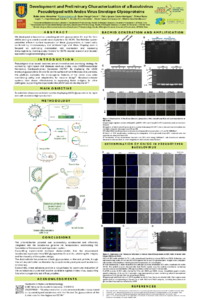
Hantaviruses infect a range of animal hosts, with rodents serving as reservoirs and transmitting the virus to humans through aerosols of their secretions and excretions. These zoonotic infections can lead to Hantavirus Cardiopulmonary Syndrome (HCPS), which in Chile and Argentina is caused by the Andes virus (ANDV). ANDV is particularly concerning due to its >40% mortality rate and unique capacity for person‑to‑person transmission. To date, no vaccine or therapeutic has been approved by the FDA or equivalent agencies.
In this work, the GPC gene fragment of ANDV, which encodes the envelope glycoproteins Gn and Gc, was integrated into the Autographa californica multiple nucleopolyhedrovirus (AcMNPV) genome using the MultiBac system. The construct was designed for dual expression under the polyhedrin (Polh) promoter for insect cells and the CMV promoter for mammalian cells. Although the GPC fragment was placed under both promoters, only robust expression under Polh has been confirmed, guiding current optimization efforts for mammalian expression. The resulting pseudotyped baculovirus showed strong expression and was successfully amplified to titers exceeding 10⁸ in Sf21 and Sf9 insect cells. The presence and localization of the glycoproteins were confirmed by Western blot using hybridoma-derived monoclonal antibodies and by indirect immunofluorescence assay (IFA). Ongoing work includes immunogold electron microscopy to visualize the ANDV´s glycoproteins on the virion surface and inoculation studies in Syrian hamsters to evaluate immunogenicity and neutralizations activity. While current experimental efforts may prove encouraging, they will be critical for establishing the immunogenic potential of the system and confirming its relevance as a vaccine platform. Although baculovirus-based pseudotyped vaccine candidates have been developed for other pathogens, this system represents a novel application in the context of ANDV. Its modular design and engineering flexibility may further support adaptation for antigen delivery or evaluation in other emerging infectious diseases.
Keywords
Baculovirus
Pseudotyped baculovirus
Andes virus
HCPS
Viral vector vaccine
Poster
Poster Vaccines Conference III .pdf
Evaluation of a novel cat allergy vaccine platform based on EMV-VLPs
A bivalent COVID-19 mRNA vaccine combined B-cell and T-cell immunogens elicits strong humoral and cellular immune response in mice