Event submissions
Published
This submission belongs to the session S3. Models for Vaccine Development and Evaluation of the event The 3rd International Online Conference on Vaccines
Published date
21 Nov, 2025
Academic Editor
'%3e%3cpath%20d='M12.6657%2010.9104C12.4185%2010.325%2012.0599%209.79327%2011.6097%209.34482C11.1609%208.89508%2010.6293%208.5365%2010.0442%208.28888C10.0389%208.28626%2010.0337%208.28495%2010.0285%208.28233C10.8446%207.69279%2011.3752%206.73249%2011.3752%205.64904C11.3752%203.8542%209.92103%202.39999%208.1262%202.39999C6.33136%202.39999%204.87715%203.8542%204.87715%205.64904C4.87715%206.73249%205.40774%207.69279%206.22393%208.28364C6.21869%208.28626%206.21345%208.28757%206.20821%208.29019C5.62129%208.5378%205.09463%208.89284%204.64265%209.34613C4.1929%209.79493%203.83432%2010.3266%203.58671%2010.9117C3.34345%2011.4845%203.21226%2012.0987%203.20023%2012.7209C3.19988%2012.7349%203.20233%2012.7488%203.20744%2012.7619C3.21255%2012.7749%203.22022%2012.7867%203.22998%2012.7968C3.23975%2012.8068%203.25142%2012.8147%203.26431%2012.8202C3.2772%2012.8256%203.29105%2012.8284%203.30504%2012.8284H4.09109C4.14874%2012.8284%204.19459%2012.7825%204.1959%2012.7262C4.2221%2011.7148%204.62823%2010.7676%205.34617%2010.0497C6.08899%209.30683%207.0755%208.89808%208.1262%208.89808C9.17689%208.89808%2010.1634%209.30683%2010.9062%2010.0497C11.6242%2010.7676%2012.0303%2011.7148%2012.0565%2012.7262C12.0578%2012.7838%2012.1037%2012.8284%2012.1613%2012.8284H12.9474C12.9613%2012.8284%2012.9752%2012.8256%2012.9881%2012.8202C13.001%2012.8147%2013.0126%2012.8068%2013.0224%2012.7968C13.0322%2012.7867%2013.0398%2012.7749%2013.0449%2012.7619C13.0501%2012.7488%2013.0525%2012.7349%2013.0522%2012.7209C13.0391%2012.0947%2012.9094%2011.4855%2012.6657%2010.9104ZM8.1262%207.9024C7.52486%207.9024%206.9589%207.6679%206.53312%207.24211C6.10733%206.81633%205.87283%206.25037%205.87283%205.64904C5.87283%205.0477%206.10733%204.48174%206.53312%204.05596C6.9589%203.63018%207.52486%203.39567%208.1262%203.39567C8.72753%203.39567%209.29349%203.63018%209.71927%204.05596C10.1451%204.48174%2010.3796%205.0477%2010.3796%205.64904C10.3796%206.25037%2010.1451%206.81633%209.71927%207.24211C9.29349%207.6679%208.72753%207.9024%208.1262%207.9024Z'%20fill='%235D1EE1'/%3e%3c/g%3e%3c/svg%3e) Jorge Leitão
Jorge LeitãoCitation
Mariya Borgoyakova, Andrey Rudometov, Ekaterina Starostina, Vladimir Yakovlev, Elena Tigeeva, Kristina Makarova, Danil Vahitov, Anna Zaykovskaya, Sergey Sharabrin, Denis Kisakov, Larisa Karpenko, Alexander Ilyichev, A bivalent COVID-19 mRNA vaccine combined B-cell and T-cell immunogens elicits strong humoral and cellular immune response in mice, in Proceedings of The 3rd International Online Conference on Vaccines, 26 November–28 November 2025, MDPI: Basel, Switzerland
Share
Email
Facebook
Twitter
LinkedIn
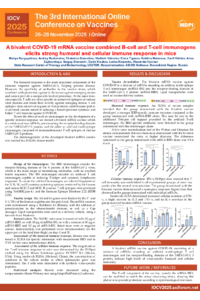
A bivalent COVID-19 mRNA vaccine combined B-cell and T-cell immunogens elicits strong humoral and cellular immune response in mice
'%3e%3cpath%20d='M12.6647%2010.9104C12.4176%2010.325%2012.0589%209.7933%2011.6088%209.34485C11.16%208.89511%2010.6283%208.53653%2010.0432%208.28891C10.038%208.28629%2010.0327%208.28498%2010.0275%208.28236C10.8437%207.69282%2011.3743%206.73252%2011.3743%205.64907C11.3743%203.85423%209.92005%202.40002%208.12522%202.40002C6.33038%202.40002%204.87618%203.85423%204.87618%205.64907C4.87618%206.73252%205.40677%207.69282%206.22296%208.28367C6.21772%208.28629%206.21248%208.2876%206.20724%208.29022C5.62031%208.53783%205.09365%208.89287%204.64167%209.34616C4.19192%209.79496%203.83334%2010.3266%203.58573%2010.9117C3.34247%2011.4846%203.21128%2012.0987%203.19925%2012.721C3.1989%2012.735%203.20135%2012.7489%203.20646%2012.7619C3.21157%2012.7749%203.21924%2012.7868%203.22901%2012.7968C3.23877%2012.8068%203.25045%2012.8148%203.26334%2012.8202C3.27623%2012.8256%203.29007%2012.8284%203.30406%2012.8284H4.09012C4.14776%2012.8284%204.19362%2012.7825%204.19493%2012.7262C4.22113%2011.7148%204.62726%2010.7676%205.34519%2010.0497C6.08802%209.30686%207.07452%208.89811%208.12522%208.89811C9.17592%208.89811%2010.1624%209.30686%2010.9052%2010.0497C11.6232%2010.7676%2012.0293%2011.7148%2012.0555%2012.7262C12.0568%2012.7839%2012.1027%2012.8284%2012.1603%2012.8284H12.9464C12.9604%2012.8284%2012.9742%2012.8256%2012.9871%2012.8202C13%2012.8148%2013.0117%2012.8068%2013.0214%2012.7968C13.0312%2012.7868%2013.0389%2012.7749%2013.044%2012.7619C13.0491%2012.7489%2013.0515%2012.735%2013.0512%2012.721C13.0381%2012.0947%2012.9084%2011.4856%2012.6647%2010.9104ZM8.12522%207.90243C7.52388%207.90243%206.95792%207.66793%206.53214%207.24215C6.10636%206.81636%205.87185%206.2504%205.87185%205.64907C5.87185%205.04773%206.10636%204.48177%206.53214%204.05599C6.95792%203.63021%207.52388%203.3957%208.12522%203.3957C8.72655%203.3957%209.29252%203.63021%209.7183%204.05599C10.1441%204.48177%2010.3786%205.04773%2010.3786%205.64907C10.3786%206.2504%2010.1441%206.81636%209.7183%207.24215C9.29252%207.66793%208.72655%207.90243%208.12522%207.90243Z'%20fill='%235D1EE1'/%3e%3c/g%3e%3c/svg%3e)
Mariya Borgoyakova 1
Andrey Rudometov 1
Ekaterina Starostina 1
Vladimir Yakovlev 1
Elena Tigeeva 1
Kristina Makarova 1
Danil Vahitov 1
Anna Zaykovskaya 1
Sergey Sharabrin 1
Denis Kisakov 1
Larisa Karpenko 1
Alexander Ilyichev 1
1. State Research Center of Virology and Biotechnology VECTOR, Rospotrebnadzor, 630559 Koltsovo, Novosibirsk Region, Russia.
Abstract
Both humoral and cellular immune responses are known to be crucial in the fight against SARS-CoV-2.
The aim of this work was to evaluate the immunogenicity profile of a bivalent mRNA vaccine encoding a multi-epitope T-cell immunogen and a B-cell immunogen as a receptor-binding domain of the S protein of the SARS-CoV-2 virus in BALB/c mice.
Two mRNA vaccines were obtained: mRNA-BSI encoding fragments of the S, M, N, and E proteins of the SARS-CoV-2 virus enriched with the large number of T-cell epitopes and mRNA-RBD encoding the receptor-binding domain (RBD) of the SARS-CoV-2 S protein. BALB/c mice were immunized with 10 μg of individual mRNA preparations or a 10 μg + 10 μg mixture intramuscularly in LNP vehicles twice with a three-week interval.
RBD-specific ELISA and neutralization assay (Wuhan and Omicron (BA.5.2) strains) showed an 2–4-fold increase in antibody titers in sera of mice immunized with the mixture of mRNA constructs compared to the group of mice that received only mRNA-RBD (mRNA-BSI did not induce a humoral response).
A T-cell response assay showed that mice that received the bivalent mRNA vaccine had a higher level of IFN-γ T-cell activation compared to the group that recieved the individual mRNA vaccine. In addition, the increases of IL-2 and TNF-α were not particularly significant, and the absence of IL-4 was noted.
The results indicate the formation of a pronounced humoral and T-cell response and a Th1 shift in mice that received the bivalent mRNA vaccine, encoding B-cell and T-cell immunogens.
The study was carried out as part of the state assignment of the FBIS SRC Virology and Biotechnology "Vector" of Rospotrebnadzor.
Keywords
bivalent mRNA-vaccine
mRNA-vaccine
multiepitope vaccine
SARS-CoV-2
Poster
Borgoyakovа.pdf
Development and Preliminary Characterization of a Baculovirus Pseudotyped with Andes Virus Envelope Glycoproteins
Generation and characterization of zein nanoparticles conjugated with folic acid as a proposal for oral vaccine nanocarriers