Event submissions
Published
This submission belongs to the session S5. New Methods for Vaccine Delivery of the event The 3rd International Online Conference on Vaccines
Published date
21 Nov, 2025
Academic Editor
'%3e%3cpath%20d='M12.6657%2010.9104C12.4185%2010.325%2012.0599%209.79327%2011.6097%209.34482C11.1609%208.89508%2010.6293%208.5365%2010.0442%208.28888C10.0389%208.28626%2010.0337%208.28495%2010.0285%208.28233C10.8446%207.69279%2011.3752%206.73249%2011.3752%205.64904C11.3752%203.8542%209.92103%202.39999%208.1262%202.39999C6.33136%202.39999%204.87715%203.8542%204.87715%205.64904C4.87715%206.73249%205.40774%207.69279%206.22393%208.28364C6.21869%208.28626%206.21345%208.28757%206.20821%208.29019C5.62129%208.5378%205.09463%208.89284%204.64265%209.34613C4.1929%209.79493%203.83432%2010.3266%203.58671%2010.9117C3.34345%2011.4845%203.21226%2012.0987%203.20023%2012.7209C3.19988%2012.7349%203.20233%2012.7488%203.20744%2012.7619C3.21255%2012.7749%203.22022%2012.7867%203.22998%2012.7968C3.23975%2012.8068%203.25142%2012.8147%203.26431%2012.8202C3.2772%2012.8256%203.29105%2012.8284%203.30504%2012.8284H4.09109C4.14874%2012.8284%204.19459%2012.7825%204.1959%2012.7262C4.2221%2011.7148%204.62823%2010.7676%205.34617%2010.0497C6.08899%209.30683%207.0755%208.89808%208.1262%208.89808C9.17689%208.89808%2010.1634%209.30683%2010.9062%2010.0497C11.6242%2010.7676%2012.0303%2011.7148%2012.0565%2012.7262C12.0578%2012.7838%2012.1037%2012.8284%2012.1613%2012.8284H12.9474C12.9613%2012.8284%2012.9752%2012.8256%2012.9881%2012.8202C13.001%2012.8147%2013.0126%2012.8068%2013.0224%2012.7968C13.0322%2012.7867%2013.0398%2012.7749%2013.0449%2012.7619C13.0501%2012.7488%2013.0525%2012.7349%2013.0522%2012.7209C13.0391%2012.0947%2012.9094%2011.4855%2012.6657%2010.9104ZM8.1262%207.9024C7.52486%207.9024%206.9589%207.6679%206.53312%207.24211C6.10733%206.81633%205.87283%206.25037%205.87283%205.64904C5.87283%205.0477%206.10733%204.48174%206.53312%204.05596C6.9589%203.63018%207.52486%203.39567%208.1262%203.39567C8.72753%203.39567%209.29349%203.63018%209.71927%204.05596C10.1451%204.48174%2010.3796%205.0477%2010.3796%205.64904C10.3796%206.25037%2010.1451%206.81633%209.71927%207.24211C9.29349%207.6679%208.72753%207.9024%208.1262%207.9024Z'%20fill='%235D1EE1'/%3e%3c/g%3e%3c/svg%3e) Silvio Tafuri
Silvio TafuriCitation
Veronica Araceli Marquez-Escobar, Sergio Rosales-Mendoza, Maria de Lourdes Betancourt-Mendiola, Assessment of Zein Nanoparticles as Carriers of SARS-CoV-2 Antigens. , in Proceedings of The 3rd International Online Conference on Vaccines, 26 November–28 November 2025, MDPI: Basel, Switzerland
Share
Email
Facebook
Twitter
LinkedIn
Assessment of Zein Nanoparticles as Carriers of SARS-CoV-2 Antigens.
'%3e%3cpath%20d='M12.6647%2010.9104C12.4176%2010.325%2012.0589%209.7933%2011.6088%209.34485C11.16%208.89511%2010.6283%208.53653%2010.0432%208.28891C10.038%208.28629%2010.0327%208.28498%2010.0275%208.28236C10.8437%207.69282%2011.3743%206.73252%2011.3743%205.64907C11.3743%203.85423%209.92005%202.40002%208.12522%202.40002C6.33038%202.40002%204.87618%203.85423%204.87618%205.64907C4.87618%206.73252%205.40677%207.69282%206.22296%208.28367C6.21772%208.28629%206.21248%208.2876%206.20724%208.29022C5.62031%208.53783%205.09365%208.89287%204.64167%209.34616C4.19192%209.79496%203.83334%2010.3266%203.58573%2010.9117C3.34247%2011.4846%203.21128%2012.0987%203.19925%2012.721C3.1989%2012.735%203.20135%2012.7489%203.20646%2012.7619C3.21157%2012.7749%203.21924%2012.7868%203.22901%2012.7968C3.23877%2012.8068%203.25045%2012.8148%203.26334%2012.8202C3.27623%2012.8256%203.29007%2012.8284%203.30406%2012.8284H4.09012C4.14776%2012.8284%204.19362%2012.7825%204.19493%2012.7262C4.22113%2011.7148%204.62726%2010.7676%205.34519%2010.0497C6.08802%209.30686%207.07452%208.89811%208.12522%208.89811C9.17592%208.89811%2010.1624%209.30686%2010.9052%2010.0497C11.6232%2010.7676%2012.0293%2011.7148%2012.0555%2012.7262C12.0568%2012.7839%2012.1027%2012.8284%2012.1603%2012.8284H12.9464C12.9604%2012.8284%2012.9742%2012.8256%2012.9871%2012.8202C13%2012.8148%2013.0117%2012.8068%2013.0214%2012.7968C13.0312%2012.7868%2013.0389%2012.7749%2013.044%2012.7619C13.0491%2012.7489%2013.0515%2012.735%2013.0512%2012.721C13.0381%2012.0947%2012.9084%2011.4856%2012.6647%2010.9104ZM8.12522%207.90243C7.52388%207.90243%206.95792%207.66793%206.53214%207.24215C6.10636%206.81636%205.87185%206.2504%205.87185%205.64907C5.87185%205.04773%206.10636%204.48177%206.53214%204.05599C6.95792%203.63021%207.52388%203.3957%208.12522%203.3957C8.72655%203.3957%209.29252%203.63021%209.7183%204.05599C10.1441%204.48177%2010.3786%205.04773%2010.3786%205.64907C10.3786%206.2504%2010.1441%206.81636%209.7183%207.24215C9.29252%207.66793%208.72655%207.90243%208.12522%207.90243Z'%20fill='%235D1EE1'/%3e%3c/g%3e%3c/svg%3e)
Veronica Araceli Marquez-Escobar 1,2

Sergio Rosales-Mendoza 1,2
Maria de Lourdes Betancourt-Mendiola 1,2
1. Department of Recombinant Biopharmaceuticals, School of Chemical Sciences, Autonomous University of San Luis Potosí, San Luis Potosí, S.L.P., 78210, Mexico
2. Department of Biotechnology, Center for Research in Health Science and Biomedicine, Autonomous University of San Luis Potosí, San Luis Potosí, S.L.P. 78210, Mexico
Abstract
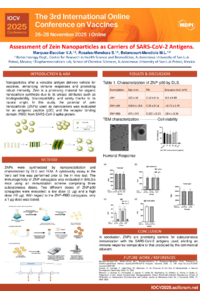
Nanoparticles offer a versatile antigen delivery vehicle for vaccines, enhancing immune responses and promoting robust immunity. Zein is a promising material for organic nanoparticle synthesis due to its unique attributes such as biodegradability, biocompatibility, and safety due to its natural origin. In this study, the potential of zein nanoparticles (ZNPs) used as nanocarriers was evaluated for an antigenic peptide (p30) and the receptor binding domain (RBD) from SARS-CoV-2 spike protein. ZNPs were synthesized by nanoprecipitation and characterization was performed using Dynamic Light Scattering (DLS) and Transmission Electron Microscopy (TEM). A cytotoxicity assay in the Vero cell line was performed prior to the in vivo test. The immunogenicity of ZNP conjugates was evaluated in BALB/c mice using an immunization scheme comprising three subcutaneous doses. Two different doses of ZNP-p30 conjugates were evaluated: a low dose (5 µg) and a high dose (10 µg). With regard to the the ZNP–RBD conjugates, only a 1 µg dose was tested. Results from DLS and TEM showed evidence of ZNP formation. According to the in vitro assay, ZNPs do not compromise cellular viability. In vivo assays demonstrated that total IgG levels with either 5 or 10 µg of ZNPs:p30 had comparable titers to the positive control group, suggesting that the formulation of ZNPs has adjuvant properties similar to alum. When IgG subclasses were analyzed, IgG1 predominated over IgG2a, suggesting that a Th2-bias (humoral) response is induced. As expected, IgM was elicited after the first immunization, and decreased over time. Interestingly, the IgG antibodies produced could recognize the full spike protein of SARS-CoV-2. Regarding ZNP:RDB formulation, the results showed that the total IgG levels were comparable with the adjuvanted group. In conclusion, ZNPs are promising carriers for subcutaneous immunization with the SARS-CoV-2 antigens used, eliciting an immune response comparable to that produced by the commercial adjuvant.
Keywords
nanoparticles
zein
antigen delivery system
in vivo assay
COVID-19
Poster
3rd IOCV Poster Veronica Araceli Marquez Escobar.pdf
Intrinsic Adjuvant Effect of Lipoprotein Signal Peptide in a Recombinant PEDV Subunit Vaccine
Biomaterial-Based Delivery Systems: Nanoparticles, Hydrogels & Microneedles in Shaping Vaccine Efficacy