Event submissions
Published
This submission belongs to the session S1. Mucosal Vaccines for Respiratory Disease of the event The 3rd International Online Conference on Vaccines
Published date
21 Nov, 2025
Academic Editor
'%3e%3cpath%20d='M12.6657%2010.9104C12.4185%2010.325%2012.0599%209.79327%2011.6097%209.34482C11.1609%208.89508%2010.6293%208.5365%2010.0442%208.28888C10.0389%208.28626%2010.0337%208.28495%2010.0285%208.28233C10.8446%207.69279%2011.3752%206.73249%2011.3752%205.64904C11.3752%203.8542%209.92103%202.39999%208.1262%202.39999C6.33136%202.39999%204.87715%203.8542%204.87715%205.64904C4.87715%206.73249%205.40774%207.69279%206.22393%208.28364C6.21869%208.28626%206.21345%208.28757%206.20821%208.29019C5.62129%208.5378%205.09463%208.89284%204.64265%209.34613C4.1929%209.79493%203.83432%2010.3266%203.58671%2010.9117C3.34345%2011.4845%203.21226%2012.0987%203.20023%2012.7209C3.19988%2012.7349%203.20233%2012.7488%203.20744%2012.7619C3.21255%2012.7749%203.22022%2012.7867%203.22998%2012.7968C3.23975%2012.8068%203.25142%2012.8147%203.26431%2012.8202C3.2772%2012.8256%203.29105%2012.8284%203.30504%2012.8284H4.09109C4.14874%2012.8284%204.19459%2012.7825%204.1959%2012.7262C4.2221%2011.7148%204.62823%2010.7676%205.34617%2010.0497C6.08899%209.30683%207.0755%208.89808%208.1262%208.89808C9.17689%208.89808%2010.1634%209.30683%2010.9062%2010.0497C11.6242%2010.7676%2012.0303%2011.7148%2012.0565%2012.7262C12.0578%2012.7838%2012.1037%2012.8284%2012.1613%2012.8284H12.9474C12.9613%2012.8284%2012.9752%2012.8256%2012.9881%2012.8202C13.001%2012.8147%2013.0126%2012.8068%2013.0224%2012.7968C13.0322%2012.7867%2013.0398%2012.7749%2013.0449%2012.7619C13.0501%2012.7488%2013.0525%2012.7349%2013.0522%2012.7209C13.0391%2012.0947%2012.9094%2011.4855%2012.6657%2010.9104ZM8.1262%207.9024C7.52486%207.9024%206.9589%207.6679%206.53312%207.24211C6.10733%206.81633%205.87283%206.25037%205.87283%205.64904C5.87283%205.0477%206.10733%204.48174%206.53312%204.05596C6.9589%203.63018%207.52486%203.39567%208.1262%203.39567C8.72753%203.39567%209.29349%203.63018%209.71927%204.05596C10.1451%204.48174%2010.3796%205.0477%2010.3796%205.64904C10.3796%206.25037%2010.1451%206.81633%209.71927%207.24211C9.29349%207.6679%208.72753%207.9024%208.1262%207.9024Z'%20fill='%235D1EE1'/%3e%3c/g%3e%3c/svg%3e) Peter Delputte
Peter DelputteCitation
Min Xuan Keh, Nur Ain Mohd Asri, Rapeah Suppian, Mohd Nor Norazmi, Frank Camacho, Immunogenicity Study of Chimeric Secretory IgA: TB Multi-Epitopes Protein as Vaccine Candidate in Development of Mucosal Vaccine Against Tuberculosis, in Proceedings of The 3rd International Online Conference on Vaccines, 26 November–28 November 2025, MDPI: Basel, Switzerland
Share
Email
Facebook
Twitter
LinkedIn
Immunogenicity Study of Chimeric Secretory IgA: TB Multi-Epitopes Protein as Vaccine Candidate in Development of Mucosal Vaccine Against Tuberculosis
'%3e%3cpath%20d='M12.6647%2010.9104C12.4176%2010.325%2012.0589%209.7933%2011.6088%209.34485C11.16%208.89511%2010.6283%208.53653%2010.0432%208.28891C10.038%208.28629%2010.0327%208.28498%2010.0275%208.28236C10.8437%207.69282%2011.3743%206.73252%2011.3743%205.64907C11.3743%203.85423%209.92005%202.40002%208.12522%202.40002C6.33038%202.40002%204.87618%203.85423%204.87618%205.64907C4.87618%206.73252%205.40677%207.69282%206.22296%208.28367C6.21772%208.28629%206.21248%208.2876%206.20724%208.29022C5.62031%208.53783%205.09365%208.89287%204.64167%209.34616C4.19192%209.79496%203.83334%2010.3266%203.58573%2010.9117C3.34247%2011.4846%203.21128%2012.0987%203.19925%2012.721C3.1989%2012.735%203.20135%2012.7489%203.20646%2012.7619C3.21157%2012.7749%203.21924%2012.7868%203.22901%2012.7968C3.23877%2012.8068%203.25045%2012.8148%203.26334%2012.8202C3.27623%2012.8256%203.29007%2012.8284%203.30406%2012.8284H4.09012C4.14776%2012.8284%204.19362%2012.7825%204.19493%2012.7262C4.22113%2011.7148%204.62726%2010.7676%205.34519%2010.0497C6.08802%209.30686%207.07452%208.89811%208.12522%208.89811C9.17592%208.89811%2010.1624%209.30686%2010.9052%2010.0497C11.6232%2010.7676%2012.0293%2011.7148%2012.0555%2012.7262C12.0568%2012.7839%2012.1027%2012.8284%2012.1603%2012.8284H12.9464C12.9604%2012.8284%2012.9742%2012.8256%2012.9871%2012.8202C13%2012.8148%2013.0117%2012.8068%2013.0214%2012.7968C13.0312%2012.7868%2013.0389%2012.7749%2013.044%2012.7619C13.0491%2012.7489%2013.0515%2012.735%2013.0512%2012.721C13.0381%2012.0947%2012.9084%2011.4856%2012.6647%2010.9104ZM8.12522%207.90243C7.52388%207.90243%206.95792%207.66793%206.53214%207.24215C6.10636%206.81636%205.87185%206.2504%205.87185%205.64907C5.87185%205.04773%206.10636%204.48177%206.53214%204.05599C6.95792%203.63021%207.52388%203.3957%208.12522%203.3957C8.72655%203.3957%209.29252%203.63021%209.7183%204.05599C10.1441%204.48177%2010.3786%205.04773%2010.3786%205.64907C10.3786%206.2504%2010.1441%206.81636%209.7183%207.24215C9.29252%207.66793%208.72655%207.90243%208.12522%207.90243Z'%20fill='%235D1EE1'/%3e%3c/g%3e%3c/svg%3e)
Min Xuan Keh 1
Nur Ain Mohd Asri 2
Rapeah Suppian 1
Mohd Nor Norazmi 2,3
Frank Camacho 4,5
1. School of Health Sciences, Universiti Sains Malaysia, Health Campus, Kubang Kerian, 16150, Kelantan Darul Naim, Malaysia.
2. School of Health Sciences, Universiti Sains Malaysia, 16150 Kubang Kerian, Kelantan, Malaysia.
3. Malaysia Genome and Vaccine Institute, National Institutes of Biotechnology Malaysia, 43000 Kajang, Selangor Darul Ehsan, Malaysia
4. Recombinant Biopharmaceuticals Laboratory, Pharmacology Department, School of Biological Sciences, Universidad de Concepcion, Concepcion, Chile
5. Center for Biotechnology and Biomedicine Spa, Concepcion, Chile
Abstract
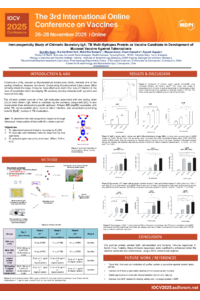
Introduction: Tuberculosis (TB), caused by Mycobacterium tuberculosis (Mtb), remains one of the most common infectious diseases worldwide. Considering that Mtb primarily infects the lungs, it may be more effective to match the route of infection to the route of vaccination when developing TB vaccines, in order to stimulate both systemic and mucosal immunity. This study explores the development and evaluation of a novel mucosal TB vaccine utilizing TB multi-epitopes.
Methods: The vaccine candidate was developed by engineering recombinant epitopes, including Ag85b, Acr, and RpfE, combined with SIgA. The constructs were cloned into AAV vectors. AAV vectors carrying the construct were co-transduced into mammary gland of goat, and milk was collected. The chimeric protein was purified from milk. BALB/c mice (n=5 per group) were divided into four main groups:PBS only, BCG+PBS, chimeric protein (Prot), and BCG with protein (BCG-Prot). The mice were immunized with 10 µg/ml chimeric protein intranasally, weekly, for three doses. After two weeks, the mice were sacrificed, and their splenocytes were cultured to evaluate their cellular responses. The IgG and IgA levels in serum, saliva, and lung lavage were measured using ELISA.
Results: Mice immunized with recombinant protein, especially those primed with BCG, showed higher IgG and IgA levels compared to other groups. With regard to cellular response, a significant increase in the percentage of activated CD4+ and CD8+ T-cells, memory cells, and cytokines production can be observed in BCG–protein group.
Conclusion: A protein complex formed by TB multi-epitopes and the secretory component can be expressed and purified in milk samples. Our study demonstrated that recombinant protein vaccine enhances mucosal immunity with intranasal immunization. The significant increase in humoral and cellular immune responses in mice, particularly in BCG-primed groups, highlights the potential of this vaccine as a booster candidate with BCG.
Keywords
Vaccine
Vaccines
Mucosal Vaccines
Intranasal Vaccines
Tuberculosis
Poster
IECV 2025.pdf
The Receptor binding domain 2 (RBD2) of binary toxin (CDT) as a promising vaccine candidate protects both mice and hamsters against CDT challenge
Successive efficacy evaluation of various commercial live-attenuated avian coronavirus vaccination schedules against challenge with circulating field strain of genotype 23 lineage