Event submissions
Published
This submission belongs to the session S6. Cancer Vaccines and Immunotherapy of the event The 3rd International Online Conference on Vaccines
Published date
21 Nov, 2025
Academic Editor
'%3e%3cpath%20d='M12.6657%2010.9104C12.4185%2010.325%2012.0599%209.79327%2011.6097%209.34482C11.1609%208.89508%2010.6293%208.5365%2010.0442%208.28888C10.0389%208.28626%2010.0337%208.28495%2010.0285%208.28233C10.8446%207.69279%2011.3752%206.73249%2011.3752%205.64904C11.3752%203.8542%209.92103%202.39999%208.1262%202.39999C6.33136%202.39999%204.87715%203.8542%204.87715%205.64904C4.87715%206.73249%205.40774%207.69279%206.22393%208.28364C6.21869%208.28626%206.21345%208.28757%206.20821%208.29019C5.62129%208.5378%205.09463%208.89284%204.64265%209.34613C4.1929%209.79493%203.83432%2010.3266%203.58671%2010.9117C3.34345%2011.4845%203.21226%2012.0987%203.20023%2012.7209C3.19988%2012.7349%203.20233%2012.7488%203.20744%2012.7619C3.21255%2012.7749%203.22022%2012.7867%203.22998%2012.7968C3.23975%2012.8068%203.25142%2012.8147%203.26431%2012.8202C3.2772%2012.8256%203.29105%2012.8284%203.30504%2012.8284H4.09109C4.14874%2012.8284%204.19459%2012.7825%204.1959%2012.7262C4.2221%2011.7148%204.62823%2010.7676%205.34617%2010.0497C6.08899%209.30683%207.0755%208.89808%208.1262%208.89808C9.17689%208.89808%2010.1634%209.30683%2010.9062%2010.0497C11.6242%2010.7676%2012.0303%2011.7148%2012.0565%2012.7262C12.0578%2012.7838%2012.1037%2012.8284%2012.1613%2012.8284H12.9474C12.9613%2012.8284%2012.9752%2012.8256%2012.9881%2012.8202C13.001%2012.8147%2013.0126%2012.8068%2013.0224%2012.7968C13.0322%2012.7867%2013.0398%2012.7749%2013.0449%2012.7619C13.0501%2012.7488%2013.0525%2012.7349%2013.0522%2012.7209C13.0391%2012.0947%2012.9094%2011.4855%2012.6657%2010.9104ZM8.1262%207.9024C7.52486%207.9024%206.9589%207.6679%206.53312%207.24211C6.10733%206.81633%205.87283%206.25037%205.87283%205.64904C5.87283%205.0477%206.10733%204.48174%206.53312%204.05596C6.9589%203.63018%207.52486%203.39567%208.1262%203.39567C8.72753%203.39567%209.29349%203.63018%209.71927%204.05596C10.1451%204.48174%2010.3796%205.0477%2010.3796%205.64904C10.3796%206.25037%2010.1451%206.81633%209.71927%207.24211C9.29349%207.6679%208.72753%207.9024%208.1262%207.9024Z'%20fill='%235D1EE1'/%3e%3c/g%3e%3c/svg%3e) Seth Pincus
Seth PincusCitation
Romano Josi, Lan Yang, Arnau Solé Casaramona, Sanjana Marar, Anish Ghimire, Alessandro Pardini, Anne Cathrine Vogt, Genrich Tolstonog, Martin Bachmann, Simone De Brot, Mona Mohsen, Programming immunity: a tetravalent mucosal nanovaccine for enhanced local and systemic antitumor responses, in Proceedings of The 3rd International Online Conference on Vaccines, 26 November–28 November 2025, MDPI: Basel, Switzerland
Share
Email
Facebook
Twitter
LinkedIn
Programming immunity: a tetravalent mucosal nanovaccine for enhanced local and systemic antitumor responses
'%3e%3cpath%20d='M12.6647%2010.9104C12.4176%2010.325%2012.0589%209.7933%2011.6088%209.34485C11.16%208.89511%2010.6283%208.53653%2010.0432%208.28891C10.038%208.28629%2010.0327%208.28498%2010.0275%208.28236C10.8437%207.69282%2011.3743%206.73252%2011.3743%205.64907C11.3743%203.85423%209.92005%202.40002%208.12522%202.40002C6.33038%202.40002%204.87618%203.85423%204.87618%205.64907C4.87618%206.73252%205.40677%207.69282%206.22296%208.28367C6.21772%208.28629%206.21248%208.2876%206.20724%208.29022C5.62031%208.53783%205.09365%208.89287%204.64167%209.34616C4.19192%209.79496%203.83334%2010.3266%203.58573%2010.9117C3.34247%2011.4846%203.21128%2012.0987%203.19925%2012.721C3.1989%2012.735%203.20135%2012.7489%203.20646%2012.7619C3.21157%2012.7749%203.21924%2012.7868%203.22901%2012.7968C3.23877%2012.8068%203.25045%2012.8148%203.26334%2012.8202C3.27623%2012.8256%203.29007%2012.8284%203.30406%2012.8284H4.09012C4.14776%2012.8284%204.19362%2012.7825%204.19493%2012.7262C4.22113%2011.7148%204.62726%2010.7676%205.34519%2010.0497C6.08802%209.30686%207.07452%208.89811%208.12522%208.89811C9.17592%208.89811%2010.1624%209.30686%2010.9052%2010.0497C11.6232%2010.7676%2012.0293%2011.7148%2012.0555%2012.7262C12.0568%2012.7839%2012.1027%2012.8284%2012.1603%2012.8284H12.9464C12.9604%2012.8284%2012.9742%2012.8256%2012.9871%2012.8202C13%2012.8148%2013.0117%2012.8068%2013.0214%2012.7968C13.0312%2012.7868%2013.0389%2012.7749%2013.044%2012.7619C13.0491%2012.7489%2013.0515%2012.735%2013.0512%2012.721C13.0381%2012.0947%2012.9084%2011.4856%2012.6647%2010.9104ZM8.12522%207.90243C7.52388%207.90243%206.95792%207.66793%206.53214%207.24215C6.10636%206.81636%205.87185%206.2504%205.87185%205.64907C5.87185%205.04773%206.10636%204.48177%206.53214%204.05599C6.95792%203.63021%207.52388%203.3957%208.12522%203.3957C8.72655%203.3957%209.29252%203.63021%209.7183%204.05599C10.1441%204.48177%2010.3786%205.04773%2010.3786%205.64907C10.3786%206.2504%2010.1441%206.81636%209.7183%207.24215C9.29252%207.66793%208.72655%207.90243%208.12522%207.90243Z'%20fill='%235D1EE1'/%3e%3c/g%3e%3c/svg%3e)
Romano Josi 1,2,3
Lan Yang 1,2

Arnau Solé Casaramona 1,2
Sanjana Marar 1,2
Anish Ghimire 1,2
Alessandro Pardini 1,2,3
Anne Cathrine Vogt 1,2
Genrich Tolstonog 4,5

Martin Bachmann 1,2,6
Simone De Brot 7
Mona Mohsen 1,2,8
1. Department of Rheumatology and Immunology, University Hospital of Bern, Bern, Switzerland
2. Department of BioMedical Research, University of Bern, Bern, Switzerland
3. Graduate School for Cellular and Biomedical Sciences (GCB), Bern, Switzerland.
4. Department of Otolaryngology - Head and Neck Surgery, Lausanne University Hospital and University of Lausanne, Lausanne, Switzerland.
5. Agora Cancer Research Centre, Lausanne, Switzerland.
6. Nuffield Department of Medicine, The Henry Welcome Building for Molecular Physiology, The Jenner Institute, University of Oxford, Oxford, UK.
7. COMPATH, Institute of Animal Pathology, University of Bern, Bern, Switzerland.
8. Tajarub Research & Development, Doha, State of Qatar
Abstract
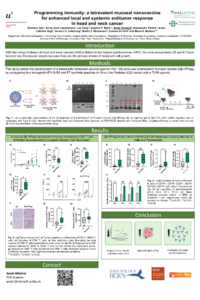
Introduction: Mucosal tumors, such as human papillomavirus (HPV)-driven head and neck carcinomas (HNC), present distinct therapeutic challenges due to their anatomical site and immunological environment. While most therapeutic cancer vaccines emphasize T cell responses, emerging evidence highlights a pivotal role for B cells in antitumor immunity. The contribution of B cells in mucosal tumors, however, remains poorly understood. Methods: We evaluated an intranasally delivered, tetravalent virus-like particle (VLP) nanovaccine, Qβ-HPVag, which presents elongated HPV16 E6/E7 epitopes and includes a TLR-9 agonist for self-adjuvancy. Using a cold, orthotopic HPV⁺ HNC mouse model, we assessed local and systemic immune responses following mucosal immunization. Results: Qβ-HPVag significantly reduced tumor burden and enhanced infiltration and function of cytotoxic CD8⁺ T cells within the tumor microenvironment. Critically, B cell depletion abrogated the vaccine’s efficacy, revealing a central role for B cells in mediating antitumor responses. Vaccination led to the expansion of tumor-infiltrating memory B cells, plasmablasts, and IgA⁺ B cells, and induced robust systemic HPV-specific IgG. Notably, vaccine efficacy was lost in C3-deficient mice, implicating complement activation as a key mediator of humoral immunity. Conclusion:Our findings demonstrate that effective mucosal vaccination against HPV⁺ HNC requires coordinated activation of both B and T cells. This study establishes B cells and complement pathways as critical components of next-generation therapeutic vaccine strategies for mucosal cancers.
Keywords
HPV-associated HNC
therapeutic tetravalent nanovaccine
orthotopic tumor model
mucosal-targeted
Poster
MDPI_Poster_AG.pdf
Selection, Design and Immunogenicity Studies of ASFV Antigens for Subunit mRNA Cocktail Vaccines with Specific Immune Response Profiles
Acceptance of HPV vaccination among adolescent girls in the EMRO region: preliminary results of a systematic review