Event submissions
Published
This submission belongs to the session S1. The Supramolecular Structure and Properties of Gels of the event The 1st International Online Conference on Gels
Published date
28 Nov, 2025
Academic Editor
'%3e%3cpath%20d='M12.6657%2010.9104C12.4185%2010.325%2012.0599%209.79327%2011.6097%209.34482C11.1609%208.89508%2010.6293%208.5365%2010.0442%208.28888C10.0389%208.28626%2010.0337%208.28495%2010.0285%208.28233C10.8446%207.69279%2011.3752%206.73249%2011.3752%205.64904C11.3752%203.8542%209.92103%202.39999%208.1262%202.39999C6.33136%202.39999%204.87715%203.8542%204.87715%205.64904C4.87715%206.73249%205.40774%207.69279%206.22393%208.28364C6.21869%208.28626%206.21345%208.28757%206.20821%208.29019C5.62129%208.5378%205.09463%208.89284%204.64265%209.34613C4.1929%209.79493%203.83432%2010.3266%203.58671%2010.9117C3.34345%2011.4845%203.21226%2012.0987%203.20023%2012.7209C3.19988%2012.7349%203.20233%2012.7488%203.20744%2012.7619C3.21255%2012.7749%203.22022%2012.7867%203.22998%2012.7968C3.23975%2012.8068%203.25142%2012.8147%203.26431%2012.8202C3.2772%2012.8256%203.29105%2012.8284%203.30504%2012.8284H4.09109C4.14874%2012.8284%204.19459%2012.7825%204.1959%2012.7262C4.2221%2011.7148%204.62823%2010.7676%205.34617%2010.0497C6.08899%209.30683%207.0755%208.89808%208.1262%208.89808C9.17689%208.89808%2010.1634%209.30683%2010.9062%2010.0497C11.6242%2010.7676%2012.0303%2011.7148%2012.0565%2012.7262C12.0578%2012.7838%2012.1037%2012.8284%2012.1613%2012.8284H12.9474C12.9613%2012.8284%2012.9752%2012.8256%2012.9881%2012.8202C13.001%2012.8147%2013.0126%2012.8068%2013.0224%2012.7968C13.0322%2012.7867%2013.0398%2012.7749%2013.0449%2012.7619C13.0501%2012.7488%2013.0525%2012.7349%2013.0522%2012.7209C13.0391%2012.0947%2012.9094%2011.4855%2012.6657%2010.9104ZM8.1262%207.9024C7.52486%207.9024%206.9589%207.6679%206.53312%207.24211C6.10733%206.81633%205.87283%206.25037%205.87283%205.64904C5.87283%205.0477%206.10733%204.48174%206.53312%204.05596C6.9589%203.63018%207.52486%203.39567%208.1262%203.39567C8.72753%203.39567%209.29349%203.63018%209.71927%204.05596C10.1451%204.48174%2010.3796%205.0477%2010.3796%205.64904C10.3796%206.25037%2010.1451%206.81633%209.71927%207.24211C9.29349%207.6679%208.72753%207.9024%208.1262%207.9024Z'%20fill='%235D1EE1'/%3e%3c/g%3e%3c/svg%3e) Paula Ferreira
Paula FerreiraCitation
Shreya Pande, Priyadarshi Chakraborty, Falguni Pati, Supramolecularly Reinforced Hydrogel Scaffolds for Advanced Tissue Engineering, in Proceedings of The 1st International Online Conference on Gels, 3 December–5 December 2025, MDPI: Basel, Switzerland
Share
Email
Facebook
Twitter
LinkedIn
Supramolecularly Reinforced Hydrogel Scaffolds for Advanced Tissue Engineering
'%3e%3cpath%20d='M12.6647%2010.9104C12.4176%2010.325%2012.0589%209.7933%2011.6088%209.34485C11.16%208.89511%2010.6283%208.53653%2010.0432%208.28891C10.038%208.28629%2010.0327%208.28498%2010.0275%208.28236C10.8437%207.69282%2011.3743%206.73252%2011.3743%205.64907C11.3743%203.85423%209.92005%202.40002%208.12522%202.40002C6.33038%202.40002%204.87618%203.85423%204.87618%205.64907C4.87618%206.73252%205.40677%207.69282%206.22296%208.28367C6.21772%208.28629%206.21248%208.2876%206.20724%208.29022C5.62031%208.53783%205.09365%208.89287%204.64167%209.34616C4.19192%209.79496%203.83334%2010.3266%203.58573%2010.9117C3.34247%2011.4846%203.21128%2012.0987%203.19925%2012.721C3.1989%2012.735%203.20135%2012.7489%203.20646%2012.7619C3.21157%2012.7749%203.21924%2012.7868%203.22901%2012.7968C3.23877%2012.8068%203.25045%2012.8148%203.26334%2012.8202C3.27623%2012.8256%203.29007%2012.8284%203.30406%2012.8284H4.09012C4.14776%2012.8284%204.19362%2012.7825%204.19493%2012.7262C4.22113%2011.7148%204.62726%2010.7676%205.34519%2010.0497C6.08802%209.30686%207.07452%208.89811%208.12522%208.89811C9.17592%208.89811%2010.1624%209.30686%2010.9052%2010.0497C11.6232%2010.7676%2012.0293%2011.7148%2012.0555%2012.7262C12.0568%2012.7839%2012.1027%2012.8284%2012.1603%2012.8284H12.9464C12.9604%2012.8284%2012.9742%2012.8256%2012.9871%2012.8202C13%2012.8148%2013.0117%2012.8068%2013.0214%2012.7968C13.0312%2012.7868%2013.0389%2012.7749%2013.044%2012.7619C13.0491%2012.7489%2013.0515%2012.735%2013.0512%2012.721C13.0381%2012.0947%2012.9084%2011.4856%2012.6647%2010.9104ZM8.12522%207.90243C7.52388%207.90243%206.95792%207.66793%206.53214%207.24215C6.10636%206.81636%205.87185%206.2504%205.87185%205.64907C5.87185%205.04773%206.10636%204.48177%206.53214%204.05599C6.95792%203.63021%207.52388%203.3957%208.12522%203.3957C8.72655%203.3957%209.29252%203.63021%209.7183%204.05599C10.1441%204.48177%2010.3786%205.04773%2010.3786%205.64907C10.3786%206.2504%2010.1441%206.81636%209.7183%207.24215C9.29252%207.66793%208.72655%207.90243%208.12522%207.90243Z'%20fill='%235D1EE1'/%3e%3c/g%3e%3c/svg%3e)
Shreya Pande 1

Priyadarshi Chakraborty 2
Falguni Pati 1
1. Department of Biomedical Engineering, Indian Institute of Technology Hyderabad, Sangareddy, Telangana, India, 502285
2. Department of Chemistry, Indian Institute of Technology Hyderabad, Sangareeddy, Telangana, India, 502285
Abstract
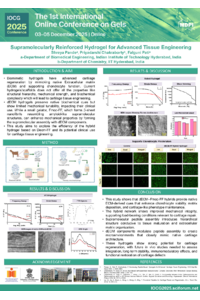
The regeneration of articular cartilage is hindered by the absence of intrinsic repair mechanisms and the lack of scaffolds that integrate both biochemical functionality and mechanical resilience. Conventional hydrogels capture certain aspects of the native niche yet remain limited by weak supramolecular cohesion and insufficient load-bearing capacity. To overcome these barriers, a hybrid hydrogel was engineered by coupling decellularized cartilage extracellular matrix (dECM) with the self-assembling peptide: fluorenylmethoxycarbonyl-modified amino acids (Fmoc-xx). Hydrogels derived from dECM retain native proteins and signaling motifs but typically collapse under physiological stresses, restricting their therapeutic value. While dECM offers native adhesion sites and instructive biochemical cues, Fmoc-xx nanofibers form a supramolecular framework that interpenetrates ECM macromolecules through hydrogen bonding and aromatic π–π stacking. These cooperative interactions generate a hierarchically organized network that transforms the mechanically fragile dECM hydrogel into a resilient, load-bearing construct. This molecular reinforcement elevated the storage modulus by nearly three orders (~1000 fold increase) of magnitude while preserving hydration and network stability. Furthermore, the hybrid scaffold provided a cell-compatible niche that enabled rapid chondrocyte adhesion as well as sustained proliferation. The hybrid hydrogel could maintain the chondrogenic phenotype, underscoring the synergy between structural resilience and biological fidelity. By uniting supramolecular self-assembly with native matrix bioactivity, this work advances a materials strategy that converts fragile dECM gels into robust, functional scaffolds. Such reinforced hydrogels do not merely mimic tissue microenvironments but actively integrate strength with bioactivity, positioning them as next-generation platforms for cartilage regeneration and broader tissue engineering applications.
Keywords
Supramolecular hydrogel
biomimicking
self-assembly
cartilage regeneration
mechanical reinforcement
Poster
IOCG_Shreya_IIT Hydearabad India.pdf
Minimalistic Tryptophan-Based Supramolecular Hydrogel as a Versatile Catalytic Scaffold
Multicomponent nucleopeptide-based hydrogels: from complexity to tunability and potential