Event submissions
Published
This submission belongs to the session S4. Gels in Medicine, Regenerative Medicine, Pharmacy, and Personal Care Products of the event The 1st International Online Conference on Gels
Published date
28 Nov, 2025
Academic Editor
'%3e%3cpath%20d='M12.6657%2010.9104C12.4185%2010.325%2012.0599%209.79327%2011.6097%209.34482C11.1609%208.89508%2010.6293%208.5365%2010.0442%208.28888C10.0389%208.28626%2010.0337%208.28495%2010.0285%208.28233C10.8446%207.69279%2011.3752%206.73249%2011.3752%205.64904C11.3752%203.8542%209.92103%202.39999%208.1262%202.39999C6.33136%202.39999%204.87715%203.8542%204.87715%205.64904C4.87715%206.73249%205.40774%207.69279%206.22393%208.28364C6.21869%208.28626%206.21345%208.28757%206.20821%208.29019C5.62129%208.5378%205.09463%208.89284%204.64265%209.34613C4.1929%209.79493%203.83432%2010.3266%203.58671%2010.9117C3.34345%2011.4845%203.21226%2012.0987%203.20023%2012.7209C3.19988%2012.7349%203.20233%2012.7488%203.20744%2012.7619C3.21255%2012.7749%203.22022%2012.7867%203.22998%2012.7968C3.23975%2012.8068%203.25142%2012.8147%203.26431%2012.8202C3.2772%2012.8256%203.29105%2012.8284%203.30504%2012.8284H4.09109C4.14874%2012.8284%204.19459%2012.7825%204.1959%2012.7262C4.2221%2011.7148%204.62823%2010.7676%205.34617%2010.0497C6.08899%209.30683%207.0755%208.89808%208.1262%208.89808C9.17689%208.89808%2010.1634%209.30683%2010.9062%2010.0497C11.6242%2010.7676%2012.0303%2011.7148%2012.0565%2012.7262C12.0578%2012.7838%2012.1037%2012.8284%2012.1613%2012.8284H12.9474C12.9613%2012.8284%2012.9752%2012.8256%2012.9881%2012.8202C13.001%2012.8147%2013.0126%2012.8068%2013.0224%2012.7968C13.0322%2012.7867%2013.0398%2012.7749%2013.0449%2012.7619C13.0501%2012.7488%2013.0525%2012.7349%2013.0522%2012.7209C13.0391%2012.0947%2012.9094%2011.4855%2012.6657%2010.9104ZM8.1262%207.9024C7.52486%207.9024%206.9589%207.6679%206.53312%207.24211C6.10733%206.81633%205.87283%206.25037%205.87283%205.64904C5.87283%205.0477%206.10733%204.48174%206.53312%204.05596C6.9589%203.63018%207.52486%203.39567%208.1262%203.39567C8.72753%203.39567%209.29349%203.63018%209.71927%204.05596C10.1451%204.48174%2010.3796%205.0477%2010.3796%205.64904C10.3796%206.25037%2010.1451%206.81633%209.71927%207.24211C9.29349%207.6679%208.72753%207.9024%208.1262%207.9024Z'%20fill='%235D1EE1'/%3e%3c/g%3e%3c/svg%3e) Aline Miller
Aline MillerCitation
Gladys Arline Politrón Zepeda, Moisés Martínez Velázquez, Rogelio Rodríguez Rodríguez, Zaira Yunuen García Carvajal, Formulation and In Vitro Evaluation of a Thermosensitive Hydrogel as an Intravaginal Drug Delivery System, in Proceedings of The 1st International Online Conference on Gels, 3 December–5 December 2025, MDPI: Basel, Switzerland
Share
Email
Facebook
Twitter
LinkedIn
Formulation and In Vitro Evaluation of a Thermosensitive Hydrogel as an Intravaginal Drug Delivery System
'%3e%3cpath%20d='M12.6647%2010.9104C12.4176%2010.325%2012.0589%209.7933%2011.6088%209.34485C11.16%208.89511%2010.6283%208.53653%2010.0432%208.28891C10.038%208.28629%2010.0327%208.28498%2010.0275%208.28236C10.8437%207.69282%2011.3743%206.73252%2011.3743%205.64907C11.3743%203.85423%209.92005%202.40002%208.12522%202.40002C6.33038%202.40002%204.87618%203.85423%204.87618%205.64907C4.87618%206.73252%205.40677%207.69282%206.22296%208.28367C6.21772%208.28629%206.21248%208.2876%206.20724%208.29022C5.62031%208.53783%205.09365%208.89287%204.64167%209.34616C4.19192%209.79496%203.83334%2010.3266%203.58573%2010.9117C3.34247%2011.4846%203.21128%2012.0987%203.19925%2012.721C3.1989%2012.735%203.20135%2012.7489%203.20646%2012.7619C3.21157%2012.7749%203.21924%2012.7868%203.22901%2012.7968C3.23877%2012.8068%203.25045%2012.8148%203.26334%2012.8202C3.27623%2012.8256%203.29007%2012.8284%203.30406%2012.8284H4.09012C4.14776%2012.8284%204.19362%2012.7825%204.19493%2012.7262C4.22113%2011.7148%204.62726%2010.7676%205.34519%2010.0497C6.08802%209.30686%207.07452%208.89811%208.12522%208.89811C9.17592%208.89811%2010.1624%209.30686%2010.9052%2010.0497C11.6232%2010.7676%2012.0293%2011.7148%2012.0555%2012.7262C12.0568%2012.7839%2012.1027%2012.8284%2012.1603%2012.8284H12.9464C12.9604%2012.8284%2012.9742%2012.8256%2012.9871%2012.8202C13%2012.8148%2013.0117%2012.8068%2013.0214%2012.7968C13.0312%2012.7868%2013.0389%2012.7749%2013.044%2012.7619C13.0491%2012.7489%2013.0515%2012.735%2013.0512%2012.721C13.0381%2012.0947%2012.9084%2011.4856%2012.6647%2010.9104ZM8.12522%207.90243C7.52388%207.90243%206.95792%207.66793%206.53214%207.24215C6.10636%206.81636%205.87185%206.2504%205.87185%205.64907C5.87185%205.04773%206.10636%204.48177%206.53214%204.05599C6.95792%203.63021%207.52388%203.3957%208.12522%203.3957C8.72655%203.3957%209.29252%203.63021%209.7183%204.05599C10.1441%204.48177%2010.3786%205.04773%2010.3786%205.64907C10.3786%206.2504%2010.1441%206.81636%209.7183%207.24215C9.29252%207.66793%208.72655%207.90243%208.12522%207.90243Z'%20fill='%235D1EE1'/%3e%3c/g%3e%3c/svg%3e)
Gladys Arline Politrón Zepeda 1

Moisés Martínez Velázquez 1
Rogelio Rodríguez Rodríguez 2

Zaira Yunuen García Carvajal 1
1. Department of Pharmaceutical Medical Biotechnology, Center for Research and Assistance in Technology and Design of the State of Jalisco (CIATEJ), A.C., Guadalajara, 44270, Mexico
2. Department of Health Sciences, University Center of the Valles (CUValles), University of Guadalajara
Ameca, Jalisco, 46600, Mexico
Abstract
Introduction.
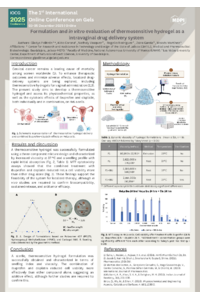
Cervical cancer remains one of the leading causes of female mortality worldwide. Localized drug delivery systems, such as thermosensitive hydrogels for intravaginal administration, offer the potential to improve therapeutic efficacy while minimizing systemic side effects. This study aimed to formulate a thermosensitive hydrogel based on Pluronic F127, hydroxypropyl methylcellulose (HPMC), and Carbopol 940, and to evaluate its physicochemical properties and the cytotoxicity of ibuprofen and cisplatin to explore a potential additive effect.
Methods.
A thermosensitive hydrogel was prepared using the cold method with Poloxamer 407, hydroxypropyl methylcellulose (HPMC), and Carbopol 940. Component ratios were optimized through mixture design considering gelling temperature and viscosity. Physicochemical characterization included viscosity (rotational viscometer), sol–gel transition temperature (tube inversion), and swelling ratio in simulated vaginal fluid. Drug entrapment was assessed by UV-Vis spectrophotometry. Cytotoxicity was assessed in HeLa cells using the MTT assay after exposure to ibuprofen and cisplatin for 24–72 h.
Results.
The hydrogel exhibited a swelling ratio (SR) of 2.08 after 3 h of hydration, corresponding to the point of maximum absorption. Cytotoxicity assays showed that ibuprofen alone induced a dose-dependent decrease in HeLa cell viability, from 98.9% at 0.39 mM to 15.6% at 12.5 mM. The calculated IC₅₀ was 9.8 mM. In contrast, sequential treatment with cisplatin at its IC₅₀ concentration (24 h) followed by ibuprofen (24 h) markedly enhanced the cytotoxic effect. Under these conditions, viability was already reduced to 44.8% at 0.39 mM and further declined to 9.3% at 12.5 mM, indicating an additive effect of the combined therapy compared with ibuprofen alone.
Conclusions.
A sterile thermosensitive hydrogel was successfully formulated and characterized. The combination of ibuprofen and cisplatin reduced HeLa cell viability more than individual treatments, indicating a potential additive effect, although further studies are required to confirm this.
Acknowledgment.
This study was supported by project CBF2023-2024-2164.
Keywords
injectable thermosensitive hydrogel
drug delivery
cytotoxicity
Poster
Poster congreso gels-3.pdf
Oxygen-releasing xerogel dressings accelerate healing in diabetic wound models
Biopolymeric Hydrogel Platforms Integrated with Colorimetric Indicators for Sustainable Intelligent Packaging