Event submissions
Published
This submission belongs to the session S4. Gels in Medicine, Regenerative Medicine, Pharmacy, and Personal Care Products of the event The 1st International Online Conference on Gels
Published date
28 Nov, 2025
Academic Editor
'%3e%3cpath%20d='M12.6657%2010.9104C12.4185%2010.325%2012.0599%209.79327%2011.6097%209.34482C11.1609%208.89508%2010.6293%208.5365%2010.0442%208.28888C10.0389%208.28626%2010.0337%208.28495%2010.0285%208.28233C10.8446%207.69279%2011.3752%206.73249%2011.3752%205.64904C11.3752%203.8542%209.92103%202.39999%208.1262%202.39999C6.33136%202.39999%204.87715%203.8542%204.87715%205.64904C4.87715%206.73249%205.40774%207.69279%206.22393%208.28364C6.21869%208.28626%206.21345%208.28757%206.20821%208.29019C5.62129%208.5378%205.09463%208.89284%204.64265%209.34613C4.1929%209.79493%203.83432%2010.3266%203.58671%2010.9117C3.34345%2011.4845%203.21226%2012.0987%203.20023%2012.7209C3.19988%2012.7349%203.20233%2012.7488%203.20744%2012.7619C3.21255%2012.7749%203.22022%2012.7867%203.22998%2012.7968C3.23975%2012.8068%203.25142%2012.8147%203.26431%2012.8202C3.2772%2012.8256%203.29105%2012.8284%203.30504%2012.8284H4.09109C4.14874%2012.8284%204.19459%2012.7825%204.1959%2012.7262C4.2221%2011.7148%204.62823%2010.7676%205.34617%2010.0497C6.08899%209.30683%207.0755%208.89808%208.1262%208.89808C9.17689%208.89808%2010.1634%209.30683%2010.9062%2010.0497C11.6242%2010.7676%2012.0303%2011.7148%2012.0565%2012.7262C12.0578%2012.7838%2012.1037%2012.8284%2012.1613%2012.8284H12.9474C12.9613%2012.8284%2012.9752%2012.8256%2012.9881%2012.8202C13.001%2012.8147%2013.0126%2012.8068%2013.0224%2012.7968C13.0322%2012.7867%2013.0398%2012.7749%2013.0449%2012.7619C13.0501%2012.7488%2013.0525%2012.7349%2013.0522%2012.7209C13.0391%2012.0947%2012.9094%2011.4855%2012.6657%2010.9104ZM8.1262%207.9024C7.52486%207.9024%206.9589%207.6679%206.53312%207.24211C6.10733%206.81633%205.87283%206.25037%205.87283%205.64904C5.87283%205.0477%206.10733%204.48174%206.53312%204.05596C6.9589%203.63018%207.52486%203.39567%208.1262%203.39567C8.72753%203.39567%209.29349%203.63018%209.71927%204.05596C10.1451%204.48174%2010.3796%205.0477%2010.3796%205.64904C10.3796%206.25037%2010.1451%206.81633%209.71927%207.24211C9.29349%207.6679%208.72753%207.9024%208.1262%207.9024Z'%20fill='%235D1EE1'/%3e%3c/g%3e%3c/svg%3e) Aline Miller
Aline MillerCitation
Joaquín Horacio Palma, Marcos Bertuola, Patricia Carolina Rivas Rojas, Élida Beatriz Hermida, OBTAINING MESH SIZES FOR VISCOELASTIC ALGINATE-BASED HYDROGELS USING FLORY THEORY AND SAXS, in Proceedings of The 1st International Online Conference on Gels, 3 December–5 December 2025, MDPI: Basel, Switzerland
Share
Email
Facebook
Twitter
LinkedIn
OBTAINING MESH SIZES FOR VISCOELASTIC ALGINATE-BASED HYDROGELS USING FLORY THEORY AND SAXS
'%3e%3cpath%20d='M12.6647%2010.9104C12.4176%2010.325%2012.0589%209.7933%2011.6088%209.34485C11.16%208.89511%2010.6283%208.53653%2010.0432%208.28891C10.038%208.28629%2010.0327%208.28498%2010.0275%208.28236C10.8437%207.69282%2011.3743%206.73252%2011.3743%205.64907C11.3743%203.85423%209.92005%202.40002%208.12522%202.40002C6.33038%202.40002%204.87618%203.85423%204.87618%205.64907C4.87618%206.73252%205.40677%207.69282%206.22296%208.28367C6.21772%208.28629%206.21248%208.2876%206.20724%208.29022C5.62031%208.53783%205.09365%208.89287%204.64167%209.34616C4.19192%209.79496%203.83334%2010.3266%203.58573%2010.9117C3.34247%2011.4846%203.21128%2012.0987%203.19925%2012.721C3.1989%2012.735%203.20135%2012.7489%203.20646%2012.7619C3.21157%2012.7749%203.21924%2012.7868%203.22901%2012.7968C3.23877%2012.8068%203.25045%2012.8148%203.26334%2012.8202C3.27623%2012.8256%203.29007%2012.8284%203.30406%2012.8284H4.09012C4.14776%2012.8284%204.19362%2012.7825%204.19493%2012.7262C4.22113%2011.7148%204.62726%2010.7676%205.34519%2010.0497C6.08802%209.30686%207.07452%208.89811%208.12522%208.89811C9.17592%208.89811%2010.1624%209.30686%2010.9052%2010.0497C11.6232%2010.7676%2012.0293%2011.7148%2012.0555%2012.7262C12.0568%2012.7839%2012.1027%2012.8284%2012.1603%2012.8284H12.9464C12.9604%2012.8284%2012.9742%2012.8256%2012.9871%2012.8202C13%2012.8148%2013.0117%2012.8068%2013.0214%2012.7968C13.0312%2012.7868%2013.0389%2012.7749%2013.044%2012.7619C13.0491%2012.7489%2013.0515%2012.735%2013.0512%2012.721C13.0381%2012.0947%2012.9084%2011.4856%2012.6647%2010.9104ZM8.12522%207.90243C7.52388%207.90243%206.95792%207.66793%206.53214%207.24215C6.10636%206.81636%205.87185%206.2504%205.87185%205.64907C5.87185%205.04773%206.10636%204.48177%206.53214%204.05599C6.95792%203.63021%207.52388%203.3957%208.12522%203.3957C8.72655%203.3957%209.29252%203.63021%209.7183%204.05599C10.1441%204.48177%2010.3786%205.04773%2010.3786%205.64907C10.3786%206.2504%2010.1441%206.81636%209.7183%207.24215C9.29252%207.66793%208.72655%207.90243%208.12522%207.90243Z'%20fill='%235D1EE1'/%3e%3c/g%3e%3c/svg%3e)
Joaquín Horacio Palma 1
Marcos Bertuola 1
Patricia Carolina Rivas Rojas 1

Élida Beatriz Hermida 1
1. Institute of Emerging Technologies and Applied Sciences (ITECA), The School of Science and Technology (ECyT) at the National University of San Martín (UNSAM), San Martín, Buenos Aires, 1650, Argentina
Abstract
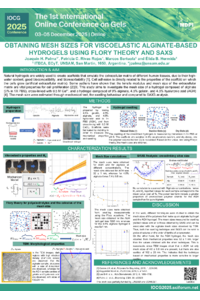
Natural hydrogels are widely used to create scaffolds that emulate the extracellular matrix of different human tissues, due to their high-water content, good biocompatibility, and bioresorbability. Cell adhesion is directly related to the properties of the scaffold on which the cells grow (artificial extracellular matrix). Some authors have shown that the tensile modulus and mesh size of the extracellular matrix are vital properties for cell proliferation.
This study aims to investigate the mechanical properties of a hydrogel composed of alginate (9% in 1X PBS), cross-linked with 0.5 M Ca²⁺, and a hydrogel composed of 9% alginate, 4.5% gelatin, and 4.5% hyaluronic acid (AGH). The mechanical properties of the hydrogel were measured using a dynamic mechanical analyzer (DMA), and the obtained curves were fitted using a viscoelastic model. The elastic component of the model was used to calculate the mesh size generated by the polymer network; mesh sizes of 6.3 ± 0.1 nm were obtained for the alginate hydrogels and 19.5 ± 0.2 nm for the AGH hydrogel.
On the other hand, the swelling of the hydrogels in a PBS solution with pH 5 was measured after 5 days of immersion. A modification of Flory's equations, which considers pH-sensitive hydrogels, was used to estimate the mesh size from the swelling tests. Mesh sizes of 2.9 ± 0.1 nm were obtained for alginate hydrogels and 3.5 ± 0.1 nm for AGH hydrogel. These results were related to mesh sizes obtained from SAXS measurements. The obtained curves were adjusted by the Debye–Bueche function, and a characteristic size of 4.15 ± 0.04 nm was obtained for alginate hydrogels and 3.21 ± 0.04 nm for AGH hydrogel.
The incorporation of gelatin and hyaluronic acid increases the mesh size, allowing modulation of the extracellular matrix structure.
Keywords
hydrogels
swelling
mesh size
viscoelasticity
Poster
Joaquin_Palma.pdf
Phenylalanine-Based Low-Molecular-Weight Gelators: Synthesis, Supramolecular Characterization and Multicomponent Gelation
Bioactive hydrogel enriched with natural-origin components has benefits for therapeutic applications