Event submissions
Published
This submission belongs to the session S2. Hydrogels, Organogels, Xerogels, and Aerogels of the event The 1st International Online Conference on Gels
Published date
28 Nov, 2025
Academic Editor
'%3e%3cpath%20d='M12.6657%2010.9104C12.4185%2010.325%2012.0599%209.79327%2011.6097%209.34482C11.1609%208.89508%2010.6293%208.5365%2010.0442%208.28888C10.0389%208.28626%2010.0337%208.28495%2010.0285%208.28233C10.8446%207.69279%2011.3752%206.73249%2011.3752%205.64904C11.3752%203.8542%209.92103%202.39999%208.1262%202.39999C6.33136%202.39999%204.87715%203.8542%204.87715%205.64904C4.87715%206.73249%205.40774%207.69279%206.22393%208.28364C6.21869%208.28626%206.21345%208.28757%206.20821%208.29019C5.62129%208.5378%205.09463%208.89284%204.64265%209.34613C4.1929%209.79493%203.83432%2010.3266%203.58671%2010.9117C3.34345%2011.4845%203.21226%2012.0987%203.20023%2012.7209C3.19988%2012.7349%203.20233%2012.7488%203.20744%2012.7619C3.21255%2012.7749%203.22022%2012.7867%203.22998%2012.7968C3.23975%2012.8068%203.25142%2012.8147%203.26431%2012.8202C3.2772%2012.8256%203.29105%2012.8284%203.30504%2012.8284H4.09109C4.14874%2012.8284%204.19459%2012.7825%204.1959%2012.7262C4.2221%2011.7148%204.62823%2010.7676%205.34617%2010.0497C6.08899%209.30683%207.0755%208.89808%208.1262%208.89808C9.17689%208.89808%2010.1634%209.30683%2010.9062%2010.0497C11.6242%2010.7676%2012.0303%2011.7148%2012.0565%2012.7262C12.0578%2012.7838%2012.1037%2012.8284%2012.1613%2012.8284H12.9474C12.9613%2012.8284%2012.9752%2012.8256%2012.9881%2012.8202C13.001%2012.8147%2013.0126%2012.8068%2013.0224%2012.7968C13.0322%2012.7867%2013.0398%2012.7749%2013.0449%2012.7619C13.0501%2012.7488%2013.0525%2012.7349%2013.0522%2012.7209C13.0391%2012.0947%2012.9094%2011.4855%2012.6657%2010.9104ZM8.1262%207.9024C7.52486%207.9024%206.9589%207.6679%206.53312%207.24211C6.10733%206.81633%205.87283%206.25037%205.87283%205.64904C5.87283%205.0477%206.10733%204.48174%206.53312%204.05596C6.9589%203.63018%207.52486%203.39567%208.1262%203.39567C8.72753%203.39567%209.29349%203.63018%209.71927%204.05596C10.1451%204.48174%2010.3796%205.0477%2010.3796%205.64904C10.3796%206.25037%2010.1451%206.81633%209.71927%207.24211C9.29349%207.6679%208.72753%207.9024%208.1262%207.9024Z'%20fill='%235D1EE1'/%3e%3c/g%3e%3c/svg%3e) SIDI A. BENCHERIF
SIDI A. BENCHERIFCitation
Katerina Koshenaj, Giovanna Ferrari, Impact of Storage on the Structure Stability of Starch-Based HPP Hydrogels Loaded with Natural Extracts, in Proceedings of The 1st International Online Conference on Gels, 3 December–5 December 2025, MDPI: Basel, Switzerland
Share
Email
Facebook
Twitter
LinkedIn
Impact of Storage on the Structure Stability of Starch-Based HPP Hydrogels Loaded with Natural Extracts
'%3e%3cpath%20d='M12.6647%2010.9104C12.4176%2010.325%2012.0589%209.7933%2011.6088%209.34485C11.16%208.89511%2010.6283%208.53653%2010.0432%208.28891C10.038%208.28629%2010.0327%208.28498%2010.0275%208.28236C10.8437%207.69282%2011.3743%206.73252%2011.3743%205.64907C11.3743%203.85423%209.92005%202.40002%208.12522%202.40002C6.33038%202.40002%204.87618%203.85423%204.87618%205.64907C4.87618%206.73252%205.40677%207.69282%206.22296%208.28367C6.21772%208.28629%206.21248%208.2876%206.20724%208.29022C5.62031%208.53783%205.09365%208.89287%204.64167%209.34616C4.19192%209.79496%203.83334%2010.3266%203.58573%2010.9117C3.34247%2011.4846%203.21128%2012.0987%203.19925%2012.721C3.1989%2012.735%203.20135%2012.7489%203.20646%2012.7619C3.21157%2012.7749%203.21924%2012.7868%203.22901%2012.7968C3.23877%2012.8068%203.25045%2012.8148%203.26334%2012.8202C3.27623%2012.8256%203.29007%2012.8284%203.30406%2012.8284H4.09012C4.14776%2012.8284%204.19362%2012.7825%204.19493%2012.7262C4.22113%2011.7148%204.62726%2010.7676%205.34519%2010.0497C6.08802%209.30686%207.07452%208.89811%208.12522%208.89811C9.17592%208.89811%2010.1624%209.30686%2010.9052%2010.0497C11.6232%2010.7676%2012.0293%2011.7148%2012.0555%2012.7262C12.0568%2012.7839%2012.1027%2012.8284%2012.1603%2012.8284H12.9464C12.9604%2012.8284%2012.9742%2012.8256%2012.9871%2012.8202C13%2012.8148%2013.0117%2012.8068%2013.0214%2012.7968C13.0312%2012.7868%2013.0389%2012.7749%2013.044%2012.7619C13.0491%2012.7489%2013.0515%2012.735%2013.0512%2012.721C13.0381%2012.0947%2012.9084%2011.4856%2012.6647%2010.9104ZM8.12522%207.90243C7.52388%207.90243%206.95792%207.66793%206.53214%207.24215C6.10636%206.81636%205.87185%206.2504%205.87185%205.64907C5.87185%205.04773%206.10636%204.48177%206.53214%204.05599C6.95792%203.63021%207.52388%203.3957%208.12522%203.3957C8.72655%203.3957%209.29252%203.63021%209.7183%204.05599C10.1441%204.48177%2010.3786%205.04773%2010.3786%205.64907C10.3786%206.2504%2010.1441%206.81636%209.7183%207.24215C9.29252%207.66793%208.72655%207.90243%208.12522%207.90243Z'%20fill='%235D1EE1'/%3e%3c/g%3e%3c/svg%3e)
Katerina Koshenaj 1

Giovanna Ferrari 1,2
1. Department of Industrial Engineering, University of Salerno, 84084 Fisciano, Italy
2. ProdAl Scarl, University of Salerno, 84084 Fisciano, Italy
Abstract
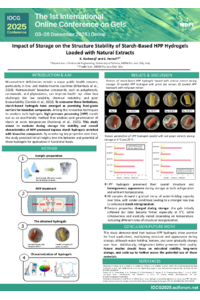
Starch-based hydrogels have garnered significant interest in recent years due to their potential applications in various fields. Their characteristic stable structure enables functionalization, allowing their use as smart carriers of the bioactive compounds of natural extracts. In this study, the physical stability of starch-based hydrogels loaded with natural extract produced via high-pressure processing (HPP) was evaluated. For this purpose, stability measurements, including swelling power, texture, pH, and organoleptic properties, were determined at various time intervals during storage at 5°C and 25°C. Hydrogels were developed using tapioca starch, which contains approximately 20.2% amylose. Tapioca starch was suspended in distilled water to prepare a 20% (w/w) suspension containing 2% (w/w) natural extract. The mixture was then subjected to high-pressure processing (HPP) at 600 MPa for 15 minutes to induce starch gelatinization and facilitate hydrogel formation. The results showed that during storage, a decrease was observed in swelling power from 1.35 to 0.28 g/g, indicating a reduction in the hydrogel’s ability to retain water, likely due to the structural rearrangements of polymer chains. Additionally, texture analyses revealed an initial decrease in hardness, cohesiveness, and springiness values at 15 days, followed by their increase after 30 days. These changes may be related to hydrogel reorganization, where initial relaxation reduces texture properties but longer-term polymer chain rearrangement or crosslinking enhances stability. Furthermore, changes in color parameters (L*, a*, and b*) suggest ongoing chemical transformations within the hydrogel matrix. Throughout the storage period, pH values remained stable at approximately 5, indicating limited acid–base interaction within the hydrogel system. Based on these findings, it can be concluded that more research is warranted to clarify molecular mechanisms and optimize release behavior for targeted nutraceutical and functional food applications.
Keywords
starch
hydrogels
high-pressure processing
natural extracts
storage
structure stability
Poster
Poster_Gels_KaterinaKoshenaj.pdf
Boosting engineered cartilage formation with recombinant spider silk
A cytocompatible photoresponsive hydrogel to study cell response to dynamic topographies