Event submissions
Published
This submission belongs to the session S2. Hydrogels, Organogels, Xerogels, and Aerogels of the event The 1st International Online Conference on Gels
Published date
28 Nov, 2025
Academic Editor
'%3e%3cpath%20d='M12.6657%2010.9104C12.4185%2010.325%2012.0599%209.79327%2011.6097%209.34482C11.1609%208.89508%2010.6293%208.5365%2010.0442%208.28888C10.0389%208.28626%2010.0337%208.28495%2010.0285%208.28233C10.8446%207.69279%2011.3752%206.73249%2011.3752%205.64904C11.3752%203.8542%209.92103%202.39999%208.1262%202.39999C6.33136%202.39999%204.87715%203.8542%204.87715%205.64904C4.87715%206.73249%205.40774%207.69279%206.22393%208.28364C6.21869%208.28626%206.21345%208.28757%206.20821%208.29019C5.62129%208.5378%205.09463%208.89284%204.64265%209.34613C4.1929%209.79493%203.83432%2010.3266%203.58671%2010.9117C3.34345%2011.4845%203.21226%2012.0987%203.20023%2012.7209C3.19988%2012.7349%203.20233%2012.7488%203.20744%2012.7619C3.21255%2012.7749%203.22022%2012.7867%203.22998%2012.7968C3.23975%2012.8068%203.25142%2012.8147%203.26431%2012.8202C3.2772%2012.8256%203.29105%2012.8284%203.30504%2012.8284H4.09109C4.14874%2012.8284%204.19459%2012.7825%204.1959%2012.7262C4.2221%2011.7148%204.62823%2010.7676%205.34617%2010.0497C6.08899%209.30683%207.0755%208.89808%208.1262%208.89808C9.17689%208.89808%2010.1634%209.30683%2010.9062%2010.0497C11.6242%2010.7676%2012.0303%2011.7148%2012.0565%2012.7262C12.0578%2012.7838%2012.1037%2012.8284%2012.1613%2012.8284H12.9474C12.9613%2012.8284%2012.9752%2012.8256%2012.9881%2012.8202C13.001%2012.8147%2013.0126%2012.8068%2013.0224%2012.7968C13.0322%2012.7867%2013.0398%2012.7749%2013.0449%2012.7619C13.0501%2012.7488%2013.0525%2012.7349%2013.0522%2012.7209C13.0391%2012.0947%2012.9094%2011.4855%2012.6657%2010.9104ZM8.1262%207.9024C7.52486%207.9024%206.9589%207.6679%206.53312%207.24211C6.10733%206.81633%205.87283%206.25037%205.87283%205.64904C5.87283%205.0477%206.10733%204.48174%206.53312%204.05596C6.9589%203.63018%207.52486%203.39567%208.1262%203.39567C8.72753%203.39567%209.29349%203.63018%209.71927%204.05596C10.1451%204.48174%2010.3796%205.0477%2010.3796%205.64904C10.3796%206.25037%2010.1451%206.81633%209.71927%207.24211C9.29349%207.6679%208.72753%207.9024%208.1262%207.9024Z'%20fill='%235D1EE1'/%3e%3c/g%3e%3c/svg%3e) SIDI A. BENCHERIF
SIDI A. BENCHERIFCitation
Akemi Nagao, Masatoshi Iriki-in, Kenta Tanaka, Masakazu Muto, Kazuya U. Kobayashi, Preparation of elastic PVA/PAAm double-network hydrogel for application in artificial blood vessel materials, in Proceedings of The 1st International Online Conference on Gels, 3 December–5 December 2025, MDPI: Basel, Switzerland
Share
Email
Facebook
Twitter
LinkedIn
Preparation of elastic PVA/PAAm double-network hydrogel for application in artificial blood vessel materials
'%3e%3cpath%20d='M12.6647%2010.9104C12.4176%2010.325%2012.0589%209.7933%2011.6088%209.34485C11.16%208.89511%2010.6283%208.53653%2010.0432%208.28891C10.038%208.28629%2010.0327%208.28498%2010.0275%208.28236C10.8437%207.69282%2011.3743%206.73252%2011.3743%205.64907C11.3743%203.85423%209.92005%202.40002%208.12522%202.40002C6.33038%202.40002%204.87618%203.85423%204.87618%205.64907C4.87618%206.73252%205.40677%207.69282%206.22296%208.28367C6.21772%208.28629%206.21248%208.2876%206.20724%208.29022C5.62031%208.53783%205.09365%208.89287%204.64167%209.34616C4.19192%209.79496%203.83334%2010.3266%203.58573%2010.9117C3.34247%2011.4846%203.21128%2012.0987%203.19925%2012.721C3.1989%2012.735%203.20135%2012.7489%203.20646%2012.7619C3.21157%2012.7749%203.21924%2012.7868%203.22901%2012.7968C3.23877%2012.8068%203.25045%2012.8148%203.26334%2012.8202C3.27623%2012.8256%203.29007%2012.8284%203.30406%2012.8284H4.09012C4.14776%2012.8284%204.19362%2012.7825%204.19493%2012.7262C4.22113%2011.7148%204.62726%2010.7676%205.34519%2010.0497C6.08802%209.30686%207.07452%208.89811%208.12522%208.89811C9.17592%208.89811%2010.1624%209.30686%2010.9052%2010.0497C11.6232%2010.7676%2012.0293%2011.7148%2012.0555%2012.7262C12.0568%2012.7839%2012.1027%2012.8284%2012.1603%2012.8284H12.9464C12.9604%2012.8284%2012.9742%2012.8256%2012.9871%2012.8202C13%2012.8148%2013.0117%2012.8068%2013.0214%2012.7968C13.0312%2012.7868%2013.0389%2012.7749%2013.044%2012.7619C13.0491%2012.7489%2013.0515%2012.735%2013.0512%2012.721C13.0381%2012.0947%2012.9084%2011.4856%2012.6647%2010.9104ZM8.12522%207.90243C7.52388%207.90243%206.95792%207.66793%206.53214%207.24215C6.10636%206.81636%205.87185%206.2504%205.87185%205.64907C5.87185%205.04773%206.10636%204.48177%206.53214%204.05599C6.95792%203.63021%207.52388%203.3957%208.12522%203.3957C8.72655%203.3957%209.29252%203.63021%209.7183%204.05599C10.1441%204.48177%2010.3786%205.04773%2010.3786%205.64907C10.3786%206.2504%2010.1441%206.81636%209.7183%207.24215C9.29252%207.66793%208.72655%207.90243%208.12522%207.90243Z'%20fill='%235D1EE1'/%3e%3c/g%3e%3c/svg%3e)
Akemi Nagao 1
Masatoshi Iriki-in 1
Kenta Tanaka 1
Masakazu Muto 2
Kazuya U. Kobayashi 1
1. Faculty of Fundamental Engineering, Nipppon Institute of Technology, Saitama Prifecture, 345-8501, 4-1 gakuendai miyashiro-cho saitama-gun, Japan
2. Graduate School of Electrical and Mechanical Engineering, The Nagoya Institute of Technology, Aich Prifecture, 466-0061, gokiso-cho, atuta-shi,sowa-ku, Japan
Abstract
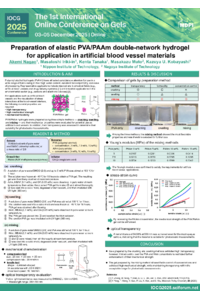
It is well known that polyvinyl alcohol (PVA) forms hydrogels in aqueous solutions, and its application in the field of biomaterials has long been anticipated. Recently a PVA–polyacrylamide (PAAm) double-network (DN) hydrogel has been developed through a repeated freeze–thaw cycle method to achieve sufficient mechanical strength. However, the DN gels are sometimes not sufficiently transparent due to the preparation process and because of crystallization, and their fields of application are limited. In this study, we developed a simple preparation process of thick and transparent PVA/PAAm DN hydrogels. The DN gel was synthesized from crushed PVA gel (the first gel)and an AAm solution(the monomer of the second gel). In total, 1.32g of PVA (saponification degree98~99 mol%) was dissolved in DMSO–water (with a mass ratio of 2:8) and the total weight was adjusted to 30 g. The solution was then heated at 90 ℃ under stirring until the PVA was fully dissolved and cooled at -40 ℃ for 24 hours.
The resulting PVA gel was finely ground with a mortar and pestle while mixing with 300g of water solution containing 21.3g of AAm, 0.04g of the polymerization initiator 2-oxoglutaric acid (OA), and 0.04g of the crosslinker N,N′ methylenebisacrylamide (MBAA). This mixture was poured into a cubic mold (25 mm per side) made of slide glass, and ultraviolet UV (365 nm) irradiation was applied to initiate the radical polymerization of the AAm. Through this process, a transparent and elastic PVA/PAAm DN hydrogel was obtained. Although the Young’s modulus of the DN gel (0.012 MPa) slightly failed to fall within this range for human blood vessels (0.02~3 MPa), its transparency may allow for the measurement of stress interactions between blood flow and vessel walls using photoelasticity. The thick and transparent DN gel made using PVA—produced at low cost—is also expected to be applied as a biomimetic material.
Keywords
PVA
PAAm
double network
gel
biomaterial
Poster
IOCG2025-100379_kobayashi_Gels- AkemiNagao.pdf
A cytocompatible photoresponsive hydrogel to study cell response to dynamic topographies
Ag+-Assisted Poly(vinyl alcohol)/Chitosan Gel for Wound Dressing