Event submissions
Published
This submission belongs to the session S2. Hydrogels, Organogels, Xerogels, and Aerogels of the event The 1st International Online Conference on Gels
Published date
28 Nov, 2025
Academic Editor
'%3e%3cpath%20d='M12.6657%2010.9104C12.4185%2010.325%2012.0599%209.79327%2011.6097%209.34482C11.1609%208.89508%2010.6293%208.5365%2010.0442%208.28888C10.0389%208.28626%2010.0337%208.28495%2010.0285%208.28233C10.8446%207.69279%2011.3752%206.73249%2011.3752%205.64904C11.3752%203.8542%209.92103%202.39999%208.1262%202.39999C6.33136%202.39999%204.87715%203.8542%204.87715%205.64904C4.87715%206.73249%205.40774%207.69279%206.22393%208.28364C6.21869%208.28626%206.21345%208.28757%206.20821%208.29019C5.62129%208.5378%205.09463%208.89284%204.64265%209.34613C4.1929%209.79493%203.83432%2010.3266%203.58671%2010.9117C3.34345%2011.4845%203.21226%2012.0987%203.20023%2012.7209C3.19988%2012.7349%203.20233%2012.7488%203.20744%2012.7619C3.21255%2012.7749%203.22022%2012.7867%203.22998%2012.7968C3.23975%2012.8068%203.25142%2012.8147%203.26431%2012.8202C3.2772%2012.8256%203.29105%2012.8284%203.30504%2012.8284H4.09109C4.14874%2012.8284%204.19459%2012.7825%204.1959%2012.7262C4.2221%2011.7148%204.62823%2010.7676%205.34617%2010.0497C6.08899%209.30683%207.0755%208.89808%208.1262%208.89808C9.17689%208.89808%2010.1634%209.30683%2010.9062%2010.0497C11.6242%2010.7676%2012.0303%2011.7148%2012.0565%2012.7262C12.0578%2012.7838%2012.1037%2012.8284%2012.1613%2012.8284H12.9474C12.9613%2012.8284%2012.9752%2012.8256%2012.9881%2012.8202C13.001%2012.8147%2013.0126%2012.8068%2013.0224%2012.7968C13.0322%2012.7867%2013.0398%2012.7749%2013.0449%2012.7619C13.0501%2012.7488%2013.0525%2012.7349%2013.0522%2012.7209C13.0391%2012.0947%2012.9094%2011.4855%2012.6657%2010.9104ZM8.1262%207.9024C7.52486%207.9024%206.9589%207.6679%206.53312%207.24211C6.10733%206.81633%205.87283%206.25037%205.87283%205.64904C5.87283%205.0477%206.10733%204.48174%206.53312%204.05596C6.9589%203.63018%207.52486%203.39567%208.1262%203.39567C8.72753%203.39567%209.29349%203.63018%209.71927%204.05596C10.1451%204.48174%2010.3796%205.0477%2010.3796%205.64904C10.3796%206.25037%2010.1451%206.81633%209.71927%207.24211C9.29349%207.6679%208.72753%207.9024%208.1262%207.9024Z'%20fill='%235D1EE1'/%3e%3c/g%3e%3c/svg%3e) SIDI A. BENCHERIF
SIDI A. BENCHERIFCitation
Markus Fabian Lorke, Sebastian Brucker, Jessica Faber, Leonie Hüttner, Renato Frischknecht, Silvia Budday, Aldo Roberto Boccaccini, Tailoring in situ-crosslinked oxidized hyaluronic acid-based hydrogels for soft tissue engineering, in Proceedings of The 1st International Online Conference on Gels, 3 December–5 December 2025, MDPI: Basel, Switzerland
Share
Email
Facebook
Twitter
LinkedIn
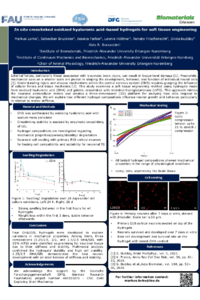
Tailoring in situ-crosslinked oxidized hyaluronic acid-based hydrogels for soft tissue engineering
'%3e%3cpath%20d='M12.6647%2010.9104C12.4176%2010.325%2012.0589%209.7933%2011.6088%209.34485C11.16%208.89511%2010.6283%208.53653%2010.0432%208.28891C10.038%208.28629%2010.0327%208.28498%2010.0275%208.28236C10.8437%207.69282%2011.3743%206.73252%2011.3743%205.64907C11.3743%203.85423%209.92005%202.40002%208.12522%202.40002C6.33038%202.40002%204.87618%203.85423%204.87618%205.64907C4.87618%206.73252%205.40677%207.69282%206.22296%208.28367C6.21772%208.28629%206.21248%208.2876%206.20724%208.29022C5.62031%208.53783%205.09365%208.89287%204.64167%209.34616C4.19192%209.79496%203.83334%2010.3266%203.58573%2010.9117C3.34247%2011.4846%203.21128%2012.0987%203.19925%2012.721C3.1989%2012.735%203.20135%2012.7489%203.20646%2012.7619C3.21157%2012.7749%203.21924%2012.7868%203.22901%2012.7968C3.23877%2012.8068%203.25045%2012.8148%203.26334%2012.8202C3.27623%2012.8256%203.29007%2012.8284%203.30406%2012.8284H4.09012C4.14776%2012.8284%204.19362%2012.7825%204.19493%2012.7262C4.22113%2011.7148%204.62726%2010.7676%205.34519%2010.0497C6.08802%209.30686%207.07452%208.89811%208.12522%208.89811C9.17592%208.89811%2010.1624%209.30686%2010.9052%2010.0497C11.6232%2010.7676%2012.0293%2011.7148%2012.0555%2012.7262C12.0568%2012.7839%2012.1027%2012.8284%2012.1603%2012.8284H12.9464C12.9604%2012.8284%2012.9742%2012.8256%2012.9871%2012.8202C13%2012.8148%2013.0117%2012.8068%2013.0214%2012.7968C13.0312%2012.7868%2013.0389%2012.7749%2013.044%2012.7619C13.0491%2012.7489%2013.0515%2012.735%2013.0512%2012.721C13.0381%2012.0947%2012.9084%2011.4856%2012.6647%2010.9104ZM8.12522%207.90243C7.52388%207.90243%206.95792%207.66793%206.53214%207.24215C6.10636%206.81636%205.87185%206.2504%205.87185%205.64907C5.87185%205.04773%206.10636%204.48177%206.53214%204.05599C6.95792%203.63021%207.52388%203.3957%208.12522%203.3957C8.72655%203.3957%209.29252%203.63021%209.7183%204.05599C10.1441%204.48177%2010.3786%205.04773%2010.3786%205.64907C10.3786%206.2504%2010.1441%206.81636%209.7183%207.24215C9.29252%207.66793%208.72655%207.90243%208.12522%207.90243Z'%20fill='%235D1EE1'/%3e%3c/g%3e%3c/svg%3e)
Markus Fabian Lorke 1
Sebastian Brucker 1
Jessica Faber 2
Leonie Hüttner 3
Renato Frischknecht 3
Silvia Budday 2

Aldo Roberto Boccaccini 1
1. Institute of Biomaterials, Friedrich-Alexander-Universität Erlangen-Nürnberg, 91058 Erlangen, Germany
2. Institute of Continuum Mechanics and Biomechanics, Friedrich-Alexander-Universität Erlangen-Nürnberg, 90762 Fürth, Germany
3. Animal Physiology, Friedrich-Alexander-Universität Erlangen-Nürnberg, 91058 Erlangen, Germany
Abstract
Mechanical cues at the cellular level play a pivotal role in guiding the development, function, and behavior of neural cells [1]. Understanding how these forces interact with their microenvironment is essential to uncovering mechanisms of injury and disease progression in neural tissues [2]. Biomaterials that mimic the extracellular matrix (ECM) and offer tunable mechanical properties are crucial to advancing neural tissue engineering. Hyaluronic acid (HA), naturally present in the brain and biologically favorable, is a promising candidate [3].
We developed ECM-mimicking hydrogels based on oxidized hyaluronic acid (OHA) with tunable mechanical properties for soft tissue applications. HA was oxidized for four hours using sodium periodate (NaIO₄), enabling Schiff base formation with gelatin (GEL). The network was further stabilized via enzymatic crosslinking with microbial transglutaminase (mTG) (7.5 mg/ml hydrogel). Thirty minutes of crosslinking at room temperature yielded dual-crosslinked hydrogels with stiffnesses tunable between 0.3 and 1.2 kPa at 37 °C. Physicochemical characterization showed that increasing GEL from 2.5% to 5% enhanced stiffness. By contrast, higher OHA content (1.25–5%) only slightly improved mechanics and mainly affected swelling, which ranged from 40 to 80%, with a 20–60% wet-weight decrease after 28 days in culture medium. The mTG concentration influenced stiffness and proved crucial for degradation resistance compared with lower levels in other approaches. OHA-based hydrogels with lower stiffness supported three-dimensional (3D) culture of various cell types, including primary neurons. Neurons grew and developed best in the softest hydrogels, indicating a cell-friendly, ECM-like environment. These results suggest OHA–GEL hydrogels could mimic neural tissue mechanics in soft tissue engineering.
References:
[1] K. Franze, “Integrating chemistry and mechanics: The forces driving axon growth,”
Annual Review of Cell and Developmental Biology, vol. 36, pp. 61–83, 2020.
[2] S. Budday et al., “Towards microstructure-informed material models for human
brain tissue,” Acta Biomaterialia, vol. 104, pp. 53–65, 2020.
[3] S. Kuth et. al., “Oxidized hyaluronic acid-gelatin based hydrogels for tissue engineering and soft tissue mimicking” Tissue Engineering Part C: Methods, vol. 28, pp. 301-313, 2022
Keywords
hyaluronic acid
neural TE
Poster
Lorke_Markus.pdf
Bone Tissue Engineering via Collagen Hydrogel-Coated PHBV-BG Scaffolds: Mimicking Both Rigid and Soft Tissues
Hydrogel-Based Injectable and Printable Calcium Phosphate Cements (CPC) – Bioactive Glass (BG) Composites for Bone Tissue Engineering