Event submissions
Published
This submission belongs to the session S4. Gels in Medicine, Regenerative Medicine, Pharmacy, and Personal Care Products of the event The 1st International Online Conference on Gels
Published date
28 Nov, 2025
Academic Editor
'%3e%3cpath%20d='M12.6657%2010.9104C12.4185%2010.325%2012.0599%209.79327%2011.6097%209.34482C11.1609%208.89508%2010.6293%208.5365%2010.0442%208.28888C10.0389%208.28626%2010.0337%208.28495%2010.0285%208.28233C10.8446%207.69279%2011.3752%206.73249%2011.3752%205.64904C11.3752%203.8542%209.92103%202.39999%208.1262%202.39999C6.33136%202.39999%204.87715%203.8542%204.87715%205.64904C4.87715%206.73249%205.40774%207.69279%206.22393%208.28364C6.21869%208.28626%206.21345%208.28757%206.20821%208.29019C5.62129%208.5378%205.09463%208.89284%204.64265%209.34613C4.1929%209.79493%203.83432%2010.3266%203.58671%2010.9117C3.34345%2011.4845%203.21226%2012.0987%203.20023%2012.7209C3.19988%2012.7349%203.20233%2012.7488%203.20744%2012.7619C3.21255%2012.7749%203.22022%2012.7867%203.22998%2012.7968C3.23975%2012.8068%203.25142%2012.8147%203.26431%2012.8202C3.2772%2012.8256%203.29105%2012.8284%203.30504%2012.8284H4.09109C4.14874%2012.8284%204.19459%2012.7825%204.1959%2012.7262C4.2221%2011.7148%204.62823%2010.7676%205.34617%2010.0497C6.08899%209.30683%207.0755%208.89808%208.1262%208.89808C9.17689%208.89808%2010.1634%209.30683%2010.9062%2010.0497C11.6242%2010.7676%2012.0303%2011.7148%2012.0565%2012.7262C12.0578%2012.7838%2012.1037%2012.8284%2012.1613%2012.8284H12.9474C12.9613%2012.8284%2012.9752%2012.8256%2012.9881%2012.8202C13.001%2012.8147%2013.0126%2012.8068%2013.0224%2012.7968C13.0322%2012.7867%2013.0398%2012.7749%2013.0449%2012.7619C13.0501%2012.7488%2013.0525%2012.7349%2013.0522%2012.7209C13.0391%2012.0947%2012.9094%2011.4855%2012.6657%2010.9104ZM8.1262%207.9024C7.52486%207.9024%206.9589%207.6679%206.53312%207.24211C6.10733%206.81633%205.87283%206.25037%205.87283%205.64904C5.87283%205.0477%206.10733%204.48174%206.53312%204.05596C6.9589%203.63018%207.52486%203.39567%208.1262%203.39567C8.72753%203.39567%209.29349%203.63018%209.71927%204.05596C10.1451%204.48174%2010.3796%205.0477%2010.3796%205.64904C10.3796%206.25037%2010.1451%206.81633%209.71927%207.24211C9.29349%207.6679%208.72753%207.9024%208.1262%207.9024Z'%20fill='%235D1EE1'/%3e%3c/g%3e%3c/svg%3e) Aline Miller
Aline MillerCitation
Beatriz Aráoz, Lara Gotthelf, Rafael A Rodriguez Acosta, Marcos Bertuola, Elida B Hermida, Hydrogel-Based Injectable and Printable Calcium Phosphate Cements (CPC) – Bioactive Glass (BG) Composites for Bone Tissue Engineering, in Proceedings of The 1st International Online Conference on Gels, 3 December–5 December 2025, MDPI: Basel, Switzerland
Share
Email
Facebook
Twitter
LinkedIn
Hydrogel-Based Injectable and Printable Calcium Phosphate Cements (CPC) – Bioactive Glass (BG) Composites for Bone Tissue Engineering
'%3e%3cpath%20d='M12.6647%2010.9104C12.4176%2010.325%2012.0589%209.7933%2011.6088%209.34485C11.16%208.89511%2010.6283%208.53653%2010.0432%208.28891C10.038%208.28629%2010.0327%208.28498%2010.0275%208.28236C10.8437%207.69282%2011.3743%206.73252%2011.3743%205.64907C11.3743%203.85423%209.92005%202.40002%208.12522%202.40002C6.33038%202.40002%204.87618%203.85423%204.87618%205.64907C4.87618%206.73252%205.40677%207.69282%206.22296%208.28367C6.21772%208.28629%206.21248%208.2876%206.20724%208.29022C5.62031%208.53783%205.09365%208.89287%204.64167%209.34616C4.19192%209.79496%203.83334%2010.3266%203.58573%2010.9117C3.34247%2011.4846%203.21128%2012.0987%203.19925%2012.721C3.1989%2012.735%203.20135%2012.7489%203.20646%2012.7619C3.21157%2012.7749%203.21924%2012.7868%203.22901%2012.7968C3.23877%2012.8068%203.25045%2012.8148%203.26334%2012.8202C3.27623%2012.8256%203.29007%2012.8284%203.30406%2012.8284H4.09012C4.14776%2012.8284%204.19362%2012.7825%204.19493%2012.7262C4.22113%2011.7148%204.62726%2010.7676%205.34519%2010.0497C6.08802%209.30686%207.07452%208.89811%208.12522%208.89811C9.17592%208.89811%2010.1624%209.30686%2010.9052%2010.0497C11.6232%2010.7676%2012.0293%2011.7148%2012.0555%2012.7262C12.0568%2012.7839%2012.1027%2012.8284%2012.1603%2012.8284H12.9464C12.9604%2012.8284%2012.9742%2012.8256%2012.9871%2012.8202C13%2012.8148%2013.0117%2012.8068%2013.0214%2012.7968C13.0312%2012.7868%2013.0389%2012.7749%2013.044%2012.7619C13.0491%2012.7489%2013.0515%2012.735%2013.0512%2012.721C13.0381%2012.0947%2012.9084%2011.4856%2012.6647%2010.9104ZM8.12522%207.90243C7.52388%207.90243%206.95792%207.66793%206.53214%207.24215C6.10636%206.81636%205.87185%206.2504%205.87185%205.64907C5.87185%205.04773%206.10636%204.48177%206.53214%204.05599C6.95792%203.63021%207.52388%203.3957%208.12522%203.3957C8.72655%203.3957%209.29252%203.63021%209.7183%204.05599C10.1441%204.48177%2010.3786%205.04773%2010.3786%205.64907C10.3786%206.2504%2010.1441%206.81636%209.7183%207.24215C9.29252%207.66793%208.72655%207.90243%208.12522%207.90243Z'%20fill='%235D1EE1'/%3e%3c/g%3e%3c/svg%3e)
Beatriz Aráoz 1
Lara Gotthelf 2
Rafael A Rodriguez Acosta 3
Marcos Bertuola 4

Elida B Hermida 4
1. Institute of Emerging Technologies and Applied Sciences (ITECA), The School of Science and Technology (ECyT) at the National University of San Martín (UNSAM), San Martín, Buenos Aires, 1650, Argentina
2. Escuela de Ciencia y Tecnología, National University of General San Martin (UNSAM), San Martin 1650, Buenos Aires, Argentina
3. Instituto Tecnológico Sabato, National Atomic Energy Commission (CNEA), UNSAM, San Martin 1650, Buenos Aires, Argentina
4. Instituto de Tecnologías Emergentes y Ciencias Aplicadas (ITECA), National Scientific and Technical Research Council (CONICET), National University of General San Martin (UNSAM), San Martin 1650, Buenos Aires, Argentina
Abstract
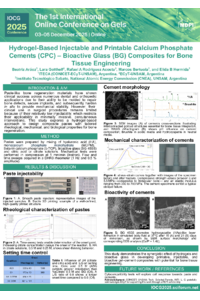
Introduction: Hydrogels play a central role in developing injectable and printable systems for bone tissue engineering. Their ability to provide structural support, biocompatibility, and processability makes them ideal candidates for creating scaffolds that mimic the extracellular matrix. This study explores a hydrogel-based approach to design composite pastes with tailored rheological, mechanical, and biological properties for bone regeneration.
Methods: A hydrogel matrix composed of biocompatible and biodegradable biopolymers—alginate, gelatine, and hyaluronic acid—was combined with calcium phosphate cements (CPCs) to enhance mechanical strength and mineralization potential. Bioactive glass particles (BG 45S5) were added to the composite to stimulate osteogenesis. The resulting composite pastes were rheologically characterized to evaluate their injectability and suitability for extrusion-based 3D bioprinting. After setting, printed and extruded constructs were analyzed using scanning electron microscopy (SEM), X-ray diffraction (XRD), and mechanical compression tests to assess in vitro stability and bioactivity.
Results: The hydrogel matrix enabled smooth paste injection, stable 3D printing, and a uniform dispersion of active components, contributing to the formation of interconnected porous structures, essential for bone tissue integration. Rheological tests confirmed adequate shear-thinning behavior. The incorporation of BG 45S5 significantly enhanced the bioactivity of the system, as evidenced by the formation of a hydroxyapatite-like layer at different time points after immersion in simulated body fluid. Mechanical testing confirmed the structural integrity of the constructs under compressive load, with compressive strength values between 3 and 5.5 MPa—comparable to trabecular bone—and an elastic modulus ranging from 300 to 700 MPa. By adjusting the hydrogel composition and BG content, setting times were controlled within the clinically acceptable range of 10–15 minutes for surgical use.
Conclusions: This study demonstrates the synergistic effect of hydrogels and bioactive glass in developing printable, injectable, and bioactive gel–cement composites with potential for bone tissue engineering.
Keywords
Bone Cements
hydrogels
bioactive glass
bone regeneration
Poster
poster Araoz - Bone Cement.pdf
Tailoring in situ-crosslinked oxidized hyaluronic acid-based hydrogels for soft tissue engineering
Silk-Based Multiple Shape Memory Organohydrogels