Event submissions
Published
This submission belongs to the session S4. Gels in Medicine, Regenerative Medicine, Pharmacy, and Personal Care Products of the event The 1st International Online Conference on Gels
Published date
28 Nov, 2025
Academic Editor
'%3e%3cpath%20d='M12.6657%2010.9104C12.4185%2010.325%2012.0599%209.79327%2011.6097%209.34482C11.1609%208.89508%2010.6293%208.5365%2010.0442%208.28888C10.0389%208.28626%2010.0337%208.28495%2010.0285%208.28233C10.8446%207.69279%2011.3752%206.73249%2011.3752%205.64904C11.3752%203.8542%209.92103%202.39999%208.1262%202.39999C6.33136%202.39999%204.87715%203.8542%204.87715%205.64904C4.87715%206.73249%205.40774%207.69279%206.22393%208.28364C6.21869%208.28626%206.21345%208.28757%206.20821%208.29019C5.62129%208.5378%205.09463%208.89284%204.64265%209.34613C4.1929%209.79493%203.83432%2010.3266%203.58671%2010.9117C3.34345%2011.4845%203.21226%2012.0987%203.20023%2012.7209C3.19988%2012.7349%203.20233%2012.7488%203.20744%2012.7619C3.21255%2012.7749%203.22022%2012.7867%203.22998%2012.7968C3.23975%2012.8068%203.25142%2012.8147%203.26431%2012.8202C3.2772%2012.8256%203.29105%2012.8284%203.30504%2012.8284H4.09109C4.14874%2012.8284%204.19459%2012.7825%204.1959%2012.7262C4.2221%2011.7148%204.62823%2010.7676%205.34617%2010.0497C6.08899%209.30683%207.0755%208.89808%208.1262%208.89808C9.17689%208.89808%2010.1634%209.30683%2010.9062%2010.0497C11.6242%2010.7676%2012.0303%2011.7148%2012.0565%2012.7262C12.0578%2012.7838%2012.1037%2012.8284%2012.1613%2012.8284H12.9474C12.9613%2012.8284%2012.9752%2012.8256%2012.9881%2012.8202C13.001%2012.8147%2013.0126%2012.8068%2013.0224%2012.7968C13.0322%2012.7867%2013.0398%2012.7749%2013.0449%2012.7619C13.0501%2012.7488%2013.0525%2012.7349%2013.0522%2012.7209C13.0391%2012.0947%2012.9094%2011.4855%2012.6657%2010.9104ZM8.1262%207.9024C7.52486%207.9024%206.9589%207.6679%206.53312%207.24211C6.10733%206.81633%205.87283%206.25037%205.87283%205.64904C5.87283%205.0477%206.10733%204.48174%206.53312%204.05596C6.9589%203.63018%207.52486%203.39567%208.1262%203.39567C8.72753%203.39567%209.29349%203.63018%209.71927%204.05596C10.1451%204.48174%2010.3796%205.0477%2010.3796%205.64904C10.3796%206.25037%2010.1451%206.81633%209.71927%207.24211C9.29349%207.6679%208.72753%207.9024%208.1262%207.9024Z'%20fill='%235D1EE1'/%3e%3c/g%3e%3c/svg%3e) Dirk Kuckling
Dirk KucklingCitation
Monica Raduly, Valentin Raditoiu, Alina Raditoiu, Adriana Frone, Iuliana Raut, BIOACTIVE SOL–GEL COATINGS OBTAINED BY NETWORK EMBEDDING OF PHYTOSYNTHESIZED SELENIUM NANOPARTICLES, in Proceedings of The 1st International Online Conference on Gels, 3 December–5 December 2025, MDPI: Basel, Switzerland
Share
Email
Facebook
Twitter
LinkedIn
BIOACTIVE SOL–GEL COATINGS OBTAINED BY NETWORK EMBEDDING OF PHYTOSYNTHESIZED SELENIUM NANOPARTICLES

Monica Raduly 1
'%3e%3cpath%20d='M12.6647%2010.9104C12.4176%2010.325%2012.0589%209.7933%2011.6088%209.34485C11.16%208.89511%2010.6283%208.53653%2010.0432%208.28891C10.038%208.28629%2010.0327%208.28498%2010.0275%208.28236C10.8437%207.69282%2011.3743%206.73252%2011.3743%205.64907C11.3743%203.85423%209.92005%202.40002%208.12522%202.40002C6.33038%202.40002%204.87618%203.85423%204.87618%205.64907C4.87618%206.73252%205.40677%207.69282%206.22296%208.28367C6.21772%208.28629%206.21248%208.2876%206.20724%208.29022C5.62031%208.53783%205.09365%208.89287%204.64167%209.34616C4.19192%209.79496%203.83334%2010.3266%203.58573%2010.9117C3.34247%2011.4846%203.21128%2012.0987%203.19925%2012.721C3.1989%2012.735%203.20135%2012.7489%203.20646%2012.7619C3.21157%2012.7749%203.21924%2012.7868%203.22901%2012.7968C3.23877%2012.8068%203.25045%2012.8148%203.26334%2012.8202C3.27623%2012.8256%203.29007%2012.8284%203.30406%2012.8284H4.09012C4.14776%2012.8284%204.19362%2012.7825%204.19493%2012.7262C4.22113%2011.7148%204.62726%2010.7676%205.34519%2010.0497C6.08802%209.30686%207.07452%208.89811%208.12522%208.89811C9.17592%208.89811%2010.1624%209.30686%2010.9052%2010.0497C11.6232%2010.7676%2012.0293%2011.7148%2012.0555%2012.7262C12.0568%2012.7839%2012.1027%2012.8284%2012.1603%2012.8284H12.9464C12.9604%2012.8284%2012.9742%2012.8256%2012.9871%2012.8202C13%2012.8148%2013.0117%2012.8068%2013.0214%2012.7968C13.0312%2012.7868%2013.0389%2012.7749%2013.044%2012.7619C13.0491%2012.7489%2013.0515%2012.735%2013.0512%2012.721C13.0381%2012.0947%2012.9084%2011.4856%2012.6647%2010.9104ZM8.12522%207.90243C7.52388%207.90243%206.95792%207.66793%206.53214%207.24215C6.10636%206.81636%205.87185%206.2504%205.87185%205.64907C5.87185%205.04773%206.10636%204.48177%206.53214%204.05599C6.95792%203.63021%207.52388%203.3957%208.12522%203.3957C8.72655%203.3957%209.29252%203.63021%209.7183%204.05599C10.1441%204.48177%2010.3786%205.04773%2010.3786%205.64907C10.3786%206.2504%2010.1441%206.81636%209.7183%207.24215C9.29252%207.66793%208.72655%207.90243%208.12522%207.90243Z'%20fill='%235D1EE1'/%3e%3c/g%3e%3c/svg%3e)
Valentin Raditoiu 1
Alina Raditoiu 1
Adriana Frone 1
Iuliana Raut 1
1. National Institute for Research & Development in Chemistry and Petrochemistry—ICECHIM, 202 Splaiul Independentei, 060021 Bucharest, Romania
Abstract
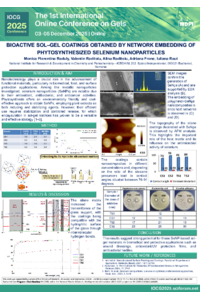
Nanotechnology plays a crucial role in the advancement of functional materials, particularly in biomedical, food, and surface protection applications. Among the metallic nanoparticles investigated, selenium nanoparticles (SeNPs) are notable due to their antioxidant, antibacterial, and anticancer activities. Phytosynthesis offers an environmentally friendly and cost-effective approach to obtain SeNPs, employing plant extracts as both reducing and stabilizing agents. However, their efficient use requires stabilization and controlled release, for which encapsulation in sol–gel matrices has proven to be a versatile and effective strategy [1–3].
This work presents the synthesis and characterization of bioactive sol-gel coatings functionalized with selenium nanoparticles (SeNPs) obtained via phytosynthesis. SeNPs were generated using Trifolium pretense or Curcuma longa plant extracts, which act as reducing and stabilizing agents, converting Se⁴⁺ ions from Na₂SeO₃ into elemental selenium (Se⁰). The nanoparticles were incorporated into hybrid sol–gel matrices generated from tetraethyl orthosilicate (TEOS) and dimethoxydimethylsilane (DMDMS) in various ratios (TEOS:DMDMS = 2:0.5–2, v/v). The hydrolysis and condensation of the precursors were catalyzed by 0.1 M HNO₃ at 25 °C for 24 h.
The resulting sols were deposited onto glass substrates by dip-coating and thermally treated to consolidate the network and immobilize the SeNPs. Surface morphology was investigated by atomic force microscopy (AFM) and scanning electron microscopy (SEM), chemical structure by Fourier-transform infrared (FTIR) spectroscopy, and optical properties by UV-Vis. Antimicrobial tests against S. aureus, E. coli, and C. albicans confirmed the biological activity of the coatings.
The results suggest strong potential for these SeNP-based sol–gel materials in biomedical and protective applications such as wound dressings, antioxidant/UV protection films, and antibacterial textiles.
Keywords
selenium nanoparticles
coatings functionalized
wound dressings
antioxidant/UV protection films
antibacterial textiles
Poster
Raduly-poster Gels-24.11.pdf
Use of chitosan/glycerol gel films for the accurate in vitro evaluation of the corrosion of biodegradable medical magnesium alloys
PREFORMULATORY STUDIES ON ROSMARINIC ACID NLCs FOR ORAL ADMINISTRATION