Event submissions
Published
This submission belongs to the session S4. Gels in Medicine, Regenerative Medicine, Pharmacy, and Personal Care Products of the event The 1st International Online Conference on Gels
Published date
28 Nov, 2025
Academic Editor
'%3e%3cpath%20d='M12.6657%2010.9104C12.4185%2010.325%2012.0599%209.79327%2011.6097%209.34482C11.1609%208.89508%2010.6293%208.5365%2010.0442%208.28888C10.0389%208.28626%2010.0337%208.28495%2010.0285%208.28233C10.8446%207.69279%2011.3752%206.73249%2011.3752%205.64904C11.3752%203.8542%209.92103%202.39999%208.1262%202.39999C6.33136%202.39999%204.87715%203.8542%204.87715%205.64904C4.87715%206.73249%205.40774%207.69279%206.22393%208.28364C6.21869%208.28626%206.21345%208.28757%206.20821%208.29019C5.62129%208.5378%205.09463%208.89284%204.64265%209.34613C4.1929%209.79493%203.83432%2010.3266%203.58671%2010.9117C3.34345%2011.4845%203.21226%2012.0987%203.20023%2012.7209C3.19988%2012.7349%203.20233%2012.7488%203.20744%2012.7619C3.21255%2012.7749%203.22022%2012.7867%203.22998%2012.7968C3.23975%2012.8068%203.25142%2012.8147%203.26431%2012.8202C3.2772%2012.8256%203.29105%2012.8284%203.30504%2012.8284H4.09109C4.14874%2012.8284%204.19459%2012.7825%204.1959%2012.7262C4.2221%2011.7148%204.62823%2010.7676%205.34617%2010.0497C6.08899%209.30683%207.0755%208.89808%208.1262%208.89808C9.17689%208.89808%2010.1634%209.30683%2010.9062%2010.0497C11.6242%2010.7676%2012.0303%2011.7148%2012.0565%2012.7262C12.0578%2012.7838%2012.1037%2012.8284%2012.1613%2012.8284H12.9474C12.9613%2012.8284%2012.9752%2012.8256%2012.9881%2012.8202C13.001%2012.8147%2013.0126%2012.8068%2013.0224%2012.7968C13.0322%2012.7867%2013.0398%2012.7749%2013.0449%2012.7619C13.0501%2012.7488%2013.0525%2012.7349%2013.0522%2012.7209C13.0391%2012.0947%2012.9094%2011.4855%2012.6657%2010.9104ZM8.1262%207.9024C7.52486%207.9024%206.9589%207.6679%206.53312%207.24211C6.10733%206.81633%205.87283%206.25037%205.87283%205.64904C5.87283%205.0477%206.10733%204.48174%206.53312%204.05596C6.9589%203.63018%207.52486%203.39567%208.1262%203.39567C8.72753%203.39567%209.29349%203.63018%209.71927%204.05596C10.1451%204.48174%2010.3796%205.0477%2010.3796%205.64904C10.3796%206.25037%2010.1451%206.81633%209.71927%207.24211C9.29349%207.6679%208.72753%207.9024%208.1262%207.9024Z'%20fill='%235D1EE1'/%3e%3c/g%3e%3c/svg%3e) Dirk Kuckling
Dirk KucklingCitation
Sara Vita Asmundo, Rita Cortesi, Maddalena Sguizzato, Francesca Ferrara, PREFORMULATORY STUDIES ON ROSMARINIC ACID NLCs FOR ORAL ADMINISTRATION, in Proceedings of The 1st International Online Conference on Gels, 3 December–5 December 2025, MDPI: Basel, Switzerland
Share
Email
Facebook
Twitter
LinkedIn
PREFORMULATORY STUDIES ON ROSMARINIC ACID NLCs FOR ORAL ADMINISTRATION
'%3e%3cpath%20d='M12.6647%2010.9104C12.4176%2010.325%2012.0589%209.7933%2011.6088%209.34485C11.16%208.89511%2010.6283%208.53653%2010.0432%208.28891C10.038%208.28629%2010.0327%208.28498%2010.0275%208.28236C10.8437%207.69282%2011.3743%206.73252%2011.3743%205.64907C11.3743%203.85423%209.92005%202.40002%208.12522%202.40002C6.33038%202.40002%204.87618%203.85423%204.87618%205.64907C4.87618%206.73252%205.40677%207.69282%206.22296%208.28367C6.21772%208.28629%206.21248%208.2876%206.20724%208.29022C5.62031%208.53783%205.09365%208.89287%204.64167%209.34616C4.19192%209.79496%203.83334%2010.3266%203.58573%2010.9117C3.34247%2011.4846%203.21128%2012.0987%203.19925%2012.721C3.1989%2012.735%203.20135%2012.7489%203.20646%2012.7619C3.21157%2012.7749%203.21924%2012.7868%203.22901%2012.7968C3.23877%2012.8068%203.25045%2012.8148%203.26334%2012.8202C3.27623%2012.8256%203.29007%2012.8284%203.30406%2012.8284H4.09012C4.14776%2012.8284%204.19362%2012.7825%204.19493%2012.7262C4.22113%2011.7148%204.62726%2010.7676%205.34519%2010.0497C6.08802%209.30686%207.07452%208.89811%208.12522%208.89811C9.17592%208.89811%2010.1624%209.30686%2010.9052%2010.0497C11.6232%2010.7676%2012.0293%2011.7148%2012.0555%2012.7262C12.0568%2012.7839%2012.1027%2012.8284%2012.1603%2012.8284H12.9464C12.9604%2012.8284%2012.9742%2012.8256%2012.9871%2012.8202C13%2012.8148%2013.0117%2012.8068%2013.0214%2012.7968C13.0312%2012.7868%2013.0389%2012.7749%2013.044%2012.7619C13.0491%2012.7489%2013.0515%2012.735%2013.0512%2012.721C13.0381%2012.0947%2012.9084%2011.4856%2012.6647%2010.9104ZM8.12522%207.90243C7.52388%207.90243%206.95792%207.66793%206.53214%207.24215C6.10636%206.81636%205.87185%206.2504%205.87185%205.64907C5.87185%205.04773%206.10636%204.48177%206.53214%204.05599C6.95792%203.63021%207.52388%203.3957%208.12522%203.3957C8.72655%203.3957%209.29252%203.63021%209.7183%204.05599C10.1441%204.48177%2010.3786%205.04773%2010.3786%205.64907C10.3786%206.2504%2010.1441%206.81636%209.7183%207.24215C9.29252%207.66793%208.72655%207.90243%208.12522%207.90243Z'%20fill='%235D1EE1'/%3e%3c/g%3e%3c/svg%3e)
Sara Vita Asmundo 1

Rita Cortesi 1

Maddalena Sguizzato 1
Francesca Ferrara 1
1. Department of Chemical, Pharmaceutical and Agricultural Sciences (DoCPAS), University of Ferrara, Ferrara 44121, Italy
Abstract
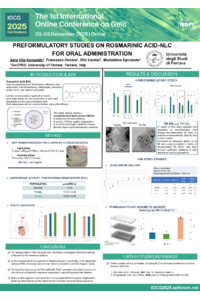
Rosmarinic acid (RA), a natural polyphenol from Rosmarinus officinalis, has antioxidant, anti-inflammatory, antidiabetic, antitumor, antimicrobial and antiviral properties. However, its pharmaceutical application is limited due to its poor water solubility, low bioavailability, and rapid degradation in the gastrointestinal tract. Fast metabolism and elimination further reduce its efficacy. This study aims to develop nanostructured lipid carriers (NLCs) to enhance oral bioavailability, protect RA from gastric degradation, and allow for prolonged intestinal release, thereby improving its overall therapeutic potential. NLCs containing Tristearin–Miglyol® or Tristearin–Vitamin E (2:1 w/w) and 2.5% Poloxamer were produced by hot homogenization and ultrasonication. RA was dispersed in the molten lipid phase, at different concentrations (0.5, 1, 2 mg/ml). Formulations were characterized by encapsulation efficiency, loading capacity, size distribution, and morphological and charge properties by means of different techniques including HPLC, Transmission Electron Microscopy (TEM), PCS and zeta potential. The preformulation study selected TM-RA1 and TV-RA1 (1 mg/ml RA), which remained stable up to 90 days post-production in terms of encapsulated RA (80%) and size, without significant variations in size distribution and polydispersity. Antioxidant activity, assessed by photochemiluminescence (PCL), was preserved. In vitro release study by equilibrium dialysis showed a controlled, time-dependent release of RA, following second-order kinetics consistent with the Higuchi model. Permeability tests using the PermeaPad® Plate revealed a five-fold reduction in RA diffusion compared to aqueous suspension, supporting sustained release. Static in vitro digestion confirmed that NLCs protect RA from gastric degradation, enabling intact delivery to the intestinal environment and promoting absorption. To improve mucosal adhesion, further studies will be conducted, including NLC in gel-based systems.
Keywords
Rosmarinic Acid
preformulatory studies
Poster
SARA VITA ASMUNDO poster-IOCG 25 .pdf
BIOACTIVE SOL–GEL COATINGS OBTAINED BY NETWORK EMBEDDING OF PHYTOSYNTHESIZED SELENIUM NANOPARTICLES
Nanofibrous Hyaluronic Acid/Gelatin Methacrylate Hydrogels Enhance Cartilage Regeneration