Event submissions
Published
This submission belongs to the session S4. Gels in Medicine, Regenerative Medicine, Pharmacy, and Personal Care Products of the event The 1st International Online Conference on Gels
Published date
28 Nov, 2025
Academic Editor
'%3e%3cpath%20d='M12.6657%2010.9104C12.4185%2010.325%2012.0599%209.79327%2011.6097%209.34482C11.1609%208.89508%2010.6293%208.5365%2010.0442%208.28888C10.0389%208.28626%2010.0337%208.28495%2010.0285%208.28233C10.8446%207.69279%2011.3752%206.73249%2011.3752%205.64904C11.3752%203.8542%209.92103%202.39999%208.1262%202.39999C6.33136%202.39999%204.87715%203.8542%204.87715%205.64904C4.87715%206.73249%205.40774%207.69279%206.22393%208.28364C6.21869%208.28626%206.21345%208.28757%206.20821%208.29019C5.62129%208.5378%205.09463%208.89284%204.64265%209.34613C4.1929%209.79493%203.83432%2010.3266%203.58671%2010.9117C3.34345%2011.4845%203.21226%2012.0987%203.20023%2012.7209C3.19988%2012.7349%203.20233%2012.7488%203.20744%2012.7619C3.21255%2012.7749%203.22022%2012.7867%203.22998%2012.7968C3.23975%2012.8068%203.25142%2012.8147%203.26431%2012.8202C3.2772%2012.8256%203.29105%2012.8284%203.30504%2012.8284H4.09109C4.14874%2012.8284%204.19459%2012.7825%204.1959%2012.7262C4.2221%2011.7148%204.62823%2010.7676%205.34617%2010.0497C6.08899%209.30683%207.0755%208.89808%208.1262%208.89808C9.17689%208.89808%2010.1634%209.30683%2010.9062%2010.0497C11.6242%2010.7676%2012.0303%2011.7148%2012.0565%2012.7262C12.0578%2012.7838%2012.1037%2012.8284%2012.1613%2012.8284H12.9474C12.9613%2012.8284%2012.9752%2012.8256%2012.9881%2012.8202C13.001%2012.8147%2013.0126%2012.8068%2013.0224%2012.7968C13.0322%2012.7867%2013.0398%2012.7749%2013.0449%2012.7619C13.0501%2012.7488%2013.0525%2012.7349%2013.0522%2012.7209C13.0391%2012.0947%2012.9094%2011.4855%2012.6657%2010.9104ZM8.1262%207.9024C7.52486%207.9024%206.9589%207.6679%206.53312%207.24211C6.10733%206.81633%205.87283%206.25037%205.87283%205.64904C5.87283%205.0477%206.10733%204.48174%206.53312%204.05596C6.9589%203.63018%207.52486%203.39567%208.1262%203.39567C8.72753%203.39567%209.29349%203.63018%209.71927%204.05596C10.1451%204.48174%2010.3796%205.0477%2010.3796%205.64904C10.3796%206.25037%2010.1451%206.81633%209.71927%207.24211C9.29349%207.6679%208.72753%207.9024%208.1262%207.9024Z'%20fill='%235D1EE1'/%3e%3c/g%3e%3c/svg%3e) Aline Miller
Aline MillerCitation
Alessandro Molinelli, Ilaria Porello, Francesco Cellesi, Filippo Rossi, Harnessing the Interaction between Hydrogel and Functional Polymeric Nanoparticles for Sustained Co-Delivery of Therapeutics, in Proceedings of The 1st International Online Conference on Gels, 3 December–5 December 2025, MDPI: Basel, Switzerland
Share
Email
Facebook
Twitter
LinkedIn
Harnessing the Interaction between Hydrogel and Functional Polymeric Nanoparticles for Sustained Co-Delivery of Therapeutics

Alessandro Molinelli 1
'%3e%3cpath%20d='M12.6647%2010.9104C12.4176%2010.325%2012.0589%209.7933%2011.6088%209.34485C11.16%208.89511%2010.6283%208.53653%2010.0432%208.28891C10.038%208.28629%2010.0327%208.28498%2010.0275%208.28236C10.8437%207.69282%2011.3743%206.73252%2011.3743%205.64907C11.3743%203.85423%209.92005%202.40002%208.12522%202.40002C6.33038%202.40002%204.87618%203.85423%204.87618%205.64907C4.87618%206.73252%205.40677%207.69282%206.22296%208.28367C6.21772%208.28629%206.21248%208.2876%206.20724%208.29022C5.62031%208.53783%205.09365%208.89287%204.64167%209.34616C4.19192%209.79496%203.83334%2010.3266%203.58573%2010.9117C3.34247%2011.4846%203.21128%2012.0987%203.19925%2012.721C3.1989%2012.735%203.20135%2012.7489%203.20646%2012.7619C3.21157%2012.7749%203.21924%2012.7868%203.22901%2012.7968C3.23877%2012.8068%203.25045%2012.8148%203.26334%2012.8202C3.27623%2012.8256%203.29007%2012.8284%203.30406%2012.8284H4.09012C4.14776%2012.8284%204.19362%2012.7825%204.19493%2012.7262C4.22113%2011.7148%204.62726%2010.7676%205.34519%2010.0497C6.08802%209.30686%207.07452%208.89811%208.12522%208.89811C9.17592%208.89811%2010.1624%209.30686%2010.9052%2010.0497C11.6232%2010.7676%2012.0293%2011.7148%2012.0555%2012.7262C12.0568%2012.7839%2012.1027%2012.8284%2012.1603%2012.8284H12.9464C12.9604%2012.8284%2012.9742%2012.8256%2012.9871%2012.8202C13%2012.8148%2013.0117%2012.8068%2013.0214%2012.7968C13.0312%2012.7868%2013.0389%2012.7749%2013.044%2012.7619C13.0491%2012.7489%2013.0515%2012.735%2013.0512%2012.721C13.0381%2012.0947%2012.9084%2011.4856%2012.6647%2010.9104ZM8.12522%207.90243C7.52388%207.90243%206.95792%207.66793%206.53214%207.24215C6.10636%206.81636%205.87185%206.2504%205.87185%205.64907C5.87185%205.04773%206.10636%204.48177%206.53214%204.05599C6.95792%203.63021%207.52388%203.3957%208.12522%203.3957C8.72655%203.3957%209.29252%203.63021%209.7183%204.05599C10.1441%204.48177%2010.3786%205.04773%2010.3786%205.64907C10.3786%206.2504%2010.1441%206.81636%209.7183%207.24215C9.29252%207.66793%208.72655%207.90243%208.12522%207.90243Z'%20fill='%235D1EE1'/%3e%3c/g%3e%3c/svg%3e)
Ilaria Porello 1
Francesco Cellesi 1

Filippo Rossi 1
1. Department of Chemistry, Materials and Chemical Engineering “Giulio Natta”, Politecnico di Milano, Via Luigi Mancinelli 7,Milan, 20131, Italy
Abstract
INTRODUCTION
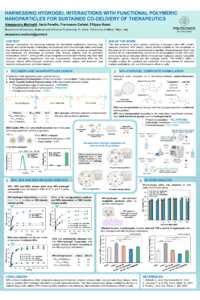
Hydrogel–nanoparticle composites have recently represented a promising strategy to develop hybrid platforms with enhanced properties in the biomedical scenario. This combination has led to superior properties, overcoming the limitations associated with single systems, such as lack of hydrophilicity and fast clearance. In this work, a nanocomposite hydrogel integrated with functional NPs is proposed to achieve sustained co-delivery of therapeutics with distinct physicochemical properties.
METHODS
Amphiphilic copolymers composed either by poly(glycerol methacrylate) (PGMA), poly(ethylene glycol methacrylate) (PEGMA), or poly(dimethylaminoethyl methacrylate) (PDMAEMA) and poly(ε-caprolactone) (PCL) were synthesized via a combination of Atom Transfer Radical Polymerization and Ring-Opening Polymerization, and then used to form nanoparticles (NPs) loaded with dexamethasone (DEX) via nanoprecipitation. Hydrogels were chemically crosslinked via polycondensation within agarose, carbomer, and hyaluronic acid. Drug-loaded NPs were incorporated into the hydrogel through different formulation strategies, depending on their superficial functional groups, to investigate DEX release under different conditions. Hydrogels were simultaneously loaded with BSA to study the co-delivery ability of the system.
RESULTS
The three NPs were either chemically, physically, or ionically entrapped within the hydrogel, according to the NP shell functionalities (Figure 1). Physical encapsulation favoured rapid NP release within 24 h and complete DEX release in 6 days, while electrostatic or chemical linkages displayed limited NP release, offering sustained DEX release profiles over 21 days, for optimized therapeutic efficacy. Simultaneously, in the presence of non-ionic NPs, BSA was completely released in 3 days, while its retention time was increased in the presence of cationic micelles.
CONCLUSIONS
The proposed strategy enabled the design of composite drug delivery systems tailored to specific applications. The different encapsulation methods showed an influence on both the properties and release kinetics of the composite system. The dual-compartment system facilitated the co-delivery of therapeutics, enabling tunable release profiles for combination therapies.
Keywords
Hydrogel
Polymer nanoparticles
Drug delivery
Poster
Molnelli_Poster Gels.pdf
Electroconductive hydrogels for spinal cord regeneration
Redox-Responsive Boronic Acid-Based Hydrogel for Controlled Drug Delivery and Theranostic Applications