Event submissions
Published
This submission belongs to the session S4. Gels in Medicine, Regenerative Medicine, Pharmacy, and Personal Care Products of the event The 1st International Online Conference on Gels
Published date
28 Nov, 2025
Academic Editor
'%3e%3cpath%20d='M12.6657%2010.9104C12.4185%2010.325%2012.0599%209.79327%2011.6097%209.34482C11.1609%208.89508%2010.6293%208.5365%2010.0442%208.28888C10.0389%208.28626%2010.0337%208.28495%2010.0285%208.28233C10.8446%207.69279%2011.3752%206.73249%2011.3752%205.64904C11.3752%203.8542%209.92103%202.39999%208.1262%202.39999C6.33136%202.39999%204.87715%203.8542%204.87715%205.64904C4.87715%206.73249%205.40774%207.69279%206.22393%208.28364C6.21869%208.28626%206.21345%208.28757%206.20821%208.29019C5.62129%208.5378%205.09463%208.89284%204.64265%209.34613C4.1929%209.79493%203.83432%2010.3266%203.58671%2010.9117C3.34345%2011.4845%203.21226%2012.0987%203.20023%2012.7209C3.19988%2012.7349%203.20233%2012.7488%203.20744%2012.7619C3.21255%2012.7749%203.22022%2012.7867%203.22998%2012.7968C3.23975%2012.8068%203.25142%2012.8147%203.26431%2012.8202C3.2772%2012.8256%203.29105%2012.8284%203.30504%2012.8284H4.09109C4.14874%2012.8284%204.19459%2012.7825%204.1959%2012.7262C4.2221%2011.7148%204.62823%2010.7676%205.34617%2010.0497C6.08899%209.30683%207.0755%208.89808%208.1262%208.89808C9.17689%208.89808%2010.1634%209.30683%2010.9062%2010.0497C11.6242%2010.7676%2012.0303%2011.7148%2012.0565%2012.7262C12.0578%2012.7838%2012.1037%2012.8284%2012.1613%2012.8284H12.9474C12.9613%2012.8284%2012.9752%2012.8256%2012.9881%2012.8202C13.001%2012.8147%2013.0126%2012.8068%2013.0224%2012.7968C13.0322%2012.7867%2013.0398%2012.7749%2013.0449%2012.7619C13.0501%2012.7488%2013.0525%2012.7349%2013.0522%2012.7209C13.0391%2012.0947%2012.9094%2011.4855%2012.6657%2010.9104ZM8.1262%207.9024C7.52486%207.9024%206.9589%207.6679%206.53312%207.24211C6.10733%206.81633%205.87283%206.25037%205.87283%205.64904C5.87283%205.0477%206.10733%204.48174%206.53312%204.05596C6.9589%203.63018%207.52486%203.39567%208.1262%203.39567C8.72753%203.39567%209.29349%203.63018%209.71927%204.05596C10.1451%204.48174%2010.3796%205.0477%2010.3796%205.64904C10.3796%206.25037%2010.1451%206.81633%209.71927%207.24211C9.29349%207.6679%208.72753%207.9024%208.1262%207.9024Z'%20fill='%235D1EE1'/%3e%3c/g%3e%3c/svg%3e) Dirk Kuckling
Dirk KucklingCitation
Andreea Mariana Negrescu, Maria Demeter, Valentina Mitran, Anisoara Cimpean, Preliminary in vitro evaluation of an e-beam cross-linked doxorubicin-loaded hybrid hydrogel as a potential therapy strategy for melanoma, in Proceedings of The 1st International Online Conference on Gels, 3 December–5 December 2025, MDPI: Basel, Switzerland
Share
Email
Facebook
Twitter
LinkedIn
Preliminary in vitro evaluation of an e-beam cross-linked doxorubicin-loaded hybrid hydrogel as a potential therapy strategy for melanoma

Andreea Mariana Negrescu 1

Maria Demeter 2
'%3e%3cpath%20d='M12.6647%2010.9104C12.4176%2010.325%2012.0589%209.7933%2011.6088%209.34485C11.16%208.89511%2010.6283%208.53653%2010.0432%208.28891C10.038%208.28629%2010.0327%208.28498%2010.0275%208.28236C10.8437%207.69282%2011.3743%206.73252%2011.3743%205.64907C11.3743%203.85423%209.92005%202.40002%208.12522%202.40002C6.33038%202.40002%204.87618%203.85423%204.87618%205.64907C4.87618%206.73252%205.40677%207.69282%206.22296%208.28367C6.21772%208.28629%206.21248%208.2876%206.20724%208.29022C5.62031%208.53783%205.09365%208.89287%204.64167%209.34616C4.19192%209.79496%203.83334%2010.3266%203.58573%2010.9117C3.34247%2011.4846%203.21128%2012.0987%203.19925%2012.721C3.1989%2012.735%203.20135%2012.7489%203.20646%2012.7619C3.21157%2012.7749%203.21924%2012.7868%203.22901%2012.7968C3.23877%2012.8068%203.25045%2012.8148%203.26334%2012.8202C3.27623%2012.8256%203.29007%2012.8284%203.30406%2012.8284H4.09012C4.14776%2012.8284%204.19362%2012.7825%204.19493%2012.7262C4.22113%2011.7148%204.62726%2010.7676%205.34519%2010.0497C6.08802%209.30686%207.07452%208.89811%208.12522%208.89811C9.17592%208.89811%2010.1624%209.30686%2010.9052%2010.0497C11.6232%2010.7676%2012.0293%2011.7148%2012.0555%2012.7262C12.0568%2012.7839%2012.1027%2012.8284%2012.1603%2012.8284H12.9464C12.9604%2012.8284%2012.9742%2012.8256%2012.9871%2012.8202C13%2012.8148%2013.0117%2012.8068%2013.0214%2012.7968C13.0312%2012.7868%2013.0389%2012.7749%2013.044%2012.7619C13.0491%2012.7489%2013.0515%2012.735%2013.0512%2012.721C13.0381%2012.0947%2012.9084%2011.4856%2012.6647%2010.9104ZM8.12522%207.90243C7.52388%207.90243%206.95792%207.66793%206.53214%207.24215C6.10636%206.81636%205.87185%206.2504%205.87185%205.64907C5.87185%205.04773%206.10636%204.48177%206.53214%204.05599C6.95792%203.63021%207.52388%203.3957%208.12522%203.3957C8.72655%203.3957%209.29252%203.63021%209.7183%204.05599C10.1441%204.48177%2010.3786%205.04773%2010.3786%205.64907C10.3786%206.2504%2010.1441%206.81636%209.7183%207.24215C9.29252%207.66793%208.72655%207.90243%208.12522%207.90243Z'%20fill='%235D1EE1'/%3e%3c/g%3e%3c/svg%3e)
Valentina Mitran 1

Anisoara Cimpean 1
1. Department of Biochemistry and Molecular Biology, Faculty of Biology, University of Bucharest, 050095 Bucharest, Romania
2. National Institute for Lasers, Plasma and Radiation Physics (INFLPR), Atomiştilor 409, 077125 Măgurele, Romania
Abstract
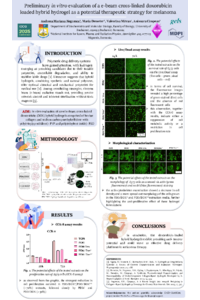
Polymeric drug delivery systems have gained attention, with hydrogels emerging as promising candidates due to their tunable properties, controllable degradation, and ability to stabilize labile drugs [1]. The literature suggests that hybrid hydrogels, combining synthetic and natural polymers, offer optimal chemical and mechanical properties for medical use [2]. Among crosslinking strategies, electron beam (e-beam) radiation stands out [3], providing precise network control and inherent sterilization without toxic reagents [4]. In this context, hybrid hydrogels of bovine collagen and sodium carboxymethylcellulose (natural) with poly(vinylpyrrolidone) and poly(ethylene oxide) (synthetic) were obtained via e-beam (25 kGy), with doxorubicin loaded before or after irradiation.
The cytotoxic and anti-proliferative effects of these hydrogels, designed to release doxorubicin at its IC50 concentration (10 ng/mL), were evaluated on A375 melanoma cells. The anti-tumour efficiency was assessed via indirect contact studies, using an extraction method (ISO 10993-5 standards), in terms of cell viability (Live/Dead test), proliferation (CCK-8 assay), and morphology (actin staining with Alexa Flour 488 – phalloidin).
The results revealed significant differences in cell proliferation among the tested hydrogels, with the lowest OD values observed for the cells grown in the extraction media from the PD81’DOX*/PD81’DOX** samples, and closely followed by the cells maintained in the extraction media from the PD81’ and PD81’DOX samples. This observation, combined with the absence of the red stained cells, indicates either a suppression of metabolic activity or a restriction in cell proliferation. Similarly, cytoskeleton examination showed a decrease in cell density and a more spread-out morphology in cells grown in the PD81’DOX* and PD81’DOX**extraction media, further highlighting the anti-proliferative effect of these hydrogel formulations.
In conclusion, the doxorubicin-loaded hybrid hydrogels exhibit promising anti-tumour potential and could serve as effective drug delivery platforms in melanoma therapy.
Acknowledgements: The authors gratefully acknowledge CNCS—UEFISCDI, project number PN-III-P1-1.1-PD2021-0552, for the financial support.
Keywords
collagen-based hydrogels
melanoma cells
e-beam crosslinking
cancer therapy
Poster
Poster _pdf (Negrescu et al).pdf
Redox-Responsive Boronic Acid-Based Hydrogel for Controlled Drug Delivery and Theranostic Applications
Enhancing the Biocontrol Potential of Bacillus amyloliquefaciens by Hydrogel Encapsulation for Combating Intestinal Pathogens