Event submissions
Published
This submission belongs to the session S2. Hydrogels, Organogels, Xerogels, and Aerogels of the event The 1st International Online Conference on Gels
Published date
28 Nov, 2025
Academic Editor
'%3e%3cpath%20d='M12.6657%2010.9104C12.4185%2010.325%2012.0599%209.79327%2011.6097%209.34482C11.1609%208.89508%2010.6293%208.5365%2010.0442%208.28888C10.0389%208.28626%2010.0337%208.28495%2010.0285%208.28233C10.8446%207.69279%2011.3752%206.73249%2011.3752%205.64904C11.3752%203.8542%209.92103%202.39999%208.1262%202.39999C6.33136%202.39999%204.87715%203.8542%204.87715%205.64904C4.87715%206.73249%205.40774%207.69279%206.22393%208.28364C6.21869%208.28626%206.21345%208.28757%206.20821%208.29019C5.62129%208.5378%205.09463%208.89284%204.64265%209.34613C4.1929%209.79493%203.83432%2010.3266%203.58671%2010.9117C3.34345%2011.4845%203.21226%2012.0987%203.20023%2012.7209C3.19988%2012.7349%203.20233%2012.7488%203.20744%2012.7619C3.21255%2012.7749%203.22022%2012.7867%203.22998%2012.7968C3.23975%2012.8068%203.25142%2012.8147%203.26431%2012.8202C3.2772%2012.8256%203.29105%2012.8284%203.30504%2012.8284H4.09109C4.14874%2012.8284%204.19459%2012.7825%204.1959%2012.7262C4.2221%2011.7148%204.62823%2010.7676%205.34617%2010.0497C6.08899%209.30683%207.0755%208.89808%208.1262%208.89808C9.17689%208.89808%2010.1634%209.30683%2010.9062%2010.0497C11.6242%2010.7676%2012.0303%2011.7148%2012.0565%2012.7262C12.0578%2012.7838%2012.1037%2012.8284%2012.1613%2012.8284H12.9474C12.9613%2012.8284%2012.9752%2012.8256%2012.9881%2012.8202C13.001%2012.8147%2013.0126%2012.8068%2013.0224%2012.7968C13.0322%2012.7867%2013.0398%2012.7749%2013.0449%2012.7619C13.0501%2012.7488%2013.0525%2012.7349%2013.0522%2012.7209C13.0391%2012.0947%2012.9094%2011.4855%2012.6657%2010.9104ZM8.1262%207.9024C7.52486%207.9024%206.9589%207.6679%206.53312%207.24211C6.10733%206.81633%205.87283%206.25037%205.87283%205.64904C5.87283%205.0477%206.10733%204.48174%206.53312%204.05596C6.9589%203.63018%207.52486%203.39567%208.1262%203.39567C8.72753%203.39567%209.29349%203.63018%209.71927%204.05596C10.1451%204.48174%2010.3796%205.0477%2010.3796%205.64904C10.3796%206.25037%2010.1451%206.81633%209.71927%207.24211C9.29349%207.6679%208.72753%207.9024%208.1262%207.9024Z'%20fill='%235D1EE1'/%3e%3c/g%3e%3c/svg%3e) SIDI A. BENCHERIF
SIDI A. BENCHERIFCitation
K Abirami, R Poojasri, Enhancing the Biocontrol Potential of Bacillus amyloliquefaciens by Hydrogel Encapsulation for Combating Intestinal Pathogens, in Proceedings of The 1st International Online Conference on Gels, 3 December–5 December 2025, MDPI: Basel, Switzerland
Share
Email
Facebook
Twitter
LinkedIn
Enhancing the Biocontrol Potential of Bacillus amyloliquefaciens by Hydrogel Encapsulation for Combating Intestinal Pathogens
'%3e%3cpath%20d='M12.6647%2010.9104C12.4176%2010.325%2012.0589%209.7933%2011.6088%209.34485C11.16%208.89511%2010.6283%208.53653%2010.0432%208.28891C10.038%208.28629%2010.0327%208.28498%2010.0275%208.28236C10.8437%207.69282%2011.3743%206.73252%2011.3743%205.64907C11.3743%203.85423%209.92005%202.40002%208.12522%202.40002C6.33038%202.40002%204.87618%203.85423%204.87618%205.64907C4.87618%206.73252%205.40677%207.69282%206.22296%208.28367C6.21772%208.28629%206.21248%208.2876%206.20724%208.29022C5.62031%208.53783%205.09365%208.89287%204.64167%209.34616C4.19192%209.79496%203.83334%2010.3266%203.58573%2010.9117C3.34247%2011.4846%203.21128%2012.0987%203.19925%2012.721C3.1989%2012.735%203.20135%2012.7489%203.20646%2012.7619C3.21157%2012.7749%203.21924%2012.7868%203.22901%2012.7968C3.23877%2012.8068%203.25045%2012.8148%203.26334%2012.8202C3.27623%2012.8256%203.29007%2012.8284%203.30406%2012.8284H4.09012C4.14776%2012.8284%204.19362%2012.7825%204.19493%2012.7262C4.22113%2011.7148%204.62726%2010.7676%205.34519%2010.0497C6.08802%209.30686%207.07452%208.89811%208.12522%208.89811C9.17592%208.89811%2010.1624%209.30686%2010.9052%2010.0497C11.6232%2010.7676%2012.0293%2011.7148%2012.0555%2012.7262C12.0568%2012.7839%2012.1027%2012.8284%2012.1603%2012.8284H12.9464C12.9604%2012.8284%2012.9742%2012.8256%2012.9871%2012.8202C13%2012.8148%2013.0117%2012.8068%2013.0214%2012.7968C13.0312%2012.7868%2013.0389%2012.7749%2013.044%2012.7619C13.0491%2012.7489%2013.0515%2012.735%2013.0512%2012.721C13.0381%2012.0947%2012.9084%2011.4856%2012.6647%2010.9104ZM8.12522%207.90243C7.52388%207.90243%206.95792%207.66793%206.53214%207.24215C6.10636%206.81636%205.87185%206.2504%205.87185%205.64907C5.87185%205.04773%206.10636%204.48177%206.53214%204.05599C6.95792%203.63021%207.52388%203.3957%208.12522%203.3957C8.72655%203.3957%209.29252%203.63021%209.7183%204.05599C10.1441%204.48177%2010.3786%205.04773%2010.3786%205.64907C10.3786%206.2504%2010.1441%206.81636%209.7183%207.24215C9.29252%207.66793%208.72655%207.90243%208.12522%207.90243Z'%20fill='%235D1EE1'/%3e%3c/g%3e%3c/svg%3e)
K Abirami 1
R Poojasri 1
1. Department of Microbiology, SRM Arts and Science College, Kattankulathur, Chengalpattu, Tamil Nadu, India
Abstract
Abstract
Introduction
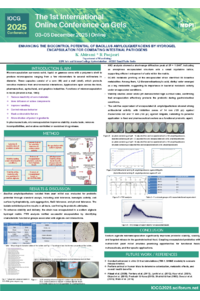
Probiotics are beneficial microorganisms that enhance host health by modulating gut microbiota and inhibiting pathogens. Bacillus amyloliquefaciens is a promising probiotic due to its resilience to gastrointestinal stress and bioactive metabolite production. Sodium alginate hydrogel encapsulation improves probiotic stability, protects against environmental stress, and enables controlled release, enhancing survival and therapeutic efficacy. This study focuses on isolating and characterizing B. amyloliquefaciens from pearl millet, evaluating probiotic traits, and enhancing delivery through alginate encapsulation. Structural confirmation, metabolic profiling, and antibacterial activity were assessed to establish potential food and pharmaceutical applications.
Methods
B. amyloliquefaciens was isolated from pearl millet and evaluated for acid tolerance, hemolytic activity, cell surface hydrophobicity, auto-aggregation, NaCl tolerance, and phenol tolerance. Cells were encapsulated in sodium alginate hydrogel and confirmed using Fourier-Transform Infrared Spectroscopy (FTIR) to identify functional groups. X-ray Diffraction (XRD) determined encapsulation structure and crystallinity, while Gas Chromatography–Mass Spectrometry (GC-MS) profiled bioactive metabolites. Encapsulated beads were tested for survival under gastrointestinal-like acidic conditions. Antibacterial activity of the cell-free supernatant was analyzed using agar well diffusion against Escherichia coli and Shigella.
Results
The isolate exhibited strong probiotic traits, including acid and phenol tolerance, high auto-aggregation, hydrophobicity, and no hemolytic activity. FTIR confirmed encapsulation via characteristic sodium alginate functional groups. XRD showed a short-range diffraction peak at 2θ = 11.848°, indicating an amorphous structure with minor crystallinity, suggesting efficient encapsulation. GC-MS identified 65 metabolites with 1,2-Benzenedicarboxylic acid and diethyl ester being dominant. Encapsulated cells showed high survival under acidic conditions, demonstrating hydrogel protection. The supernatant exhibited antibacterial activity, with inhibition zones of 14 mm against E. coli (125 μl) and 17 mm against Shigella (100 μl).
Conclusion
B. amyloliquefaciens from pearl millet showed strong probiotic potential. Sodium alginate encapsulation improved survival, preserved metabolic activity, and enabled controlled release. Hydrogel encapsulation is highlighted as a key strategy for improving probiotic survival, controlled release, and efficacy in next-generation formulations.
Keywords
B. amyloliquefaciens
Encapsulation
XRD
Intestinal Pathogens & Hydrogel
Poster
Abirami Poster PPT.pdf
Preliminary in vitro evaluation of an e-beam cross-linked doxorubicin-loaded hybrid hydrogel as a potential therapy strategy for melanoma
Tuning the viscoelastic properties of hydrogels to mimic prostatic cancer microenvironment