Event submissions
Published
This submission belongs to the session S2. Hydrogels, Organogels, Xerogels, and Aerogels of the event The 1st International Online Conference on Gels
Published date
28 Nov, 2025
Academic Editor
'%3e%3cpath%20d='M12.6657%2010.9104C12.4185%2010.325%2012.0599%209.79327%2011.6097%209.34482C11.1609%208.89508%2010.6293%208.5365%2010.0442%208.28888C10.0389%208.28626%2010.0337%208.28495%2010.0285%208.28233C10.8446%207.69279%2011.3752%206.73249%2011.3752%205.64904C11.3752%203.8542%209.92103%202.39999%208.1262%202.39999C6.33136%202.39999%204.87715%203.8542%204.87715%205.64904C4.87715%206.73249%205.40774%207.69279%206.22393%208.28364C6.21869%208.28626%206.21345%208.28757%206.20821%208.29019C5.62129%208.5378%205.09463%208.89284%204.64265%209.34613C4.1929%209.79493%203.83432%2010.3266%203.58671%2010.9117C3.34345%2011.4845%203.21226%2012.0987%203.20023%2012.7209C3.19988%2012.7349%203.20233%2012.7488%203.20744%2012.7619C3.21255%2012.7749%203.22022%2012.7867%203.22998%2012.7968C3.23975%2012.8068%203.25142%2012.8147%203.26431%2012.8202C3.2772%2012.8256%203.29105%2012.8284%203.30504%2012.8284H4.09109C4.14874%2012.8284%204.19459%2012.7825%204.1959%2012.7262C4.2221%2011.7148%204.62823%2010.7676%205.34617%2010.0497C6.08899%209.30683%207.0755%208.89808%208.1262%208.89808C9.17689%208.89808%2010.1634%209.30683%2010.9062%2010.0497C11.6242%2010.7676%2012.0303%2011.7148%2012.0565%2012.7262C12.0578%2012.7838%2012.1037%2012.8284%2012.1613%2012.8284H12.9474C12.9613%2012.8284%2012.9752%2012.8256%2012.9881%2012.8202C13.001%2012.8147%2013.0126%2012.8068%2013.0224%2012.7968C13.0322%2012.7867%2013.0398%2012.7749%2013.0449%2012.7619C13.0501%2012.7488%2013.0525%2012.7349%2013.0522%2012.7209C13.0391%2012.0947%2012.9094%2011.4855%2012.6657%2010.9104ZM8.1262%207.9024C7.52486%207.9024%206.9589%207.6679%206.53312%207.24211C6.10733%206.81633%205.87283%206.25037%205.87283%205.64904C5.87283%205.0477%206.10733%204.48174%206.53312%204.05596C6.9589%203.63018%207.52486%203.39567%208.1262%203.39567C8.72753%203.39567%209.29349%203.63018%209.71927%204.05596C10.1451%204.48174%2010.3796%205.0477%2010.3796%205.64904C10.3796%206.25037%2010.1451%206.81633%209.71927%207.24211C9.29349%207.6679%208.72753%207.9024%208.1262%207.9024Z'%20fill='%235D1EE1'/%3e%3c/g%3e%3c/svg%3e) SIDI A. BENCHERIF
SIDI A. BENCHERIFCitation
Fabiana Cavarzan, Matteo Cremonesi, Giuseppe Guagliano, Elisa Restivo, Francesco Briatico Vangosa, Paola Chiarugi, Elisa Giannoni, Marta Iozzo, Giulia Gangarossa, Nora Bloise, Paola Petrini, Tuning the viscoelastic properties of hydrogels to mimic prostatic cancer microenvironment, in Proceedings of The 1st International Online Conference on Gels, 3 December–5 December 2025, MDPI: Basel, Switzerland
Share
Email
Facebook
Twitter
LinkedIn
Tuning the viscoelastic properties of hydrogels to mimic prostatic cancer microenvironment
'%3e%3cpath%20d='M12.6647%2010.9104C12.4176%2010.325%2012.0589%209.7933%2011.6088%209.34485C11.16%208.89511%2010.6283%208.53653%2010.0432%208.28891C10.038%208.28629%2010.0327%208.28498%2010.0275%208.28236C10.8437%207.69282%2011.3743%206.73252%2011.3743%205.64907C11.3743%203.85423%209.92005%202.40002%208.12522%202.40002C6.33038%202.40002%204.87618%203.85423%204.87618%205.64907C4.87618%206.73252%205.40677%207.69282%206.22296%208.28367C6.21772%208.28629%206.21248%208.2876%206.20724%208.29022C5.62031%208.53783%205.09365%208.89287%204.64167%209.34616C4.19192%209.79496%203.83334%2010.3266%203.58573%2010.9117C3.34247%2011.4846%203.21128%2012.0987%203.19925%2012.721C3.1989%2012.735%203.20135%2012.7489%203.20646%2012.7619C3.21157%2012.7749%203.21924%2012.7868%203.22901%2012.7968C3.23877%2012.8068%203.25045%2012.8148%203.26334%2012.8202C3.27623%2012.8256%203.29007%2012.8284%203.30406%2012.8284H4.09012C4.14776%2012.8284%204.19362%2012.7825%204.19493%2012.7262C4.22113%2011.7148%204.62726%2010.7676%205.34519%2010.0497C6.08802%209.30686%207.07452%208.89811%208.12522%208.89811C9.17592%208.89811%2010.1624%209.30686%2010.9052%2010.0497C11.6232%2010.7676%2012.0293%2011.7148%2012.0555%2012.7262C12.0568%2012.7839%2012.1027%2012.8284%2012.1603%2012.8284H12.9464C12.9604%2012.8284%2012.9742%2012.8256%2012.9871%2012.8202C13%2012.8148%2013.0117%2012.8068%2013.0214%2012.7968C13.0312%2012.7868%2013.0389%2012.7749%2013.044%2012.7619C13.0491%2012.7489%2013.0515%2012.735%2013.0512%2012.721C13.0381%2012.0947%2012.9084%2011.4856%2012.6647%2010.9104ZM8.12522%207.90243C7.52388%207.90243%206.95792%207.66793%206.53214%207.24215C6.10636%206.81636%205.87185%206.2504%205.87185%205.64907C5.87185%205.04773%206.10636%204.48177%206.53214%204.05599C6.95792%203.63021%207.52388%203.3957%208.12522%203.3957C8.72655%203.3957%209.29252%203.63021%209.7183%204.05599C10.1441%204.48177%2010.3786%205.04773%2010.3786%205.64907C10.3786%206.2504%2010.1441%206.81636%209.7183%207.24215C9.29252%207.66793%208.72655%207.90243%208.12522%207.90243Z'%20fill='%235D1EE1'/%3e%3c/g%3e%3c/svg%3e)
Fabiana Cavarzan 1
Matteo Cremonesi 1
Giuseppe Guagliano 2
Elisa Restivo 3
Francesco Briatico Vangosa 1
Paola Chiarugi 4

Elisa Giannoni 4
Marta Iozzo 4
Giulia Gangarossa 4
Nora Bloise 3

Paola Petrini 1
1. Department of Chemistry, Materials and Chemical Engineering "Giulio Natta", Polytechnic University of Milan, Milan, 20133, Italy
2. Department of Molecular Biotechnology and Health Sciences, University of Turin, Turin, 10126, Italy
3. Department of Molecular Medicine, University of Pavia, Pavia, 27100, Italy
4. Department of Experimental and Clinical Biomedical Sciences “Mario Serio”, University of Florence, Florence, 50134, Italy
Abstract
Introduction
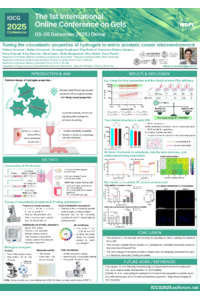
Three-dimensional hydrogels are increasingly being proposed1 to mimic biological tissues and micromechanical environments, owing to their tunability. Understanding structure–composition relationships is crucial for tailoring their properties. A prostate cancer (PCa) model was developed using an internally crosslinked2 alginate/gelatin hydrogel, designed to mimic the micromechanical environment and optimized for bioprinting with human PCa cells.
Methods
Hydrogels were prepared by sequentially mixing solutions/suspensions in 22Rv1 culture medium (final composition of 2% w/v gelatin, 6% w/v alginate, 0.7% w/v CaCO3, 3.74% w/v GDL, and 3x10⁶ 22Rv1 cells/ml). Hydrogels were then covered with an equal volume of buffered medium. Frequency sweep tests were performed at 20–0.1 Hz at 20 °C, 37 °C, and 50 °C using a rotational rheometer. Gelation time was evaluated by time sweep tests.
Results
The hydrogel formed a semi-IPN showing in frequency sweep tests higher G’’ at 20 °C and no G’ variations upon temperature changes. The timing of the medium addition (tadd) was used to control the viscoelastic properties. At 37 °C, 24 h after crosslinking onset, with tadd of 60 min, G’ reached 5.5 kPa (at 1.05 Hz), within the PCa stiffness range (5–10 kPa)3, and G’’ was 240 Pa. Printability was a priori assessed by rheological analyses and then with a pneumatic 3D bioprinter2,4. The best performance (printability coefficient 1.17) was obtained 30 min after crosslinking onset, with a 25G conical nozzle, 10 mm/s speed, and 70 kPa pressure. After 72 h, cell viability and metabolic activity increased compared to 1 h incubation (slightly below 2- and 1.5-fold, respectively). The initial pH (~6.5) gradually reached neutrality within 2 h (tadd 60 min; one medium change after 1 h).
Conclusions
Our study shows how composition and experimental parameters influence the properties of an alginate/gelatin hydrogel, providing a versatile approach for advanced 3D models and other hydrogel-based systems.
Keywords
Hydrogels
3D models
3D printing
Rheology
Bioinks
Biomaterials
Gels
3D microenvironments
Poster
posterIOCG2025_Cavarzan.pdf
Enhancing the Biocontrol Potential of Bacillus amyloliquefaciens by Hydrogel Encapsulation for Combating Intestinal Pathogens
Influence of the dimethylsulfoxide–water mixtures on the properties of poly(vinyl alcohol) cryogels