Event submissions
Published
This submission belongs to the session S2. Hydrogels, Organogels, Xerogels, and Aerogels of the event The 1st International Online Conference on Gels
Published date
28 Nov, 2025
Academic Editor
'%3e%3cpath%20d='M12.6657%2010.9104C12.4185%2010.325%2012.0599%209.79327%2011.6097%209.34482C11.1609%208.89508%2010.6293%208.5365%2010.0442%208.28888C10.0389%208.28626%2010.0337%208.28495%2010.0285%208.28233C10.8446%207.69279%2011.3752%206.73249%2011.3752%205.64904C11.3752%203.8542%209.92103%202.39999%208.1262%202.39999C6.33136%202.39999%204.87715%203.8542%204.87715%205.64904C4.87715%206.73249%205.40774%207.69279%206.22393%208.28364C6.21869%208.28626%206.21345%208.28757%206.20821%208.29019C5.62129%208.5378%205.09463%208.89284%204.64265%209.34613C4.1929%209.79493%203.83432%2010.3266%203.58671%2010.9117C3.34345%2011.4845%203.21226%2012.0987%203.20023%2012.7209C3.19988%2012.7349%203.20233%2012.7488%203.20744%2012.7619C3.21255%2012.7749%203.22022%2012.7867%203.22998%2012.7968C3.23975%2012.8068%203.25142%2012.8147%203.26431%2012.8202C3.2772%2012.8256%203.29105%2012.8284%203.30504%2012.8284H4.09109C4.14874%2012.8284%204.19459%2012.7825%204.1959%2012.7262C4.2221%2011.7148%204.62823%2010.7676%205.34617%2010.0497C6.08899%209.30683%207.0755%208.89808%208.1262%208.89808C9.17689%208.89808%2010.1634%209.30683%2010.9062%2010.0497C11.6242%2010.7676%2012.0303%2011.7148%2012.0565%2012.7262C12.0578%2012.7838%2012.1037%2012.8284%2012.1613%2012.8284H12.9474C12.9613%2012.8284%2012.9752%2012.8256%2012.9881%2012.8202C13.001%2012.8147%2013.0126%2012.8068%2013.0224%2012.7968C13.0322%2012.7867%2013.0398%2012.7749%2013.0449%2012.7619C13.0501%2012.7488%2013.0525%2012.7349%2013.0522%2012.7209C13.0391%2012.0947%2012.9094%2011.4855%2012.6657%2010.9104ZM8.1262%207.9024C7.52486%207.9024%206.9589%207.6679%206.53312%207.24211C6.10733%206.81633%205.87283%206.25037%205.87283%205.64904C5.87283%205.0477%206.10733%204.48174%206.53312%204.05596C6.9589%203.63018%207.52486%203.39567%208.1262%203.39567C8.72753%203.39567%209.29349%203.63018%209.71927%204.05596C10.1451%204.48174%2010.3796%205.0477%2010.3796%205.64904C10.3796%206.25037%2010.1451%206.81633%209.71927%207.24211C9.29349%207.6679%208.72753%207.9024%208.1262%207.9024Z'%20fill='%235D1EE1'/%3e%3c/g%3e%3c/svg%3e) SIDI A. BENCHERIF
SIDI A. BENCHERIFCitation
Olga Yu. Kolosova, Lada V. Barannikova, Vladimir I. Lozinsky, Influence of the dimethylsulfoxide–water mixtures on the properties of poly(vinyl alcohol) cryogels, in Proceedings of The 1st International Online Conference on Gels, 3 December–5 December 2025, MDPI: Basel, Switzerland
Share
Email
Facebook
Twitter
LinkedIn
Influence of the dimethylsulfoxide–water mixtures on the properties of poly(vinyl alcohol) cryogels
'%3e%3cpath%20d='M12.6647%2010.9104C12.4176%2010.325%2012.0589%209.7933%2011.6088%209.34485C11.16%208.89511%2010.6283%208.53653%2010.0432%208.28891C10.038%208.28629%2010.0327%208.28498%2010.0275%208.28236C10.8437%207.69282%2011.3743%206.73252%2011.3743%205.64907C11.3743%203.85423%209.92005%202.40002%208.12522%202.40002C6.33038%202.40002%204.87618%203.85423%204.87618%205.64907C4.87618%206.73252%205.40677%207.69282%206.22296%208.28367C6.21772%208.28629%206.21248%208.2876%206.20724%208.29022C5.62031%208.53783%205.09365%208.89287%204.64167%209.34616C4.19192%209.79496%203.83334%2010.3266%203.58573%2010.9117C3.34247%2011.4846%203.21128%2012.0987%203.19925%2012.721C3.1989%2012.735%203.20135%2012.7489%203.20646%2012.7619C3.21157%2012.7749%203.21924%2012.7868%203.22901%2012.7968C3.23877%2012.8068%203.25045%2012.8148%203.26334%2012.8202C3.27623%2012.8256%203.29007%2012.8284%203.30406%2012.8284H4.09012C4.14776%2012.8284%204.19362%2012.7825%204.19493%2012.7262C4.22113%2011.7148%204.62726%2010.7676%205.34519%2010.0497C6.08802%209.30686%207.07452%208.89811%208.12522%208.89811C9.17592%208.89811%2010.1624%209.30686%2010.9052%2010.0497C11.6232%2010.7676%2012.0293%2011.7148%2012.0555%2012.7262C12.0568%2012.7839%2012.1027%2012.8284%2012.1603%2012.8284H12.9464C12.9604%2012.8284%2012.9742%2012.8256%2012.9871%2012.8202C13%2012.8148%2013.0117%2012.8068%2013.0214%2012.7968C13.0312%2012.7868%2013.0389%2012.7749%2013.044%2012.7619C13.0491%2012.7489%2013.0515%2012.735%2013.0512%2012.721C13.0381%2012.0947%2012.9084%2011.4856%2012.6647%2010.9104ZM8.12522%207.90243C7.52388%207.90243%206.95792%207.66793%206.53214%207.24215C6.10636%206.81636%205.87185%206.2504%205.87185%205.64907C5.87185%205.04773%206.10636%204.48177%206.53214%204.05599C6.95792%203.63021%207.52388%203.3957%208.12522%203.3957C8.72655%203.3957%209.29252%203.63021%209.7183%204.05599C10.1441%204.48177%2010.3786%205.04773%2010.3786%205.64907C10.3786%206.2504%2010.1441%206.81636%209.7183%207.24215C9.29252%207.66793%208.72655%207.90243%208.12522%207.90243Z'%20fill='%235D1EE1'/%3e%3c/g%3e%3c/svg%3e)
Olga Yu. Kolosova 1
Lada V. Barannikova 1

Vladimir I. Lozinsky 1
1. A.N.Nesmeyanov Institute of Organoelement Compounds, Russian Academy of Sciences, 119334 Vavilov Street 28, building 1, Moscow, Russia
Abstract
Introduction.
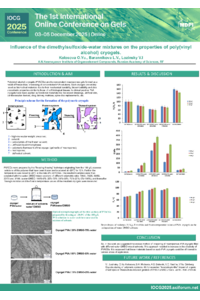
Poly(vinyl alcohol) cryogels (PVACGs) are the noncovalent macroporous gels formed as a result of freeze–thaw processing of concentrated PVA solutions. Such cryogels are widely used as biomedical materials due to their mechanical durability, biocompatibility and also viscoelastic properties similar to those of soft biological tissues.
In some cases, the application of PVACGs is limited by the yet insufficient rigidity of these materials. There are several ways to enhance the physico-mechanical properties of PVACGs, e.g., by increasing the initial polymer concentration, by inserting kosmotropic additives, by performing additional “freezing–thawing” cycles. We suggested another decision for increasing the elasticity of PVACGs by their treatment with water-DMSO mixed solutions.
Methods.
PVACGs were prepared by the “freezing–thawing” technique originating from the 100 g/L aqueous solutions of this polymer that have been frozen and incubated at -20oC for 12 h. Furthermore, the temperature was raised to 20oC at the rate of 0.03oC/min. The resultant samples were than saturated with the water–DMSO mixed solutions of different volumetric ratio: 100/0, 75/25, 50/50, 25/75 and 0/100. Following this, Young’s modulus and the fusion temperature values of the resultant cryogels were measured.
Results.
It was shown that the rigidity grew with an increase in DMSO share in mixed solutions. In addition, the highest gel strength and heat endurance were reported for PVACGs saturated with the 50/50 (v/v) water–DMSO mixture. Young’s modulus increased by ~30 times (up to 235±4 kPa) compared to the PVA cryogel (7.5±0.6 kPa) prepared from the aqueous polymer solution. After rinsing “saturated” cryogels with pure water, their rigidity decreased (till 79 ±2 kPa), but not critically so the high rigidity of PVA cryogels was preserved. Tf values of the corresponding samples were as follows: 92,6±0,9 °C and 77,8±0,8 °C.
Conclusion
The results of this study suggest that these materials based on such PVA cryogels could be of interest in various areas of application.
Keywords
poly(vinyl alcohol) cryogels
cryotropic gelation
dimethylsulfoxide
saturated cryogels
Poster
Kolosova.pdf
Tuning the viscoelastic properties of hydrogels to mimic prostatic cancer microenvironment
Green and Sustainable Energy Storage Using Borax–Chitosan Hydrogel Electrolytes in EDLCs