Event submissions
Published
This submission belongs to the session S4. Gels in Medicine, Regenerative Medicine, Pharmacy, and Personal Care Products of the event The 1st International Online Conference on Gels
Published date
28 Nov, 2025
Academic Editor
'%3e%3cpath%20d='M12.6657%2010.9104C12.4185%2010.325%2012.0599%209.79327%2011.6097%209.34482C11.1609%208.89508%2010.6293%208.5365%2010.0442%208.28888C10.0389%208.28626%2010.0337%208.28495%2010.0285%208.28233C10.8446%207.69279%2011.3752%206.73249%2011.3752%205.64904C11.3752%203.8542%209.92103%202.39999%208.1262%202.39999C6.33136%202.39999%204.87715%203.8542%204.87715%205.64904C4.87715%206.73249%205.40774%207.69279%206.22393%208.28364C6.21869%208.28626%206.21345%208.28757%206.20821%208.29019C5.62129%208.5378%205.09463%208.89284%204.64265%209.34613C4.1929%209.79493%203.83432%2010.3266%203.58671%2010.9117C3.34345%2011.4845%203.21226%2012.0987%203.20023%2012.7209C3.19988%2012.7349%203.20233%2012.7488%203.20744%2012.7619C3.21255%2012.7749%203.22022%2012.7867%203.22998%2012.7968C3.23975%2012.8068%203.25142%2012.8147%203.26431%2012.8202C3.2772%2012.8256%203.29105%2012.8284%203.30504%2012.8284H4.09109C4.14874%2012.8284%204.19459%2012.7825%204.1959%2012.7262C4.2221%2011.7148%204.62823%2010.7676%205.34617%2010.0497C6.08899%209.30683%207.0755%208.89808%208.1262%208.89808C9.17689%208.89808%2010.1634%209.30683%2010.9062%2010.0497C11.6242%2010.7676%2012.0303%2011.7148%2012.0565%2012.7262C12.0578%2012.7838%2012.1037%2012.8284%2012.1613%2012.8284H12.9474C12.9613%2012.8284%2012.9752%2012.8256%2012.9881%2012.8202C13.001%2012.8147%2013.0126%2012.8068%2013.0224%2012.7968C13.0322%2012.7867%2013.0398%2012.7749%2013.0449%2012.7619C13.0501%2012.7488%2013.0525%2012.7349%2013.0522%2012.7209C13.0391%2012.0947%2012.9094%2011.4855%2012.6657%2010.9104ZM8.1262%207.9024C7.52486%207.9024%206.9589%207.6679%206.53312%207.24211C6.10733%206.81633%205.87283%206.25037%205.87283%205.64904C5.87283%205.0477%206.10733%204.48174%206.53312%204.05596C6.9589%203.63018%207.52486%203.39567%208.1262%203.39567C8.72753%203.39567%209.29349%203.63018%209.71927%204.05596C10.1451%204.48174%2010.3796%205.0477%2010.3796%205.64904C10.3796%206.25037%2010.1451%206.81633%209.71927%207.24211C9.29349%207.6679%208.72753%207.9024%208.1262%207.9024Z'%20fill='%235D1EE1'/%3e%3c/g%3e%3c/svg%3e) Aline Miller
Aline MillerCitation
David Rohindra, Tejesvi Patel, Roselyn Lata, Engineered HPMC/Starch Hydrogels for pH-Independent Drug Release, in Proceedings of The 1st International Online Conference on Gels, 3 December–5 December 2025, MDPI: Basel, Switzerland
Share
Email
Facebook
Twitter
LinkedIn
Engineered HPMC/Starch Hydrogels for pH-Independent Drug Release

David Rohindra 1
'%3e%3cpath%20d='M12.6647%2010.9104C12.4176%2010.325%2012.0589%209.7933%2011.6088%209.34485C11.16%208.89511%2010.6283%208.53653%2010.0432%208.28891C10.038%208.28629%2010.0327%208.28498%2010.0275%208.28236C10.8437%207.69282%2011.3743%206.73252%2011.3743%205.64907C11.3743%203.85423%209.92005%202.40002%208.12522%202.40002C6.33038%202.40002%204.87618%203.85423%204.87618%205.64907C4.87618%206.73252%205.40677%207.69282%206.22296%208.28367C6.21772%208.28629%206.21248%208.2876%206.20724%208.29022C5.62031%208.53783%205.09365%208.89287%204.64167%209.34616C4.19192%209.79496%203.83334%2010.3266%203.58573%2010.9117C3.34247%2011.4846%203.21128%2012.0987%203.19925%2012.721C3.1989%2012.735%203.20135%2012.7489%203.20646%2012.7619C3.21157%2012.7749%203.21924%2012.7868%203.22901%2012.7968C3.23877%2012.8068%203.25045%2012.8148%203.26334%2012.8202C3.27623%2012.8256%203.29007%2012.8284%203.30406%2012.8284H4.09012C4.14776%2012.8284%204.19362%2012.7825%204.19493%2012.7262C4.22113%2011.7148%204.62726%2010.7676%205.34519%2010.0497C6.08802%209.30686%207.07452%208.89811%208.12522%208.89811C9.17592%208.89811%2010.1624%209.30686%2010.9052%2010.0497C11.6232%2010.7676%2012.0293%2011.7148%2012.0555%2012.7262C12.0568%2012.7839%2012.1027%2012.8284%2012.1603%2012.8284H12.9464C12.9604%2012.8284%2012.9742%2012.8256%2012.9871%2012.8202C13%2012.8148%2013.0117%2012.8068%2013.0214%2012.7968C13.0312%2012.7868%2013.0389%2012.7749%2013.044%2012.7619C13.0491%2012.7489%2013.0515%2012.735%2013.0512%2012.721C13.0381%2012.0947%2012.9084%2011.4856%2012.6647%2010.9104ZM8.12522%207.90243C7.52388%207.90243%206.95792%207.66793%206.53214%207.24215C6.10636%206.81636%205.87185%206.2504%205.87185%205.64907C5.87185%205.04773%206.10636%204.48177%206.53214%204.05599C6.95792%203.63021%207.52388%203.3957%208.12522%203.3957C8.72655%203.3957%209.29252%203.63021%209.7183%204.05599C10.1441%204.48177%2010.3786%205.04773%2010.3786%205.64907C10.3786%206.2504%2010.1441%206.81636%209.7183%207.24215C9.29252%207.66793%208.72655%207.90243%208.12522%207.90243Z'%20fill='%235D1EE1'/%3e%3c/g%3e%3c/svg%3e)
Tejesvi Patel 1
Roselyn Lata 1
1. Department of Biological and Chemical Science, The University of the South Pacific, Suva, 0000, Fiji
Abstract
Introduction:
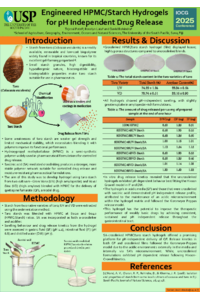
Natural polymer-based hydrogels offer a biodegradable and biocompatible platform for sustained drug release, especially for drugs with pH-dependent solubility. This study investigates the development of hydrogel films using hydroxypropyl methylcellulose (HPMC) and taro starches from two cultivars—Uroni Vonu (high amylopectin) and Vavai Dina (high amylose)—for the delivery of quetiapine fumarate, a weakly basic drug. The aim was to develop a matrix capable of achieving pH-independent, sustained drug release.
Methods:
Gelatinized taro starch was blended with HPMC at 80:20 and 60:40 (HPMC/Starch) ratios. Succinic acid was incorporated as both a crosslinker and acidifier. Films were characterized using FTIR, SEM, DSC, and rheological methods. Swelling and drug release behavior were assessed in gastric (pH 1.2) and intestinal (pH 6.8) fluids. Release kinetics were evaluated using Zero-order, First-order, Higuchi, Hixson–Crowell, and Korsmeyer–Peppas models.
Results:
FTIR and SEM confirmed crosslinking and improved matrix porosity, especially in 60:40 blends. All hydrogels showed pH-independent swelling, with slightly greater uptake in amylopectin-rich formulations. Drug release from uncrosslinked films was pH-dependent. The release of quetiapine fumarate in both gastric fluid and succinic acid-crosslinked hydrogels followed the Korsmeyer–Peppas model, likely due to the presence of acidic conditions. In the crosslinked formulations, succinic acid generates an internal acidic microenvironment that mimics the gastric pH, supporting a diffusion-driven release mechanism. In contrast, the pure HPMC and non-crosslinked hydrogel films best fit the Hixson–Crowell model in intestinal fluid, suggesting erosion-based release from shrinking geometries.
Conclusion:
Succinic acid-crosslinked HPMC/taro starch hydrogels offer a promising platform for pH-independent delivery of quetiapine fumarate. Release kinetics in both gastric fluid and crosslinked films followed the Korsmeyer–Peppas model due to acidic environments—externally in the medium and internally via succinic acid’s microenvironment. In contrast, uncrosslinked formulations followed Hixson–Crowell kinetics.
Keywords
Drug Release
Kinetics
Starch
HPMC
Poster
Engineered HPMCStarch Hydrogels for pH Independent Drug Release.pdf
Green and Sustainable Energy Storage Using Borax–Chitosan Hydrogel Electrolytes in EDLCs
Exploring the future of shaping protein assembly systems for pharmaceutical formulations