Event submissions
Published
This submission belongs to the session S2. Hydrogels, Organogels, Xerogels, and Aerogels of the event The 1st International Online Conference on Gels
Published date
28 Nov, 2025
Academic Editor
'%3e%3cpath%20d='M12.6657%2010.9104C12.4185%2010.325%2012.0599%209.79327%2011.6097%209.34482C11.1609%208.89508%2010.6293%208.5365%2010.0442%208.28888C10.0389%208.28626%2010.0337%208.28495%2010.0285%208.28233C10.8446%207.69279%2011.3752%206.73249%2011.3752%205.64904C11.3752%203.8542%209.92103%202.39999%208.1262%202.39999C6.33136%202.39999%204.87715%203.8542%204.87715%205.64904C4.87715%206.73249%205.40774%207.69279%206.22393%208.28364C6.21869%208.28626%206.21345%208.28757%206.20821%208.29019C5.62129%208.5378%205.09463%208.89284%204.64265%209.34613C4.1929%209.79493%203.83432%2010.3266%203.58671%2010.9117C3.34345%2011.4845%203.21226%2012.0987%203.20023%2012.7209C3.19988%2012.7349%203.20233%2012.7488%203.20744%2012.7619C3.21255%2012.7749%203.22022%2012.7867%203.22998%2012.7968C3.23975%2012.8068%203.25142%2012.8147%203.26431%2012.8202C3.2772%2012.8256%203.29105%2012.8284%203.30504%2012.8284H4.09109C4.14874%2012.8284%204.19459%2012.7825%204.1959%2012.7262C4.2221%2011.7148%204.62823%2010.7676%205.34617%2010.0497C6.08899%209.30683%207.0755%208.89808%208.1262%208.89808C9.17689%208.89808%2010.1634%209.30683%2010.9062%2010.0497C11.6242%2010.7676%2012.0303%2011.7148%2012.0565%2012.7262C12.0578%2012.7838%2012.1037%2012.8284%2012.1613%2012.8284H12.9474C12.9613%2012.8284%2012.9752%2012.8256%2012.9881%2012.8202C13.001%2012.8147%2013.0126%2012.8068%2013.0224%2012.7968C13.0322%2012.7867%2013.0398%2012.7749%2013.0449%2012.7619C13.0501%2012.7488%2013.0525%2012.7349%2013.0522%2012.7209C13.0391%2012.0947%2012.9094%2011.4855%2012.6657%2010.9104ZM8.1262%207.9024C7.52486%207.9024%206.9589%207.6679%206.53312%207.24211C6.10733%206.81633%205.87283%206.25037%205.87283%205.64904C5.87283%205.0477%206.10733%204.48174%206.53312%204.05596C6.9589%203.63018%207.52486%203.39567%208.1262%203.39567C8.72753%203.39567%209.29349%203.63018%209.71927%204.05596C10.1451%204.48174%2010.3796%205.0477%2010.3796%205.64904C10.3796%206.25037%2010.1451%206.81633%209.71927%207.24211C9.29349%207.6679%208.72753%207.9024%208.1262%207.9024Z'%20fill='%235D1EE1'/%3e%3c/g%3e%3c/svg%3e) SIDI A. BENCHERIF
SIDI A. BENCHERIFCitation
Astha Vishwakarma, Benjamin Carbonnier, Samia Mahouche Chergui, Time-optimized genipin–chitosan aerogels for catalytic applications, in Proceedings of The 1st International Online Conference on Gels, 3 December–5 December 2025, MDPI: Basel, Switzerland
Share
Email
Facebook
Twitter
LinkedIn
Time-optimized genipin–chitosan aerogels for catalytic applications
'%3e%3cpath%20d='M12.6647%2010.9104C12.4176%2010.325%2012.0589%209.7933%2011.6088%209.34485C11.16%208.89511%2010.6283%208.53653%2010.0432%208.28891C10.038%208.28629%2010.0327%208.28498%2010.0275%208.28236C10.8437%207.69282%2011.3743%206.73252%2011.3743%205.64907C11.3743%203.85423%209.92005%202.40002%208.12522%202.40002C6.33038%202.40002%204.87618%203.85423%204.87618%205.64907C4.87618%206.73252%205.40677%207.69282%206.22296%208.28367C6.21772%208.28629%206.21248%208.2876%206.20724%208.29022C5.62031%208.53783%205.09365%208.89287%204.64167%209.34616C4.19192%209.79496%203.83334%2010.3266%203.58573%2010.9117C3.34247%2011.4846%203.21128%2012.0987%203.19925%2012.721C3.1989%2012.735%203.20135%2012.7489%203.20646%2012.7619C3.21157%2012.7749%203.21924%2012.7868%203.22901%2012.7968C3.23877%2012.8068%203.25045%2012.8148%203.26334%2012.8202C3.27623%2012.8256%203.29007%2012.8284%203.30406%2012.8284H4.09012C4.14776%2012.8284%204.19362%2012.7825%204.19493%2012.7262C4.22113%2011.7148%204.62726%2010.7676%205.34519%2010.0497C6.08802%209.30686%207.07452%208.89811%208.12522%208.89811C9.17592%208.89811%2010.1624%209.30686%2010.9052%2010.0497C11.6232%2010.7676%2012.0293%2011.7148%2012.0555%2012.7262C12.0568%2012.7839%2012.1027%2012.8284%2012.1603%2012.8284H12.9464C12.9604%2012.8284%2012.9742%2012.8256%2012.9871%2012.8202C13%2012.8148%2013.0117%2012.8068%2013.0214%2012.7968C13.0312%2012.7868%2013.0389%2012.7749%2013.044%2012.7619C13.0491%2012.7489%2013.0515%2012.735%2013.0512%2012.721C13.0381%2012.0947%2012.9084%2011.4856%2012.6647%2010.9104ZM8.12522%207.90243C7.52388%207.90243%206.95792%207.66793%206.53214%207.24215C6.10636%206.81636%205.87185%206.2504%205.87185%205.64907C5.87185%205.04773%206.10636%204.48177%206.53214%204.05599C6.95792%203.63021%207.52388%203.3957%208.12522%203.3957C8.72655%203.3957%209.29252%203.63021%209.7183%204.05599C10.1441%204.48177%2010.3786%205.04773%2010.3786%205.64907C10.3786%206.2504%2010.1441%206.81636%209.7183%207.24215C9.29252%207.66793%208.72655%207.90243%208.12522%207.90243Z'%20fill='%235D1EE1'/%3e%3c/g%3e%3c/svg%3e)
Astha Vishwakarma 1

Benjamin Carbonnier 1
Samia Mahouche Chergui 1
1. Department of Molecular Chemistry and Macromolecular Materials (C3M), Institute of Chemistry and Materials Paris-Est(ICMPE)- National Centre for Scientific Research(CNRS)- Paris-East Créteil University(UPEC), Thiais, 94320, France
Abstract
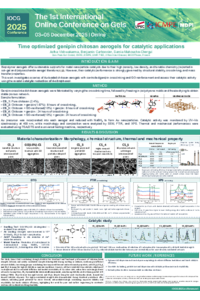
Introduction: Natural polymer-based aerogels are gaining prominence as functional catalytic supports in green chemistry. Chitosan crosslinked with genipin forms robust, biodegradable aerogels with tunable surface functionalities and porous structures. In this work, the effect of crosslinking time on the catalytic efficiency and structural properties of chitosan–genipin aerogels is systematically explored.
Methods: Genipin–chitosan aerogels (2.4% w/v chitosan, 1.67% genipin) were prepared with controlled crosslinking times (4, 8, 24, 72 hours) before freeze-drying. Catalytic performance was evaluated using model reactions, while structural evolution was monitored via XRD, SEM, and mechanical testing. Mechanical properties were evaluated using a universal testing machine (Instron 5567, USA) in accordance with ASTM D1621. Repair/healing capability of these materials were analysed, and self-healing efficiency was quantified through fracture–repair cycles using water-mediated healing protocols.
Results: Crosslinking time profoundly influenced both catalytic and self-healing properties. Short crosslinking (4-8 hours) preserved 62% self-healing efficiency while maintaining accessible porosity (32-24%) ideal for catalytic applications. Extended crosslinking (24-72 hours) enhanced mechanical strength (2.1-2.4 MPa) but eliminated self-healing capability. Thermal stability improved with crosslinking duration, with main degradation shifting from 274°C to higher temperatures.
Conclusions: Crosslinking time serves as a critical parameter in designing bio-based catalytic systems. This study demonstrates how genipin-crosslinked chitosan aerogels can be tailored for specific catalytic applications by controlling the crosslinking kinetics. The resulting materials offer a sustainable and efficient platform for catalytic processes, aligning with the goals of green and circular chemistry.
Keywords
Chitosan
Genipin
freeze drying
catalysis
chemical crosslinking
Poster
AV _ IOCG 3.12 poster.pdf
Cellulose-in-cellulose 3D-printed hydrogels and aerogels for soft tissue engineering
Antibacterial superabsorbent hydrogels based on polysaccharides crosslinked with citric acid