Event submissions
Published
This submission belongs to the session S4. Gels in Medicine, Regenerative Medicine, Pharmacy, and Personal Care Products of the event The 1st International Online Conference on Gels
Published date
28 Nov, 2025
Academic Editor
'%3e%3cpath%20d='M12.6657%2010.9104C12.4185%2010.325%2012.0599%209.79327%2011.6097%209.34482C11.1609%208.89508%2010.6293%208.5365%2010.0442%208.28888C10.0389%208.28626%2010.0337%208.28495%2010.0285%208.28233C10.8446%207.69279%2011.3752%206.73249%2011.3752%205.64904C11.3752%203.8542%209.92103%202.39999%208.1262%202.39999C6.33136%202.39999%204.87715%203.8542%204.87715%205.64904C4.87715%206.73249%205.40774%207.69279%206.22393%208.28364C6.21869%208.28626%206.21345%208.28757%206.20821%208.29019C5.62129%208.5378%205.09463%208.89284%204.64265%209.34613C4.1929%209.79493%203.83432%2010.3266%203.58671%2010.9117C3.34345%2011.4845%203.21226%2012.0987%203.20023%2012.7209C3.19988%2012.7349%203.20233%2012.7488%203.20744%2012.7619C3.21255%2012.7749%203.22022%2012.7867%203.22998%2012.7968C3.23975%2012.8068%203.25142%2012.8147%203.26431%2012.8202C3.2772%2012.8256%203.29105%2012.8284%203.30504%2012.8284H4.09109C4.14874%2012.8284%204.19459%2012.7825%204.1959%2012.7262C4.2221%2011.7148%204.62823%2010.7676%205.34617%2010.0497C6.08899%209.30683%207.0755%208.89808%208.1262%208.89808C9.17689%208.89808%2010.1634%209.30683%2010.9062%2010.0497C11.6242%2010.7676%2012.0303%2011.7148%2012.0565%2012.7262C12.0578%2012.7838%2012.1037%2012.8284%2012.1613%2012.8284H12.9474C12.9613%2012.8284%2012.9752%2012.8256%2012.9881%2012.8202C13.001%2012.8147%2013.0126%2012.8068%2013.0224%2012.7968C13.0322%2012.7867%2013.0398%2012.7749%2013.0449%2012.7619C13.0501%2012.7488%2013.0525%2012.7349%2013.0522%2012.7209C13.0391%2012.0947%2012.9094%2011.4855%2012.6657%2010.9104ZM8.1262%207.9024C7.52486%207.9024%206.9589%207.6679%206.53312%207.24211C6.10733%206.81633%205.87283%206.25037%205.87283%205.64904C5.87283%205.0477%206.10733%204.48174%206.53312%204.05596C6.9589%203.63018%207.52486%203.39567%208.1262%203.39567C8.72753%203.39567%209.29349%203.63018%209.71927%204.05596C10.1451%204.48174%2010.3796%205.0477%2010.3796%205.64904C10.3796%206.25037%2010.1451%206.81633%209.71927%207.24211C9.29349%207.6679%208.72753%207.9024%208.1262%207.9024Z'%20fill='%235D1EE1'/%3e%3c/g%3e%3c/svg%3e) Dirk Kuckling
Dirk KucklingCitation
Arina Vladislavovna Korotkova, Ekaterina Sergeevna Chikanova, Kristina Yurievna Kotyakova, Yulia Alekseevna Makarets, Dmitry Vladimirovich Shtansky, Antibacterial superabsorbent hydrogels based on polysaccharides crosslinked with citric acid, in Proceedings of The 1st International Online Conference on Gels, 3 December–5 December 2025, MDPI: Basel, Switzerland
Share
Email
Facebook
Twitter
LinkedIn
Antibacterial superabsorbent hydrogels based on polysaccharides crosslinked with citric acid
'%3e%3cpath%20d='M12.6647%2010.9104C12.4176%2010.325%2012.0589%209.7933%2011.6088%209.34485C11.16%208.89511%2010.6283%208.53653%2010.0432%208.28891C10.038%208.28629%2010.0327%208.28498%2010.0275%208.28236C10.8437%207.69282%2011.3743%206.73252%2011.3743%205.64907C11.3743%203.85423%209.92005%202.40002%208.12522%202.40002C6.33038%202.40002%204.87618%203.85423%204.87618%205.64907C4.87618%206.73252%205.40677%207.69282%206.22296%208.28367C6.21772%208.28629%206.21248%208.2876%206.20724%208.29022C5.62031%208.53783%205.09365%208.89287%204.64167%209.34616C4.19192%209.79496%203.83334%2010.3266%203.58573%2010.9117C3.34247%2011.4846%203.21128%2012.0987%203.19925%2012.721C3.1989%2012.735%203.20135%2012.7489%203.20646%2012.7619C3.21157%2012.7749%203.21924%2012.7868%203.22901%2012.7968C3.23877%2012.8068%203.25045%2012.8148%203.26334%2012.8202C3.27623%2012.8256%203.29007%2012.8284%203.30406%2012.8284H4.09012C4.14776%2012.8284%204.19362%2012.7825%204.19493%2012.7262C4.22113%2011.7148%204.62726%2010.7676%205.34519%2010.0497C6.08802%209.30686%207.07452%208.89811%208.12522%208.89811C9.17592%208.89811%2010.1624%209.30686%2010.9052%2010.0497C11.6232%2010.7676%2012.0293%2011.7148%2012.0555%2012.7262C12.0568%2012.7839%2012.1027%2012.8284%2012.1603%2012.8284H12.9464C12.9604%2012.8284%2012.9742%2012.8256%2012.9871%2012.8202C13%2012.8148%2013.0117%2012.8068%2013.0214%2012.7968C13.0312%2012.7868%2013.0389%2012.7749%2013.044%2012.7619C13.0491%2012.7489%2013.0515%2012.735%2013.0512%2012.721C13.0381%2012.0947%2012.9084%2011.4856%2012.6647%2010.9104ZM8.12522%207.90243C7.52388%207.90243%206.95792%207.66793%206.53214%207.24215C6.10636%206.81636%205.87185%206.2504%205.87185%205.64907C5.87185%205.04773%206.10636%204.48177%206.53214%204.05599C6.95792%203.63021%207.52388%203.3957%208.12522%203.3957C8.72655%203.3957%209.29252%203.63021%209.7183%204.05599C10.1441%204.48177%2010.3786%205.04773%2010.3786%205.64907C10.3786%206.2504%2010.1441%206.81636%209.7183%207.24215C9.29252%207.66793%208.72655%207.90243%208.12522%207.90243Z'%20fill='%235D1EE1'/%3e%3c/g%3e%3c/svg%3e)
Arina Vladislavovna Korotkova 1
Ekaterina Sergeevna Chikanova 2
Kristina Yurievna Kotyakova 2
Yulia Alekseevna Makarets 2
Dmitry Vladimirovich Shtansky 2
1. National University of Science and Technology “MISIS”, Moscow 119049, Russia
2. Research Centre "Inorganic nanomaterials", National University of Science and Technology “MISIS”, Moscow 119049, Russia
Abstract
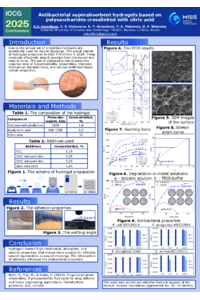
Introduction: Functional hydrogels are currently being actively studied. Due to their unique set of properties, hydrogels are used in various fields. In particular, they are used for wound dressings, the global marker of which amounted to USD 476 million in 2024. These materials effectively absorb exudate from the wound and keep it moist. The use of polysaccharides ensures the required level of biocompatibility, crosslinking improves mechanical characteristics, and various additives impact certain properties.
Methods: Hydrogels were made from carboxymethylcellulose (CMC, 1000 kDa) and hyaluronic acid (HA, 800 kDa) crosslinked by citric acid (CA). Polycaprolactone (PCL) nanomates obtained by electrospinning, CuO and ZnO nanoparticles, and aloe vera (AV) were added to hydrogels. The samples were examined by FTIR, SEM and EDS analysis systems. Their appearance, swelling ratio, dissolution in tris-buffer and isotonic solution, pH, and hydrophilic, adhesive, mechanical, and antibacterial properties were studied.
Results: The resulting transparent materials have high adhesive and hydrophilic properties. They have an interconnected system of pores with a size of 5-100 microns. Based on the FTIR results, the crosslinking of -OH groups in polysaccharides using CA was confirmed by the determination of C=O, C-O, O-C-O, and C-O-C ester vibrations. The relative elongation of materials is 170 %. Young's modulus is 0.8 kPa. The highest swelling ratio was observed for samples with ZnO, CuO, and AV and measured as 919, 749 and 792 %, respectively. The hydrogels were stable for 7 days in model solutions. The highest rate of dissolution was observed in isotonic solution. The materials showed antibacterial properties against Gram-positive and Gram-negative bacteria.
Conclusions: The materials obtained showed antipathogenic, high mechanical, absorption, and stability properties. It makes them suitable for making wound dressings and effective wound regeneration.
The work was carried out with the financial support of the Russian Science Foundation (Agreement No. 25–19–00458).
Keywords
wound dressing
hydrogel
carboxymethylcellulose
hyaluronic acid
citric acid
Poster
Poster_KorotkovaAV.pdf
Time-optimized genipin–chitosan aerogels for catalytic applications
Design of a novel biodegradable hydrogel scaffold for cultured meat production